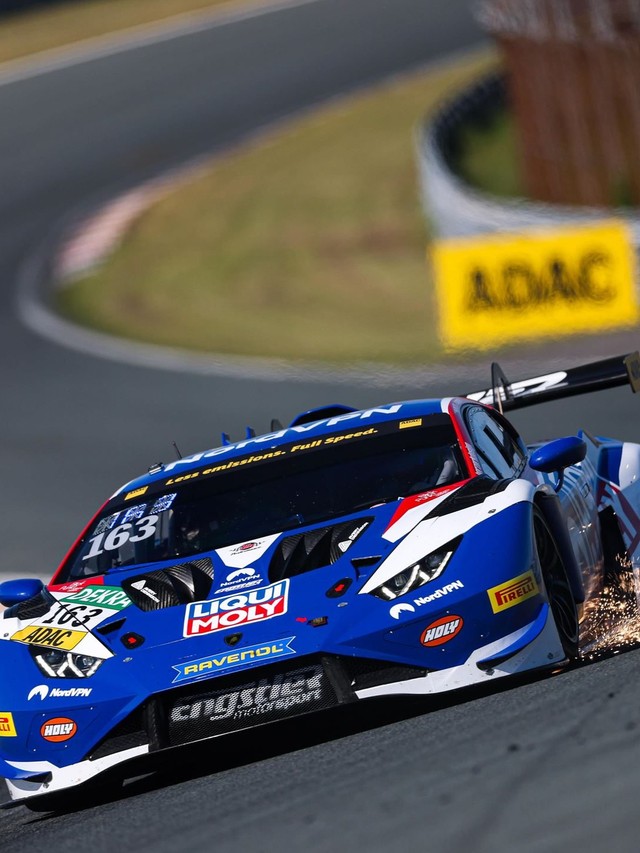
The Fifth Triumph: Huracán GT3 Extends Its Unbeaten Run at Lausitzring
When Mirko Bortolotti crossed the line first in Race 2 at the Lausitzring on May 21, 2017, the result looked routine on paper: pole position, lights-to-flag control, comfortable margin. Routine, except that it was the fifth consecutive international GT victory for the Lamborghini Huracán GT3 in less than a month, spanning two different championship series and four different circuits. That kind of consistency across varied conditions and competition formats does not happen by accident.
The winning streak included four prior victories in the Blancpain GT Series championship at Monza, Brands Hatch (Race 1 and Race 2), and Silverstone before the Grasser Racing Team carried the momentum into the second round of the ADAC GT Masters German Championship. Bortolotti, a Lamborghini Squadra Corse Factory Driver, secured pole with a lap time of 1’21″533 during the second qualifying session, roughly two tenths clear of his own teammate Christian Engelhart in the sister #63 car. In a field of twenty-eight entries where seventeen cars were separated by a single second in qualifying, that margin was significant.
Bortolotti’s approach was blunt and effective: qualifying pace from the opening corner. By the time the mandatory driver change arrived, his co-driver Ezequiel Perez Companc inherited the #19 Huracán GT3 with over five seconds of breathing room. Perez Companc, a GT3 Junior Driver in Lamborghini’s Squadra Corse program, managed the gap cleanly to bring home Grasser Racing Team’s first win of the 2017 ADAC GT Masters season, finishing ahead of the Audi R8 LMS of team Montaplast, piloted by 2016 champions Connor De Phillippi and Christopher Mies. The #63 sister car, with Engelhart and Rolf Ineichen, added a third-place podium to complete a strong weekend for the Austrian squad.
Engineering the Edge: What Made the 2017 Huracán GT3 Formidable
Winning one race is a function of pace. Winning five in a row across different tracks and series points to something deeper in the car’s fundamental architecture. The Huracán GT3 that competed in 2017 was powered by a naturally aspirated 5.2-liter V10 engine derived from the road car, and that choice of aspiration mattered enormously in a class where Balance of Performance regulations attempt to equalize different powertrains.
A naturally aspirated engine delivers its power in a linear, predictable curve. For a driver managing tire degradation over a stint, fighting for position in traffic, or pushing through a qualifying lap, that predictability translates into confidence. The driver knows exactly what the car will do at every point in the rev range. Turbocharged rivals may produce equivalent peak numbers, but the way power arrives, and how that interacts with traction, tire temperature, and braking stability, shapes the entire driving experience. Bortolotti’s ability to extract qualifying pace from the first corner suggests a car that rewards aggression without punishing the driver for it.
The chassis combined aluminum and carbon fiber construction, a philosophy carried over from the road-going Huracán but extensively reworked for GT3 regulations. One source reports the car was developed with significant input from Dallara, the Italian chassis specialist whose fingerprints appear on everything from IndyCar to Le Mans prototypes. That collaboration brought a level of structural analysis and aerodynamic refinement that complemented Lamborghini’s engine expertise. The result was a platform that could be set up to work across the fast sweeps of Silverstone, the stop-start demands of Brands Hatch, and the particular challenges of Lausitzring, all within the same month.

A bright green Lamborghini Huracán GT3 race car speeds around the track, leading a pink competitor with wind turbines in the distance.
Squadra Corse’s Strategic Play: Drivers, Teams, and the Junior Program
A fast car without the right people operating it is just expensive potential. The 2017 winning streak highlighted how Lamborghini Squadra Corse structured its customer racing ecosystem to maximize results, and why that structure proved just as important as the car itself.
Bortolotti was the anchor. As a Factory Driver, he brought the pace and consistency needed to put the car on pole and build early race advantages. The pairing with Perez Companc was equally deliberate. The Argentinian was part of Lamborghini’s GT3 Junior Driver program, a pipeline designed to develop emerging talent within the Squadra Corse framework. Giving a junior driver the responsibility of protecting a five-second lead in a competitive ADAC GT Masters field, against the reigning champions no less, was both a test and a statement of confidence. Perez Companc delivered.
Engelhart, in the sister car, was doing double duty: racing with Bortolotti in the Blancpain GT Series and with Ineichen in the ADAC GT Masters. In qualifying, Engelhart was just 0.13 seconds faster than the Audi R8 LMS of Christopher Haase from team Montaplast, a margin that underscores how tight the competition was at the front. Both Grasser Racing Team entries locked out the front row, a result that speaks to the team’s preparation as much as the car’s raw speed.
Grasser Racing Team itself deserves recognition. The Austrian outfit became one of the most visible Huracán GT3 customer teams during this period, and their ability to extract consistent performance from the platform across multiple championships demonstrated something Squadra Corse needed to prove: that the Huracán GT3 worked in the hands of a well-organized private team, not only when a factory engineering squad was standing behind the pit wall.
A Legacy Forged: From Five Wins to a Decade of GT3 Relevance
The 2017 winning streak did not exist in isolation. It marked the moment when the broader motorsport world had to take the Huracán GT3 seriously as a consistent frontrunner rather than an occasional podium contender, and it set the trajectory for everything that followed.
Lamborghini subsequently evolved the platform through the Huracán GT3 EVO and then the EVO2, refining aerodynamics, intake systems, and chassis details while retaining the naturally aspirated V10 at its core. The EVO2, based on the road-going Huracán STO, introduced a new airscoop and rear fin inspired by the Super Trofeo race cars, improving intake efficiency and allowing the removal of side air vents for cleaner airflow to the rear wing. Each iteration built on lessons learned from competition, and the foundation laid by results like the 2017 Lausitzring weekend made it easier to justify continued investment in the platform.
Racing success also fed back into the road car lineup. Lamborghini released the Huracán EVO GT Celebration, a limited run of 36 units reserved for the American market, to commemorate the GT3 EVO’s endurance racing victories. That kind of cross-pollination between track and showroom is central to how Lamborghini positions its brand: the racing car validates the engineering, and the road car carries the story to customers.
For buyers and collectors who follow Lamborghini’s motorsport trajectory, the 2017 streak represents the inflection point. Before it, the Huracán GT3 was a promising newcomer. After it, the car became the platform that teams and drivers specifically sought out for customer racing campaigns. By 2026, the Huracán GT3 platform was described as a decade-old design still capable of leading the field, with Lamborghini GT3 Junior Driver Finn Zulauf leading the ADAC GT Masters standings. A decade of competitive relevance from a single platform architecture is extraordinarily rare in GT racing.
The Competitive Arena: Lamborghini Against the GT3 Establishment
Context matters. When the Huracán GT3 was racking up wins in 2017, it was competing against established GT3 programs from manufacturers with far longer histories in the category. The Audi R8 LMS, sharing the same Volkswagen Group 5.2-liter V10 in a different package, was the car the Huracán GT3 beat directly at Lausitzring. The 2016 ADAC GT Masters champions, De Phillippi and Mies, finished behind the Grasser Lamborghini. That result was not a fluke of circumstance; it reflected genuine pace advantage.
Lamborghini’s approach to GT3 racing differed from some competitors in a fundamental way. The naturally aspirated V10 gave drivers a throttle response and sound signature that became part of the car’s identity on track. Spectators at ADAC GT Masters events during this era could identify the Huracán GT3 by ear alone, a detail that sounds trivial but contributes to the kind of emotional connection that turns casual fans into brand loyalists.
The strategic question Lamborghini now faces is how to replicate this success as the brand transitions its racing platform to the next generation. The Temerario GT3 program represents the future, carrying a fundamentally different powertrain philosophy. Whether a turbocharged hybrid can generate the same kind of driver confidence and team loyalty that the naturally aspirated Huracán GT3 built over a decade remains one of the most interesting open questions in customer racing. The 2017 winning streak set the benchmark. Everything that follows will be measured against it.


