Autocar’s Innovation Award and What It Actually Validated
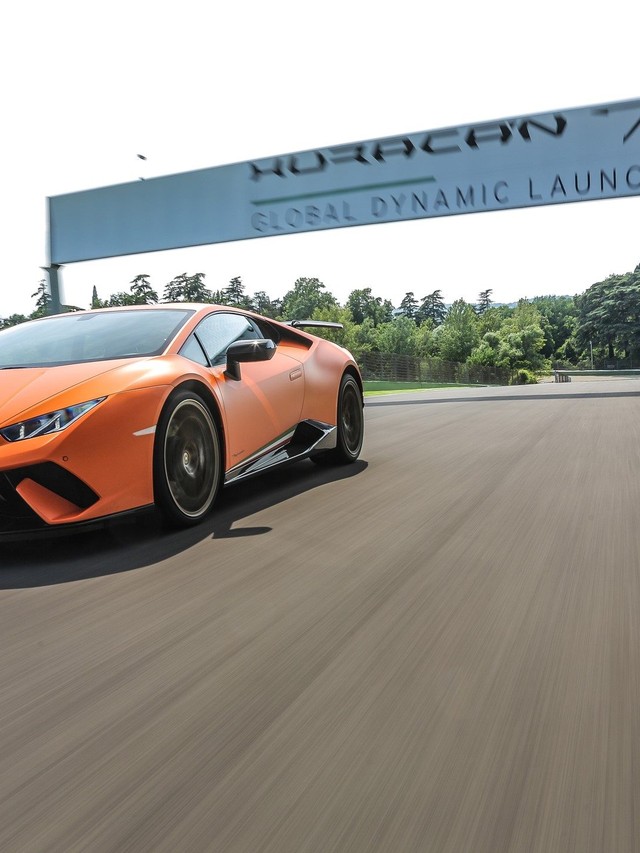
When Autocar handed its 2017 Innovation Award to the Lamborghini Huracán Performante at Silverstone, the honor went specifically to the car’s patented active aerodynamics system, not to the car as a whole. Maurizio Reggiani, Lamborghini’s Board Member for Research and Development, accepted the award during a week that also saw the Performante’s global dynamic media launch in Italy. The timing was deliberate: journalists could drive the car and then see the engineering behind it recognized by one of Britain’s oldest automotive publications.
Autocar editor Mark Tisshaw framed the award around technology that “most impressed us during the last year,” calling out the Performante’s active aero for having, in his words, taken “dynamic handling to a new level.” Awards from trade publications can sometimes feel like polite handshakes. This one carried weight because Autocar’s editors had already driven the car at launch and were evaluating the system’s real-world effect on handling, not just its novelty on paper.
The distinction matters for enthusiasts. Plenty of supercars carry impressive spec sheets. Fewer earn independent recognition for a single patented subsystem. Lamborghini’s Aerodinamica Lamborghini Attiva, or ALA, was the specific technology singled out, and understanding why requires looking past the trophy and into the engineering that made it possible.
ALA Explained: Active Aerodynamics Built from Forged Composites
ALA works on a principle that sounds simple but proved fiendishly difficult to execute in a lightweight, reliable production package: vary the car’s aerodynamic load in real time so it generates maximum downforce when cornering and minimum drag when accelerating in a straight line. Traditional fixed aerodynamic elements force engineers to compromise. A big rear wing gives you grip through fast corners but acts like a parachute on the straights. ALA eliminated that tradeoff.
The system operates through electronically controlled flaps integrated into both the front splitter and the rear wing. At the front, active flaps sit within a carbon forged frame. When closed, they direct airflow over the car to generate high downforce for stability under braking and through high-speed corners. When ALA activates the flaps, they open to reduce pressure on the front spoiler and channel air underneath, cutting drag.
The rear wing is where ALA becomes genuinely clever. Internal air channels run through the wing structure itself, with electro-actuated flaps controlling flow. Close the flaps and the wing behaves like a conventional high-downforce element. Open them and air passes through the wing’s internal passages, effectively stalling it and slashing aerodynamic resistance. Critically, Lamborghini can open the left and right rear flaps independently. This creates what the company calls aero-vectoring: differential downforce across the rear axle that helps rotate the car into corners, supplementing the mechanical grip of the all-wheel-drive system.
The entire system runs through Lamborghini’s Piattaforma Inerziale (LPI), the same inertial platform that governs the car’s stability control and dynamic systems. Flap transitions happen in under 500 milliseconds. Construction relies heavily on Forged Composites, Lamborghini’s proprietary material that uses chopped carbon fiber in a forging process rather than traditional woven layups. The result is lighter, stronger, and easier to form into the complex aerodynamic shapes that ALA’s internal ducting demands.
For buyers considering a Performante on the secondary market today, the ALA system remains one of the car’s defining engineering signatures. It requires no driver input and operates transparently, which means the performance benefit is always present whether you are pushing hard on a track day or simply driving quickly on a mountain road.
The Nürburgring Record and Eight Other Circuits
Engineering awards validate ideas. Lap records validate results. The Huracán Performante arrived carrying a production car lap record at the Nürburgring Nordschleife, the benchmark circuit where aerodynamic efficiency matters enormously because of its mix of ultra-high-speed sections, elevation changes, and technical corners.
Reggiani referenced the Nordschleife record directly when accepting the Autocar award, calling it proof that the Performante’s abilities were “already proven” before any trophy arrived. Independent reports indicate the car also set production car lap records on eight international circuits, a breadth of validation suggesting ALA’s benefits are not limited to one track’s particular layout or speed profile.
The Nordschleife is worth pausing on because it exposes exactly the kind of compromises ALA was designed to eliminate. The circuit’s long straights punish high-drag configurations. Its fast sweepers demand maximum downforce. A car with fixed aerodynamics must pick one priority or split the difference. ALA let the Performante run low drag on the straights and high downforce through the corners, gaining time in both sectors. That dual advantage is what separated it from rivals carrying similar power-to-weight ratios.
Lamborghini says the Performante delivers 640 horsepower at 8,000 rpm from its naturally aspirated 5.2-liter V10, with 600 Nm of torque at 6,500 rpm. Acceleration from 0 to 62 mph takes 2.9 seconds, and the top speed exceeds 201 mph. Those numbers are competitive but not dramatically ahead of the car’s direct rivals. The lap records came from how the car used its power, not how much it had. That distinction is the clearest proof of ALA’s value: the system turned a strong powertrain into a record-breaking one by managing the air around it.
How ALA Compared to Rival Active Aero Approaches
The Performante did not invent the concept of active aerodynamics. McLaren pioneered adjustable rear wings in its road cars, using them primarily as air brakes and for drag reduction. Ferrari developed sophisticated underbody and S-duct solutions for the 488 Pista that managed front-axle lift and downforce. Porsche employed deployable rear spoilers across the 911 range. Each approach reflected a different engineering philosophy.
What set ALA apart was the integration of aero-vectoring into the system’s core purpose. Most competitor active aero systems adjust total downforce or total drag symmetrically across the car. ALA’s ability to independently modulate left and right rear flaps meant it could influence yaw behavior, effectively using aerodynamics as a chassis tuning tool rather than just a speed tool. The system worked in concert with the mechanical differential and all-wheel-drive torque distribution to sharpen turn-in and mid-corner balance.
Forged Composites construction also gave Lamborghini an advantage in packaging. Traditional active aero systems often rely on hydraulic actuators, which add weight and complexity. ALA’s electro-actuated flaps, built into lightweight forged carbon structures, kept the system’s mass penalty minimal. Lamborghini’s figures for the later ALA 2.0 system, developed for the Aventador SVJ, cite electronic actuators that weigh 80% less than hydraulic equivalents, a trajectory that started with the Performante’s original design.
Owners who track both Lamborghini and rival machinery often note that ALA’s effect is most perceptible in fast direction changes and under heavy braking into corners, situations where the aero-vectoring supplements the car’s mechanical grip in ways that feel intuitive rather than intrusive. The system does not announce itself with dramatic wing movements visible in the mirrors. It simply makes the car faster and more planted when the driver asks for it.
ALA’s Legacy Inside Lamborghini’s Engineering Roadmap
The Performante’s 2017 award marked the beginning of a lineage, not a one-off achievement. Lamborghini evolved ALA into ALA 2.0 for the Aventador SVJ, applying the same principles to a heavier V12 flagship with even more aggressive aerodynamic demands. The SVJ went on to reclaim the Nordschleife production car record from the Porsche 911 GT2 RS, validating the system’s scalability.
The Huracán STO, which arrived later in the lineup, took a different path. It used fixed aerodynamic elements inspired by Lamborghini’s Super Trofeo and GT3 race cars rather than active ALA flaps. The STO’s approach reflected a philosophy closer to pure motorsport homologation, where regulations often restrict movable aero devices. Car and Driver noted that the STO embraced track life with a design ethos rooted in racing rather than variable street-to-circuit optimization. The contrast between Performante and STO illustrates how Lamborghini used the Huracán platform to explore two distinct aerodynamic philosophies: intelligent adaptability versus raw, fixed-element aggression.
Looking at the current generation, the Revuelto carries forward Lamborghini’s commitment to active aerodynamics in a hybrid-era package, though the company’s specific implementation details for that car’s aero system represent a separate chapter. The broader point is that ALA established a precedent within Sant’Agata Bolognese: aerodynamics could be an active, intelligent system rather than a static design constraint. Every subsequent Lamborghini model with any form of variable aero owes a conceptual debt to the Performante’s original patent.
For prospective buyers weighing a Performante against later Huracán variants like the Tecnica or STO, the ALA system remains a meaningful differentiator. The Performante occupies a unique position as the variant that combined naturally aspirated V10 power with genuinely active aerodynamics, a pairing that no subsequent Huracán repeated. As the Huracán generation recedes into the secondary market and the Temerario era begins, the Performante’s combination of technologies looks increasingly like a historical inflection point rather than just another special edition.
The Autocar Innovation Award captured that inflection in real time. Independent validation from a publication with no commercial stake in Lamborghini’s success confirmed what the Nordschleife stopwatch already suggested: ALA was a genuine engineering advance, and its influence on Lamborghini’s future was only beginning.
Gallery


