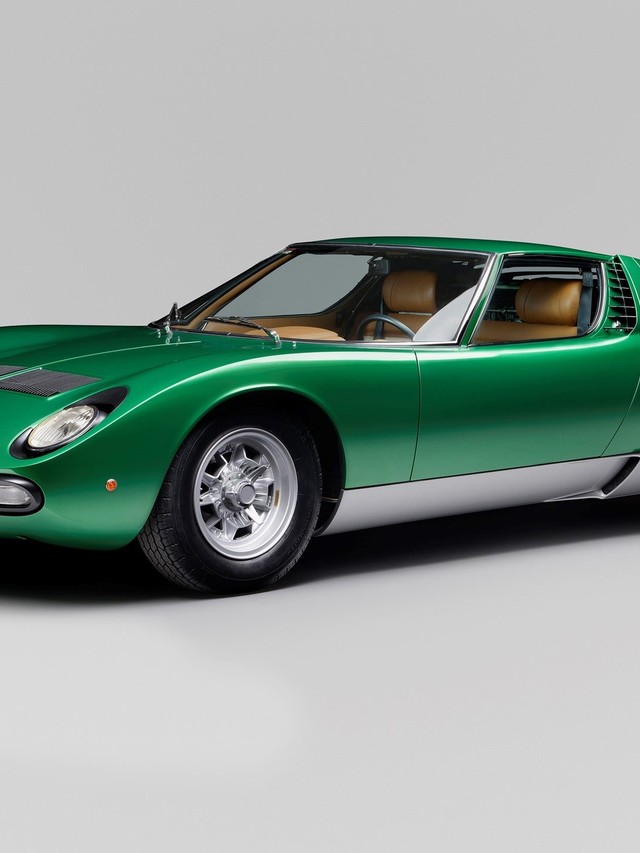
The Geneva Show Car Resurfaces at Amelia Island
When Lamborghini Polo Storico presented the fully restored 1971 Geneva Motor Show Miura SV, chassis #4846, at the Amelia Island Concours d’Elegance running March 10 to 13, the car looked breathtaking in its original Verde Metallizata over tan leather. Yet the real story was not the paint. This was Polo Storico’s first completed restoration since the division opened in spring 2015, and the choice of subject reveals exactly how Lamborghini intends to wield its heritage program: by tackling the hardest possible brief first, then letting the result speak for itself.
Chassis #4846 occupies a strange and fascinating place in the production record. Lamborghini says it was the pre-production model for all subsequent Miura SVs, a true one-off that carried over certain components from the earlier Miura S while introducing features that would define the production SV run. It debuted on Bertone’s stand at the 1971 Geneva Motor Show, the same show where Lamborghini itself unveiled the Countach on its own stand. Two cars that would shape decades of supercar culture, separated by a few meters of exhibition hall. Choosing this particular chassis as the division’s inaugural project was a calculated statement: if the factory can authenticate and restore a car that does not even conform to its own parts catalog, every other classic Lamborghini becomes a simpler proposition.
A Pre-Production Puzzle: Why #4846 Could Not Be Treated Like Any Other SV
Restoring a standard production Miura SV would already be a serious undertaking. Restoring this one required Polo Storico to solve a problem most heritage workshops never face: the car they were rebuilding sat at the exact boundary between the Miura S and SV generations, containing a mix of components from both. No parts catalog could simply be followed page by page.
Lamborghini says the team conducted exhaustive research to ensure every detail matched the car’s Geneva show specification, deliberately avoiding the temptation to install later production SV parts that would have been easier to source but historically inaccurate. The distinction matters enormously to collectors and concours judges. A car restored with incorrect-period components, even components from the same model variant, loses its claim to authenticity. For a show car with documented provenance, that claim is the entire point.
The restoration involved a complete strip of both chassis and engine. Archived photographs, historical documentation, and original production sheets held by Automobili Lamborghini guided the reshaping of every body panel to its original lines and angles. Every component was either restored or replaced using original Lamborghini parts and factory craftsmanship, from the bodywork and paint to the interior trim and engine overhaul. The process consumed more than a year. That willingness to preserve #4846’s unique S-to-SV transitional character, rather than normalizing it into a standard SV specification, signals a philosophy that prioritizes historical accuracy over convenience, and it sets the tone for everything Polo Storico will do going forward.

The legendary Lamborghini Miura P400, finished in a striking green, is beautifully presented in a studio environment.
What Polo Storico Actually Does, and Why This Project Sets the Standard
“This is a very important car, not only for its place in history as the Geneva show car and the forerunner of future Miura SV models built, but as the first completed project of Lamborghini Polo Storico.”
Enrico Maffeo, Head of Polo Storico, framed the significance plainly: That last phrase deserves emphasis. Polo Storico opened in spring 2015 with a mandate covering four areas: restoration of historic Lamborghini models, archive management, supply of original spare parts covering approximately 70% of the historic car parc according to Lamborghini, and official certification of historic cars. The certification element is where the division’s work translates most directly into owner value. A Lamborghini classic carrying factory certification of authenticity occupies a different tier in the collector market than one restored by even the most reputable independent shop. The factory holds the original production sheets, the archived photographs, the institutional knowledge of how these cars were built. No independent restorer can replicate that access.
By proving the concept on #4846, Polo Storico demonstrated that its archive and workshop infrastructure can handle not just routine restorations but genuinely complex research problems. Multiple owners on enthusiast forums describe factory certification as a meaningful differentiator when buying or selling classic Lamborghinis, though specific cost details for Polo Storico restorations remain undisclosed. Lamborghini does not publish pricing for this level of work, and the cost likely varies dramatically depending on the car’s condition, rarity, and the scope of research required.
The Competitive Landscape: Factory Heritage as Brand Strategy
Lamborghini was not the first Italian supercar manufacturer to formalize its heritage operations. Ferrari Classiche predates Polo Storico by roughly a decade, offering similar services: authentication, restoration, and certification backed by factory archives. Porsche operates its own Classic division. Mercedes-Benz runs a dedicated facility in Fellbach. The pattern is clear across the industry: factory heritage programs protect brand equity and, critically, protect resale values for the owners who keep these cars alive.
What distinguishes Polo Storico’s debut is the refusal to take the easy route. Many heritage programs default to restoring vehicles to a “typical” production specification. By honoring #4846’s pre-production anomalies rather than smoothing them away, Polo Storico staked out a position that carries real implications for owners of other unusual or early-production Lamborghinis. If the factory will honor the quirks of a one-off show car, it suggests a willingness to research and authenticate the full spectrum of production variations, not just the cars that fit neatly into established catalogs. That promise, backed by the tangible evidence of a completed car on a concours lawn, is worth more than any brochure.
Fifty Years of the Miura, and What Comes Next
Lamborghini notes that the Miura celebrates its fiftieth anniversary this year, and the timing of this restoration is no accident. The Miura’s transverse mid-engine V12 layout established the architectural template that every subsequent mid-engine supercar would follow, from the Countach through the Diablo, Murciélago, Aventador, and now the Revuelto. The SV represented the final, most refined expression of that original idea: wider rear track, revised suspension, more power, and the kind of incremental engineering polish that only comes at the end of a production run. Presenting the restored Geneva show car during the anniversary year ties Polo Storico’s capabilities directly to the model that defines the brand’s identity.
For prospective buyers of classic Lamborghinis, the practical takeaway is straightforward. Original spare parts coverage extends to roughly 70% of the historic car parc, which means support infrastructure exists for a substantial portion of the brand’s production history. The Miura market already commands serious money, and factory-certified examples tend to occupy the top of the value range. Whether Polo Storico’s involvement will create a measurable premium over independently restored cars remains to be seen as more projects reach completion. What #4846 establishes is a benchmark: the factory can do this work at the highest level, and it chose the most historically complex car in its back catalog to prove the point. Every restoration that follows will be measured against this one.


