MotoGP Legends Take the Wheel at Lamborghini’s Track Academy
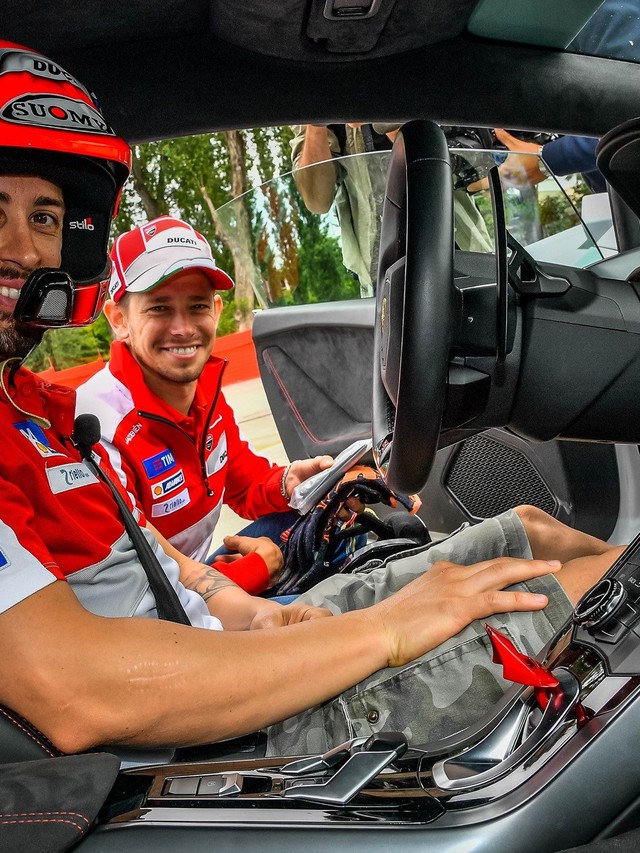
Two-time MotoGP world champion Casey Stoner and Ducati factory rider Andrea Dovizioso walked into the Autodromo di Imola on May 24, 2016, fresh from the Italian Grand Prix at Mugello, and climbed into a pair of Lamborghini Huracáns. The occasion was the first European date on Lamborghini’s 2016 Track Accademia calendar, specifically the “Intensivo” program, and both riders participated in exactly the same format offered to paying clients: individual coaching, progressive car control exercises, and full track sessions.
The riders began the day behind the wheel of the rear-wheel-drive Huracán LP 580-2, running power oversteer drills before graduating to full circuit laps in the all-wheel-drive LP 610-4. Starting with the more playful, tail-happy RWD car let two men accustomed to managing traction on a MotoGP machine recalibrate their instincts for a vehicle with roughly twice the power and twice the contact patches. The LP 610-4 sessions that followed shifted the focus to outright pace and corner-exit grip.
Professional motorcycle racers operate at the absolute frontier of vehicle dynamics: lean angles, braking markers measured in centimeters, throttle application on the edge of a highside. When riders at that level express genuine surprise at a car’s behavior, it carries weight that a standard press-day testimonial does not. Their reactions revealed something specific about the Huracán’s character, and about what Lamborghini’s Track Accademia is designed to unlock.
From Two Wheels to Four: What the Huracán Taught Two Champions
The transition from MotoGP bike to mid-engine supercar is less intuitive than it sounds. On a motorcycle, the rider is the primary aerodynamic element and the principal source of weight transfer. Braking is front-loaded and violent, corner speed is limited by lean angle and tire contact patch, and throttle modulation governs whether the rear stays planted or throws the rider over the handlebars. A Huracán inverts several of those relationships, and both riders zeroed in on the differences that surprised them most.
Dovizioso described the Huracán as surprisingly “competitive,” praising the V10’s sound and the car’s stability, but singled out the braking as the revelation.
“Compared to the bike, you can continue to brake hard into the apex making the most of deceleration, that’s the big difference.”
Trail braking on a motorcycle is a high-risk maneuver that demands extraordinary feel. That Dovizioso found the Huracán’s braking zone liberating rather than restrictive speaks to how well Lamborghini calibrated the car’s balance under deceleration, a trait that matters enormously for road-car owners exploring track days for the first time.
Stoner’s take was different in emphasis but equally revealing. The Australian, who had never raced or ridden at Imola, focused on the Huracán’s dual personality.
“The Huracán could seem tricky to drive, because it has the appearance of a race car. But actually it allows you to do pretty much anything you want: it’s ok for everyday use, but when you go on track it becomes an animal!”
He also highlighted the contrast in throttle application, noting that the Huracán allows the driver to get on the power earlier and carry it through the turn in a way that a MotoGP bike simply does not permit. Both riders, in different ways, were describing the same fundamental quality: the Huracán’s ability to make a fast driver feel faster, rather than punishing mistakes. That quality does not happen by accident. It is precisely what the Track Accademia‘s progressive curriculum is built to reveal.
RWD Fun Versus AWD Grip: Why the Program Uses Both Huracáns
The Intensivo program’s decision to run both the LP 580-2 and LP 610-4 reflects a genuine philosophical split in the Huracán lineup, and the back-to-back format turns that split into something a driver can feel rather than merely read about.
The LP 580-2, with its rear-wheel-drive layout, is the more communicative car. Power oversteer drills in the 580-2 force the driver to manage the rear axle actively, building throttle sensitivity and an understanding of weight transfer that no amount of sim time can replicate. Lamborghini positioned the LP 580-2 as the purist’s Huracán when it launched, and using it as the opening act at the Accademia reinforces that message: this is the car that teaches you something.
The LP 610-4, with its electronically managed all-wheel-drive system, plays a complementary role. It rewards commitment. The additional front-axle traction means corner-exit speeds climb, and the car flatters a driver who trusts it. Moving from the 580-2 to the 610-4 within a single day gives participants a visceral comparison that no spec sheet can communicate. Owners who drove both walked away understanding not just which car was faster, but which car suited their driving style.
For anyone considering a used Huracán today, this distinction remains relevant. The LP 580-2 commands a loyal following among drivers who prioritize engagement over outright lap times, while the LP 610-4 remains the more versatile all-conditions weapon. The Track Accademia format, intentionally or not, functioned as a very expensive test drive that clarified that choice.
Inside the Intensivo: What Lamborghini’s Track Academy Actually Delivers
Lamborghini describes the Intensivo as a full day on track comprising car control exercises, coached circuit laps with individual instruction, telemetry and video analysis, and hot laps driven by professional instructors drawn from Lamborghini Squadra Corse’s Youngster development programs. The coaching model uses small groups, with instructors providing real-time guidance through radio communication, a format designed to accelerate learning without overwhelming participants.
The 2016 calendar spanned five international venues: Shanghai, Imola, the Nürburgring, Las Vegas, and Valencia. Las Vegas also hosted a separate “Pilota Lamborghini” program, indicating Lamborghini was already segmenting its experiential offerings by skill level and format. The Accademia’s progressive structure, which ranges from introductory levels up through advanced programs, suggests the company viewed track instruction not as a one-off marketing exercise but as a retention tool, a way to deepen the relationship between owner and machine.
Lamborghini does not publicly list pricing for the Accademia programs. Ferrari’s Corso Pilota and Porsche’s Experience Centers serve broadly similar functions, but the competitive nuance lies in execution. Porsche operates permanent facilities with year-round scheduling. Ferrari leans heavily on its Fiorano heritage. Lamborghini’s approach, rotating through iconic circuits and pairing the experience with Italian hospitality, positions the Accademia as something closer to a curated motorsport holiday than a corporate driving school. The format clearly targets a client who values exclusivity and atmosphere alongside seat time.
The Ducati Connection: What the Imola Meeting Signals
The Imola event also facilitated an informal meeting between Giorgio Sanna, then Head of Lamborghini Motorsport, and Ducati Corse’s Paolo Ciabatti and Davide Tardozzi. Both brands sit within the Volkswagen Group, and the meeting underscored a relationship that extended well beyond a single track day.
That relationship produced tangible products in subsequent years. Limited-edition Ducati models drew direct design inspiration from Lamborghini cars, including the Diavel 1260 Lamborghini (inspired by the Sián FKP 37), the Streetfighter V4 Lamborghini (which referenced the Huracán STO), and more recently a Panigale V4 Lamborghini tied to the Revuelto. A Huracán STO wearing Desmosedici GP livery appeared in Bologna’s Piazza Maggiore in 2022 to celebrate Pecco Bagnaia’s MotoGP championship. The 2016 Imola event, modest in its public profile, now looks like an early chapter in a collaboration strategy that both brands have continued to develop.
For Lamborghini, the value of associating with MotoGP is straightforward. Motorcycle racing carries a rawness and physical intensity that aligns with the brand’s identity far more naturally than gentler sponsorship platforms. When a two-time MotoGP champion calls your road car an “animal,” that endorsement resonates with an audience that cares about performance credibility above all else.
What the Huracán’s Track Legacy Means Now
The Huracán line that Stoner and Dovizioso drove at Imola went on to become one of Lamborghini’s most commercially successful and competitively prolific platforms. The Super Trofeo one-make series put hundreds of stripped race cars on circuits worldwide, and the GT3 variant became a fixture of international endurance racing. Car and Driver recently tested the Huracán Super Trofeo Evo2 at its Lightning Lap event, recording a 2:30.6 lap time with 612 horsepower on tap, a reminder of how much performance Lamborghini extracted from the platform over its lifetime.
The Temerario GT3, which will succeed the Huracán GT3 Evo 2 as Lamborghini’s factory-backed GT3 contender, represents the first race car entirely designed and developed in-house at Sant’Agata Bolognese. It will use a modified version of the road car’s twin-turbocharged engine, marking a decisive shift from the naturally aspirated V10 that defined the Huracán era. The specific engine note that Dovizioso praised at Imola, that stunning V10 wail, belongs to a closed chapter.
For current Huracán owners, the Track Accademia format remains one of the best ways to explore what their cars can actually do in a structured, coached environment. For prospective buyers watching the used market, the LP 580-2 in particular continues to represent one of the most engaging naturally aspirated mid-engine cars available at any price. Two MotoGP champions inadvertently validated that point on a spring day at Imola, and the Track Accademia they attended was built to let every owner discover the same thing for themselves.
Gallery


