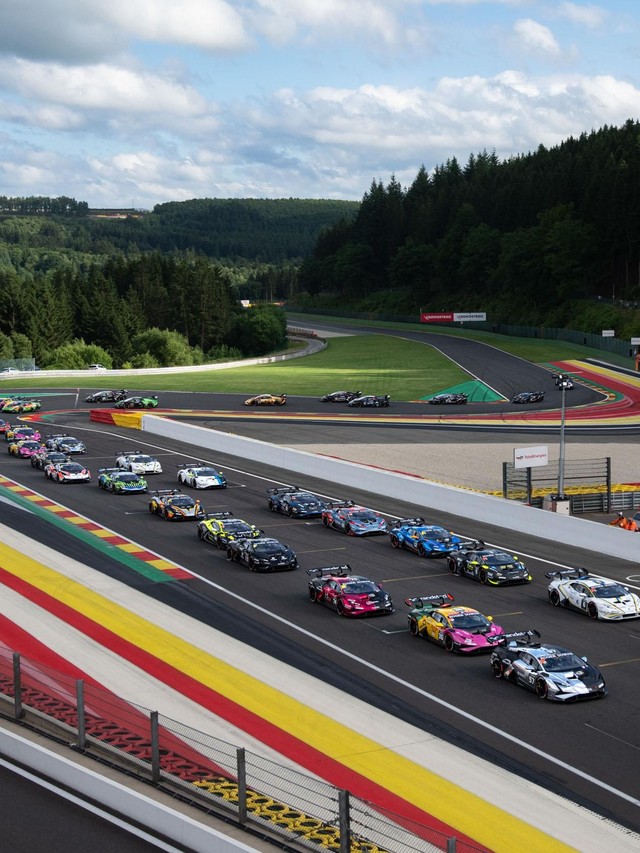
Super Trofeo Asia Returns to Suzuka for a Double-Header Weekend
Lamborghini’s 2017 Super Trofeo Asia series reaches its midseason pivot this weekend at Suzuka Circuit, the 5.82-kilometer figure-eight layout in Mie Prefecture that started life as a Honda test track in 1962 and went on to host decades of Formula One drama. The third round of six brings a two-day double-header on June 24 and 25: a 40-minute sprint race on Saturday and a 50-minute race on Sunday, with qualifying opening the weekend at 8:35 am JST.
This marks the sixth consecutive year Lamborghini has staged a Super Trofeo event in Japan, and the second time in two years the series has visited Suzuka specifically. At 5.82 km, Suzuka is the longest venue on the 2017 Asia calendar, a detail that matters when you consider the Huracán Super Trofeo is a rear-wheel-drive, naturally aspirated V10 car being asked to manage traction through Degner curves and the 130R. The event also runs alongside the second round of the Blancpain GT Series Asia, where Lamborghini fields several Huracán GT3 entries, giving the brand a visible double presence on the same weekend. That overlap is no accident. It reveals how deliberately Squadra Corse uses its customer racing calendar to build relationships, cultivate new drivers, and keep the Lamborghini name in front of exactly the audience it wants to reach across Asia.
The VIP Hospitality Play: Selling the Brand Beyond the Pit Wall
Every Super Trofeo Asia stop includes a dealer-hosted VIP hospitality program, and this is the part that rarely gets attention in race previews but arguably drives more long-term value than any podium result. Lamborghini and its regional dealers entertain owners and prospective buyers with premium trackside access and Italian dining while the cars circulate below.
The logic is straightforward. A gentleman driver who races a Huracán Super Trofeo on Saturday might buy a road-going Aventador on Monday. A VIP guest watching from the hospitality suite might place a deposit before dessert. Customer racing programs across the supercar industry function this way, but Lamborghini’s approach in Asia is distinctive because the brand is actively expanding its dealer network and sales volume in the region. Hosting six race weekends across Malaysia, Thailand, Japan, China, and then converging at Imola for a World Final creates a recurring calendar of touchpoints with exactly the clientele Lamborghini wants to cultivate. Ferrari Challenge and Porsche’s Carrera Cup operate on a similar principle, but Lamborghini’s version leans harder into the lifestyle wrapper, treating every round as a curated brand experience rather than a pure sporting event.
Asia’s Strategic Weight on Lamborghini’s Motorsport Map
The geographic spread of Lamborghini’s 2017 one-make racing underscores how central Asia has become to the brand’s growth ambitions. The European series is in its ninth year, North America in its fifth, and the Asia series marks its sixth season. For the first time, a Middle East series joins the calendar, bringing the total to four continental championships feeding into a single World Final at Imola.
That is an ambitious structure for a manufacturer that builds roughly 3,500 cars a year (at the time). The Asia series alone spans 12 races across six weekends from Sepang to Shanghai, reflecting Lamborghini’s bet that the region will continue to generate both new customers and new racers. Japan gets two of those rounds: Suzuka now, Fuji International Speedway in August. That level of commitment to a single market within the Asia calendar signals how seriously Squadra Corse treats Japanese enthusiasts, who tend to be deeply loyal and technically engaged owners. Each weekend is another opportunity to deepen those relationships, blending competitive motorsport with the kind of personal access that turns a car buyer into a lifelong brand advocate.
Drivers to Watch: F1 Veterans, Young Guns, and Gentleman Racers
The Suzuka grid illustrates the breadth of talent the Super Trofeo format is designed to accommodate, and the class structure that keeps all of them coming back. Former Formula One driver Shinji Nakano joins the Pro class alongside teammate Hiroyuki Iiri, racing for Lamborghini Osaka. Nakano’s presence lends credibility and local star power, but the series equally values its gentleman competitors: Toshiyuki Ochiai, part of the 2016 Pro-Am championship-winning team, returns with HoJust Racing, while 2016 runner-up Yudai Uchida races under the Lamborghini Azabu banner.
Separate podiums for Pro, Pro-Am, AM, and a Lamborghini Cup for rookies are a deliberate design choice. They keep professional drivers from discouraging wealthy amateurs, which in turn keeps entry numbers healthy and dealer relationships intact. Leading the Pro class at the midseason mark are Young Drivers Program graduates Afiq Yazid and Cozzolino Kei of Clazzio Racing, followed by Leipert’s Ben Gersekowski and Rory Collingbourne. In Pro-Am, another Young Drivers Program alumnus, Rik Breukers, leads with GDL Racing alongside Nigel Farmer.
Emperor Racing’s Akihiko Nakaya is partnering with 2016 GT Asia Champion Edoardo Liberati in a Huracán GT3 for the concurrent Blancpain event, further blurring the line between Lamborghini’s customer racing tiers and reinforcing how the Super Trofeo serves as a feeder system for higher-level GT competition.
The Huracán Super Trofeo: Road-Car DNA, Race-Car Diet
Lamborghini says the 2017 Huracán Super Trofeo carries over unchanged from the previous year. It uses the same 5.2-liter naturally aspirated V10 found in the road car, managed by a Motec control unit that produces 620 horsepower. At a dry weight of 1,270 kg, the resulting weight-to-power ratio sits at 2.05 kg per horsepower.
Sharing the road car’s engine block and basic architecture means every lap of competitive data feeds back into Lamborghini’s understanding of the V10 platform’s limits. Pirelli P Zero slicks, a prominent rear diffuser, and a large rear wing handle the aerodynamic workload, while the roll cage and stripped interior account for the roughly 200 kg shed from the road car’s curb weight. The car is rear-wheel drive only, making it a more demanding and educational tool for drivers moving up through the ranks. For enthusiasts watching from the grandstands or the hospitality suite, the sound alone is worth the trip: a naturally aspirated V10 at full song through Suzuka’s Esses is a visceral advertisement for Lamborghini’s engineering philosophy that no brochure can replicate.
Super Trofeo and GT3: Two Ladders, One Brand
Lamborghini’s customer racing ecosystem rests on a clear distinction between the Super Trofeo and the GT3 programs. The Super Trofeo is a one-make series: identical cars, controlled specifications, relatively accessible entry. The GT3 program places the Huracán GT3 into multi-manufacturer championships like Blancpain, where it competes wheel-to-wheel against Ferraris, Porsches, and Mercedes-AMGs.
The Super Trofeo functions as both a standalone championship and a pipeline. Young Drivers Program graduates like Breukers and Yazid cut their teeth in Super Trofeo before moving to GT3 seats. For Lamborghini, this dual structure means the brand maintains a controlled environment for customer engagement while also competing at the sharp end of international GT racing. The concurrent scheduling at Suzuka, with Super Trofeo and Blancpain GT Series Asia sharing the same weekend, makes the relationship visible and tangible for anyone in attendance. It is the clearest illustration of how Squadra Corse turns a hospitality weekend into a genuine motorsport ladder.
The Road to Imola: What Comes Next
After Suzuka, the 2017 Asia calendar moves to Fuji International Speedway in August and Shanghai International Circuit in September before the entire global series converges at the Autodromo di Imola in November. The World Final brings together the top competitors from the European, North American, Asian, and (for the first time) Middle Eastern series to contest a global podium on Lamborghini’s home turf in the Bologna region.
The series is structured to reward sustained participation across a full season, not one-off appearances. Points accumulate over 12 races, and the World Final invitation is the payoff. Lamborghini does not publicly detail the cost of fielding a car for a full season, but the investment goes well beyond the car itself, encompassing team logistics, travel across four countries, and the wear items that a V10 race car consumes at a prodigious rate. The reward is access to a global community of like-minded owners and a direct line to Squadra Corse, which is precisely the kind of relationship Lamborghini is building these weekends to create.
Gallery


