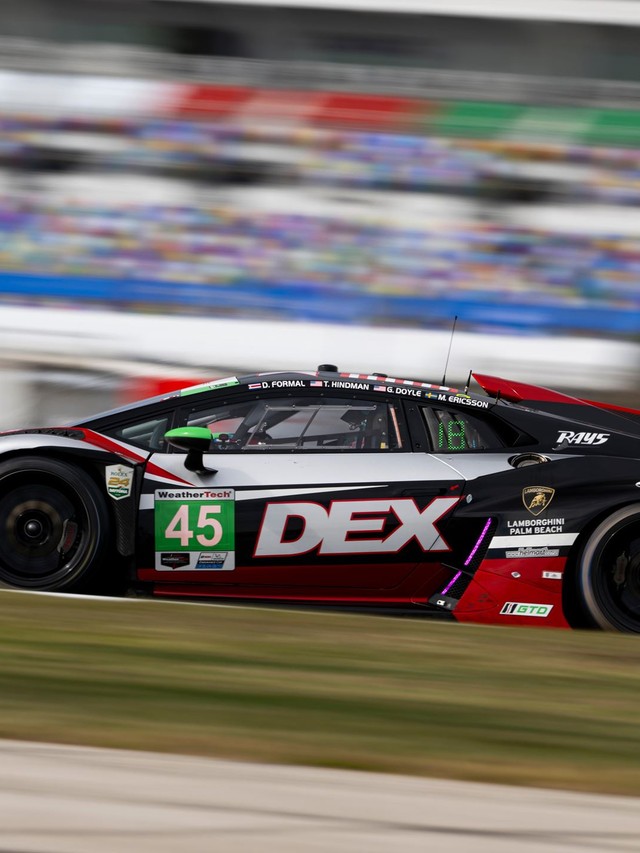
A Rolling Showroom Before the Green Flag at Fuji
Before a single Huracán Super Trofeo fired its engine on the Fuji International Speedway grid, 45 Lamborghini road cars paraded around one of Japan’s most storied circuits. Forty-five owners willing to bring their cars to a racetrack, line up in formation, and publicly declare their allegiance to the brand before a paying audience and a field of professional racers. No digital campaign can replicate that kind of activation, and Lamborghini knew it.
The 2016 Lamborghini Blancpain Super Trofeo Asia series concluded its Asian circuit season at Fuji with this dual spectacle: a customer experience layered directly on top of competitive single-make racing. Fuji International Speedway had hosted the Asia series every year since its inception, and this marked the second Japanese stop of the 2016 season, following an earlier round at Suzuka in June. Returning twice to Japan in a single calendar was deliberate. Japan’s deeply rooted motorsports culture, combined with one of the world’s most affluent luxury car markets, made it the ideal stage for Lamborghini to demonstrate both its racing credentials and the depth of its ownership community.
That parade served a commercial purpose well beyond the photo opportunity. Lamborghini owners in Japan tend to be intensely loyal, and events like this reinforce a sense of belonging that keeps them inside the brand ecosystem when the next purchase decision arrives. For a manufacturer that sells exclusivity as much as performance, filling a racetrack with 45 of its own road cars is a statement of market health. Everything that followed on race day, from the grid walk to the podium ceremony, drew its energy from that opening act.
Race Day at Fuji: Ochiai and Yazid Win From Sixth on the Grid
Eighteen Huracán Super Trofeo cars lined up on the starting grid under skies that had turned from clear to overcast, a familiar trick of Mount Fuji’s microclimate. Qualifying put New Zealand’s Jono Lester on pole, with Dilango Racing’s Armaan Ebrahim from India a razor-thin margin behind and local driver Eiji Yamada in third. Series favorite Toshiyuki Ochiai, one half of the season’s dominant pairing, started down in sixth.
What followed was a race defined by constant position changes. Lester and his teammate Yudai Uchida traded the lead with Dilantha Malagamuwa and Ebrahim for more than half the distance, exchanging first place at least four times. While those two crews fought each other, Ochiai and teammate Afiq Yazid quietly worked their way through the field. By around lap 22, the pair emerged at the front.
The battle behind them was equally fluid. Jake Parsons and fellow Australian Aidian Wright pushed past Yamada for third by lap 12, only for Yamada to reclaim the podium position later in the race. Indonesian driver Andrew Haryanto climbed from ninth into seventh, while local drivers Akira Mizutani and Hironori Takeuchi mounted a mid-race charge that eventually carried them past Uchida and Lester into fourth. Ochiai and Yazid ultimately won from their sixth-place grid slot, with Malagamuwa and Ebrahim finishing second and Yamada completing the podium.
Ten Japanese drivers competed in the race, and Japanese teams held the top two championship positions for the 2016 season. For a series that spans the entire Asian continent, that local dominance at Fuji carried real weight with the spectators in attendance, and it underscored exactly why Lamborghini kept coming back.
Japan’s Role in Lamborghini’s Asian Motorsport Calculus
Lamborghini’s decision to anchor the Super Trofeo Asia calendar around Japan reflects a straightforward commercial reality. Japan remains one of the most important markets for exotic car sales in Asia, and its enthusiast community brings a level of technical sophistication and brand loyalty that few other regions can match. Owners in Japan do not simply buy a Lamborghini and park it. They modify, they track, they attend events, and they bring their friends.
Hosting the series finale at Fuji rather than at circuits in Southeast Asia or China was a calculated move. Fuji’s proximity to Tokyo, its Formula 1 heritage, and its challenging layout, with a long main straight feeding into a technical infield section, gave the event both prestige and genuine competitive credibility. The circuit’s consistent presence on the Super Trofeo Asia calendar since the series began underscores how central Japan is to Lamborghini’s regional strategy.
The broader competitive context matters here. Ferrari and Porsche both run their own single-make customer racing series in the region, and both use similar tactics: blend owner engagement with competitive racing, create a pathway from road car ownership to track participation, and keep the brand visible in motorsport-obsessed markets. Lamborghini’s advantage at Fuji in 2016 was the sheer enthusiasm of its Japanese customer base, a community that showed up with 45 road cars before the racing even started. That kind of organic turnout is difficult for any rival to manufacture.
Building a Talent Pipeline: The Young Drivers Program Expands
Yazid’s race-winning performance at Fuji provided Lamborghini with a convenient proof point for one of its quieter strategic investments. The company cited his strong 2016 season as evidence of the Young Drivers Program’s effectiveness, and the timing of that claim was not accidental. In the same year, Lamborghini announced two new additions to its driver development ladder: the GT3 Junior Program and the Kart Drivers Program.
Established in 2014, the Young Drivers Program evaluates and develops promising drivers under 25 who compete in the Super Trofeo series. The GT3 Junior Program extends that pathway into the more senior GT3 championships, where Lamborghini competes against factory-backed efforts from McLaren, Ferrari, Porsche, and Mercedes-AMG. Adding a kart-level program at the bottom of the ladder signals that Lamborghini wants to identify talent earlier, before those drivers commit to another manufacturer’s ecosystem.
This multi-tiered approach mirrors what Ferrari and Porsche already operate. Ferrari’s Driver Academy feeds talent into its GT and single-seater programs; Porsche’s Junior Programme scouts from its Carrera Cup series. Lamborghini’s expansion in 2016 was an acknowledgment that competing for young talent requires more than a single entry point. The program’s comprehensive evaluation process, which assesses performance, consistency, physical fitness, and professionalism both on and off the track, aims to produce well-rounded drivers ready for the highest levels of GT racing. The pathway Lamborghini built through Super Trofeo and the GT3 Junior Program would eventually feed into its factory driver roster, and the lessons learned from customer engagement events like Fuji would inform how Squadra Corse structured its programs in subsequent years.
What Super Trofeo Means for the Brand Beyond Trophies
As a single-make racing series, the Lamborghini Blancpain Super Trofeo puts every car on the grid in identical specification. That levels the competitive playing field and shifts the emphasis to driver skill and team strategy rather than engineering budgets. For Lamborghini, the format serves multiple purposes at once.
It keeps the Huracán visible in a competitive context that road car buyers can relate to. Watching a car that shares its basic architecture with the one in your garage race wheel-to-wheel at Fuji creates an emotional connection that a GT3 or LMP program, with its heavily modified machinery, simply cannot. It also provides a controlled environment for Lamborghini to develop relationships with privateer teams and gentleman drivers who may eventually step up to GT3 competition, bringing their budgets and brand loyalty with them. And the Blancpain partnership, with the Swiss watchmaker serving as the series’ title partner, reinforced Lamborghini’s positioning in the luxury space, connecting the brand with another icon of craftsmanship and exclusivity.
For prospective buyers considering a Super Trofeo entry, the practical reality in 2016 was that Lamborghini did not publicly disclose the full cost of participation. What the series offered was a turnkey racing experience with factory support, a global calendar spanning Europe, Asia, and North America, and a World Final that brought all three regional championships together. The 2016 World Final took place in Valencia, Spain, giving Fuji’s competitors one more major event to close their season.
The Huracán Super Trofeo itself sat at the top of the Huracán’s track-focused hierarchy, a dedicated race car derived from the road car platform but stripped and modified for competition. It replaced the Gallardo Super Trofeo when the Huracán generation launched, carrying forward a customer racing tradition that Lamborghini started with the Gallardo and would eventually extend into the Temerario era. Autoblog reported that the Temerario GT3, debuted at the 2025 Goodwood Festival of Speed, represents Lamborghini’s first competition car fully designed, developed, and built in-house, a significant evolution from the outsourced development model of earlier programs.
The Bigger Picture for Lamborghini Enthusiasts
Events like the 2016 Fuji finale tend to get filed away as routine race reports, but they reveal more about a manufacturer’s priorities than most product launches do. Lamborghini chose to invest in a customer parade, a multi-tiered driver development program, and repeated visits to Japan’s most prestigious circuit because these activities build the kind of brand equity that sustains sales between model cycles.
Those 45 road cars that paraded before the race were not props. They represented real customers who chose Lamborghini over every other exotic available in Japan, and who were willing to spend a weekend at a racetrack to celebrate that choice. For a brand navigating the transition from naturally aspirated engines to hybrid powertrains, maintaining that level of community engagement becomes even more critical. Buyers who feel connected to the brand through shared experiences are far more likely to follow Lamborghini into its next chapter than those who simply admire the cars from a distance.
Ochiai and Yazid’s victory from sixth on the grid made for a satisfying competitive narrative. But the real story at Fuji was the ecosystem Lamborghini assembled around the racing: owners in the paddock, young drivers on the ladder, and a Japanese market that treats the brand as something worth showing up for.
Gallery


