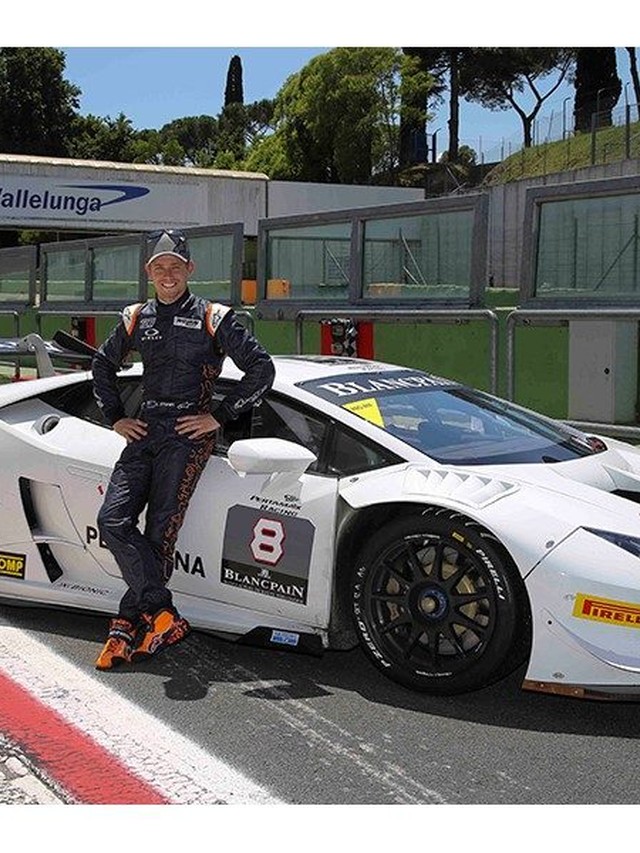
A Champion Trades Two Wheels for 620 Horsepower
Two-time MotoGP World Champion Casey Stoner, a noted Lamborghini enthusiast, joined Squadra Corse at the Autodromo Vallelunga for an exclusive test session in the Huracán Super Trofeo. The timing was no accident. Squadra Corse was already at the 4,085-meter Italian circuit to initiate new drivers participating in Lamborghini’s Young Drivers and GT3 Junior Programs, and placing a champion from a completely different discipline alongside those aspiring racers gave the programs a stamp of credibility that no brochure could replicate.
Stoner’s background makes the outing more than a celebrity photo opportunity. After retiring from MotoGP he competed in the Australian V8 Supercars Dunlop Series in 2013, so he arrived at Vallelunga with genuine car-racing experience rather than motorcycle reflexes alone. Lamborghini says he improved lap after lap in the rear-wheel-drive, 620-horsepower machine. That progression matters because the Super Trofeo’s LP620-2 configuration sends all its power through the rear axle, demanding a particular kind of trust from the driver. A motorcycle champion adapting quickly to that layout speaks well of the car’s communication through the steering and pedals, and by extension, of the coaching structure wrapped around it.
Why Lamborghini Staged This Particular Endorsement
Before the track test, Stoner had visited the Lamborghini factory in Sant’Agata Bolognese and was given a Huracán LP 610-4 to drive for several days. The Vallelunga session extended that relationship into racing territory, and his public comments afterward carried the weight of a competitor who understands what a well-sorted machine feels like at the limit.
“Not many people in the world will get the opportunity to do this. I was able to run some laps with the Huracán Super Trofeo and get a feel of what a Lamborghini is like on the track.”
Stoner also singled out Adrian Zaugg and the other coach drivers by name, which suggests the session was structured around the same coaching methodology that Squadra Corse applies to its junior program participants. The implication is pointed: the same infrastructure that supports aspiring GT racers can satisfy a world champion. That is a recruiting pitch disguised as a press event.
Lamborghini’s one-make championship, the Blancpain Super Trofeo, runs across Europe, Asia, and North America, and the Young Drivers and GT3 Junior Programs feed directly into that ecosystem. Every high-profile endorsement raises the perceived value of those programs for the wealthy amateur drivers and funded young talents who actually pay to participate. Stoner lending his name to the experience validates the pipeline in a way that resonates far beyond a single test day at Vallelunga.
The Huracán Super Trofeo’s Racing Credentials
The car Stoner drove deserves context beyond its headline power figure. The Huracán Super Trofeo runs a naturally aspirated 5.2-liter V10 producing 620 horsepower at 8,250 rpm and 570 Nm of torque, channeled through an X-Trac six-speed sequential gearbox to the rear wheels only. A three-disc racing clutch, lightweight flywheel, and track-specific aerodynamics, including the prominent rear wing visible in photos from the day, make this a purpose-built race car with no road-car concessions.
The LP620-2 designation tells the whole story for anyone fluent in Lamborghini nomenclature: 620 horsepower, two driven wheels. In a brand that built its modern identity around all-wheel drive, a rear-drive-only race car represents a deliberate choice to prioritize driver engagement and adjustability over the safety net of front-axle traction. For program participants stepping into one of these for the first time, that rear-drive character is both the challenge and the education.
As Autoblog noted in a separate piece about a road-titled Super Trofeo, these cars occupy a unique space in the Lamborghini ecosystem: too extreme for the street, too accessible relative to full GT3 machinery for seasoned professionals, and perfectly calibrated for the driver-development role Squadra Corse intends. That positioning is exactly what makes the car such an effective tool for junior programs, and why Stoner’s quick adaptation to it carries meaning for prospective entrants.
From Huracán to Temerario: What Comes Next for the Pipeline
Stoner’s test took place during the Huracán era, but the road-going Huracán line has since been replaced by the plug-in hybrid Temerario. On the racing side, the Temerario GT3 represents a significant escalation: Lamborghini’s first competition car fully designed, developed, and built in-house rather than outsourced to a partner constructor.
For drivers currently in Squadra Corse’s junior programs, this transition carries real consequences. The naturally aspirated V10 that defined the Super Trofeo experience will give way to a turbocharged hybrid powertrain with fundamentally different characteristics. Teams and drivers who built their instincts around the Huracán’s linear power delivery and high-rpm personality will need to recalibrate for turbo lag management, energy deployment strategy, and a different weight distribution.
Lamborghini’s investment in driver development makes more strategic sense in this light. A well-structured junior pipeline ensures that when the Temerario GT3 arrives on grids, the brand already fields drivers who understand its racing philosophy and can provide meaningful development feedback. Stoner’s endorsement of the coaching quality and the car’s character reinforces the program’s reputation at precisely the moment when continuity matters most. The current Huracán-based series represents the final chapter of naturally aspirated V10 customer racing from Sant’Agata, and what replaces it promises to be faster but different in character. That alone makes the current programs worth watching closely.
Gallery


