A Worldwide Assault on GT Racing
Twelve months after the Grasser Racing Team rolled two Huracán GT3s onto a Monza grid for the car’s competitive debut, Lamborghini’s customer racing operation looked almost unrecognizable. By the start of the 2016 European season, the program spanned more than 20 customer teams running 40 cars across 78 race weekends in 13 international championships. The geographic reach stretched from IMSA’s WeatherTech SportsCar Championship in North America to SuperGT and the Asian Le Mans Series in the East, with the European heartland covered by the Blancpain GT Series, ADAC GT Masters, British GT Championship, Campionato Italiano GT, International GT Open, and more.
Going from two cars at a single event to 40 entries across four continents in a single calendar year is not organic growth. It is a coordinated strategic offensive, one designed to embed the Huracán GT3 in every major GT3 ecosystem simultaneously rather than building presence incrementally the way Lamborghini had done with the Gallardo GT3 before it. The 2016 campaign was the year Squadra Corse stopped being a boutique racing operation and declared itself a global program, and every element of the season, from team selection to driver pairings, served that singular ambition.
Why Customer Racing Became Lamborghini’s Brand Weapon
For a manufacturer whose road cars sell on emotion, spectacle, and the promise of extreme performance, GT3 racing serves a function no marketing campaign can replicate. Every weekend a Huracán GT3 finishes on a podium, it validates the engineering underneath the road car in a way that a press photograph or a private test-track lap time cannot. The GT3 class, governed by Balance of Performance regulations that keep competition tight, forces cars to prove themselves against direct rivals from Ferrari, Porsche, McLaren, and Audi under genuinely comparable conditions.
Lamborghini’s decision to flood the global grid in 2016 was as much about perception as trophies. Porsche’s 911 GT3 R and the then-new Ferrari 488 GT3 (which, according to one report, also made its racing debut in 2016) represented the benchmarks. A single team winning a single race can be dismissed as circumstance; 40 cars competing across every major series forces the conversation to change. Volume on grids worldwide was the mechanism Lamborghini chose to establish itself as a permanent fixture rather than an occasional entrant.
From Monza Victory to Global Readiness
The Huracán GT3 earned its credibility quickly. Lamborghini says the car made its debut outing in April 2015 and secured a victory in the Blancpain GT Endurance Series Cup at Monza with the Grasser Racing Team, which initially fielded two cars. That early result gave Squadra Corse the proof of concept it needed to approach customer teams worldwide with a compelling pitch: a car that could win in its first season, backed by factory support from Sant’Agata.
Grasser Racing became the anchor operation for the European expansion. Based in Austria, the team scaled from those original two cars to a confirmed three-car entry for the Blancpain GT Sprint Cup opener at Misano in April 2016. That kind of commitment from a privateer squad speaks to confidence in the platform. Teams do not triple their investment in a car they consider a development project; they do it when the manufacturer’s support structure convinces them the risk is manageable and the car is ready to fight.
The Teams and Drivers Leading the Charge
The Blancpain GT Sprint Cup opener at Misano World Circuit Marco Simoncelli offered a snapshot of Lamborghini’s broader ambitions. Seven Huracán GT3s lined up among a 40-car grid, split between two teams with distinctly different driver philosophies.
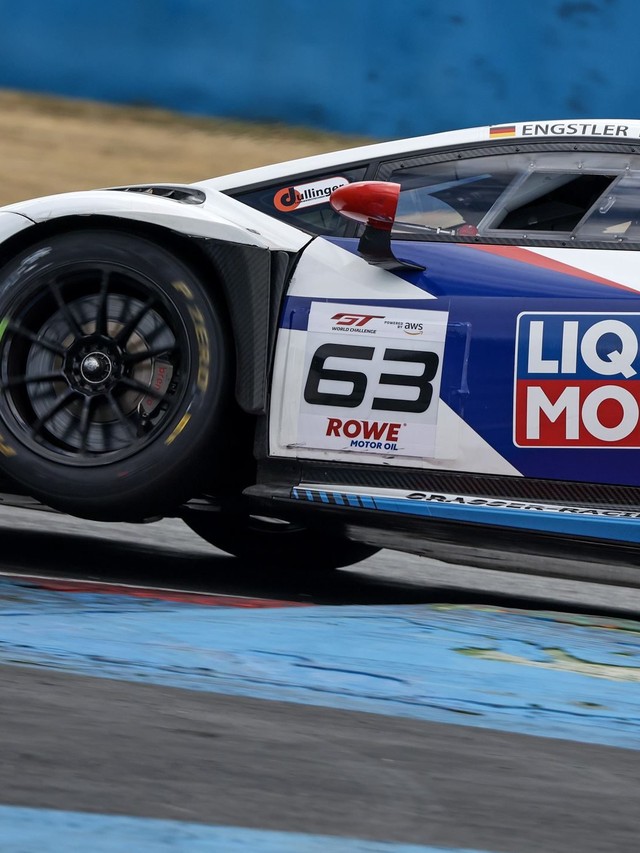
Grasser Racing Team’s three entries mixed experience with youth. The #63 paired factory driver Mirko Bortolotti with GT3 Junior Driver Nicolas Pohler, a combination designed to let the young driver learn racecraft from one of Lamborghini’s most accomplished professionals. Jeroen Bleekemolen and Stefan Rosina took the #16, while GT3 Junior Program members Luca Stolz and Michele Beretta shared the #19.
German outfit Attempto Racing mirrored that approach with its own three-car lineup. Two entries drew from the Squadra Corse GT3 Junior Program: Jeroen Mul and Max Van Splunteren in the #100, Daniel Zampieri and Patric Niederhauser in the #101. The headline name on Attempto’s roster was Davide Valsecchi, the former GP2 champion, who shared the #77 with Jack Falla. Valsecchi’s presence lent the program a degree of single-seater pedigree that GT3 grids do not always attract.
Looking at these lineups, what stands out is how deliberately Lamborghini seeded Junior Program drivers across multiple teams rather than concentrating them in a single entry. Each young driver shared a car with either a factory professional or an experienced gentleman racer, ensuring mentorship was built into the structure rather than left to chance. The pairings were not accidental; they were the talent-development arm of the same global offensive that put 40 cars on grids worldwide.

The Lamborghini Huracán GT3 showcases its aggressive aerodynamic design and sponsor livery in a pristine studio environment.
The GT3 Junior Program as a Talent Pipeline
The Lamborghini Squadra Corse GT3 Junior Program deserves attention beyond its role as a line item in a race entry list. At Misano alone, at least five of the fourteen drivers across the seven Huracán GT3s came through the Junior Program. That ratio signals something more structured than a sponsorship deal or a pay-driver arrangement.
Lamborghini’s approach mirrors what other manufacturers do in single-seater feeder series but applies it to GT racing, a category where young talent often struggles to find factory-backed seats because the business model favors gentleman drivers who bring budgets. By embedding Junior drivers alongside experienced professionals in competitive customer teams, Squadra Corse created a pathway that did not depend on a young driver’s personal funding.
The long-term payoff of such programs can be significant. Leonardo Pulcini, for example, won the GT3 Junior Program shootout in 2022 and earned promotion to Lamborghini’s factory driver roster for 2023, according to one report. That kind of trajectory, from junior selection to factory contract, gives the program credibility with aspiring drivers and their management teams. It also gives Lamborghini a deeper bench of proven professionals to deploy as the brand’s racing commitments grow, reinforcing the infrastructure that made the 2016 offensive possible in the first place.
Competing for Grid Supremacy Against Ferrari and Porsche
Context matters when evaluating the scale of Lamborghini’s 2016 push. Porsche’s 911 GT3 R was already the default choice for many privateer teams, benefiting from decades of customer racing infrastructure and a global parts network few manufacturers could match. Ferrari’s 488 GT3, entering competition in the same year according to available reporting, brought the weight of Maranello’s brand and its own extensive Corse Clienti support network.
Lamborghini’s challenge was not simply building a fast car. The Huracán GT3 needed to prove that Squadra Corse could deliver the kind of trackside engineering support, parts logistics, and data analysis that customer teams expect when they commit hundreds of thousands of dollars to a racing program. One report indicates the later Huracán GT3 Evo carried a price tag of approximately $430,000, which gives a sense of the financial commitment each team made.
For buyers weighing a Huracán GT3 against a 911 GT3 R or a 488 GT3, the decision came down to more than lap times. It involved trust in the manufacturer’s long-term commitment to the platform, the quality of factory support at remote circuits, and the resale value of the car when the next homologation cycle arrived. Lamborghini’s answer was to make that commitment impossible to question through sheer volume: 40 cars, 13 series, every major continent covered. The grid presence itself became the argument.
What the 2016 Offensive Set in Motion
The 2016 season did not exist in isolation. It served as the foundation for everything Lamborghini’s customer racing division built afterward. The Huracán GT3 went on to receive EVO and EVO2 upgrades that kept it competitive through multiple homologation cycles, and the car eventually became a fixture on grids from the Nurburgring 24 Hours to the IMSA endurance calendar.
The Junior Program seeded the driver pipeline. The customer team network established the logistical backbone. And the sheer number of cars on grids worldwide forced competitors, media, and fans to recalibrate what they expected from Lamborghini on a racetrack. Sim racers familiar with the Huracán GT3 through titles like Gran Turismo know the car’s reputation for being rewarding but demanding, a machine that punishes sloppy inputs and rewards precision. Multiple forum discussions describe it as requiring a fundamentally different driving approach compared to its competitors. That digital reputation tracks with the real car’s character: a mid-engine V10 that asks more of its drivers than the rear-engine stability of a 911 GT3 R but rewards commitment with a level of mechanical grip and mid-corner rotation the Porsche cannot replicate.
At its core, the 2016 program was a bet that the Huracán GT3 could earn its place on merit rather than heritage. Forty cars on grids worldwide was the opening argument. The results that followed over the next several seasons provided the verdict.


