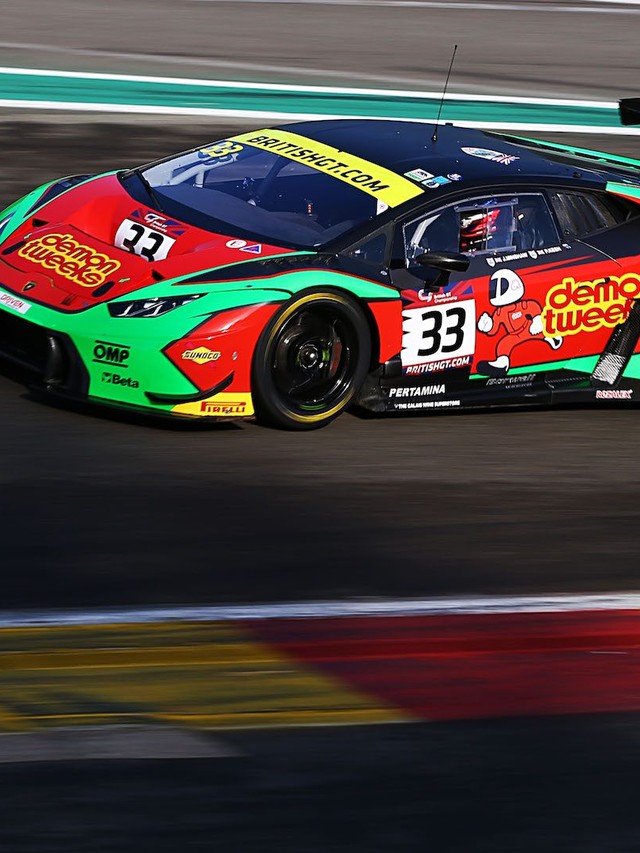
Barwell’s Fourth Win of 2017: Commanding Spa from Pit Lane
Phil Keen and Jon Minshaw drove the #33 Lamborghini Huracán GT3 to a 14-second victory in Race 1 of the 2017 British GT Championship at Spa-Francorchamps on July 9, marking their fourth win of the season. The result extended their lead in both the driver and team standings with only two rounds remaining, and it did so through a method that reveals as much about the Huracán GT3’s versatility as any lap time could: pit lane timing.
Two lengthy safety car periods, triggered by an on-track accident, disrupted the 60-minute race. Most teams treat safety cars as a nuisance, a compression of hard-earned gaps. Barwell treated them as an opportunity. The team timed its mandatory pit stop so that Keen re-entered the circuit ahead of the Bentley and Aston Martin entries that had been running in contention, converting what might have been a close battle into a comfortable gap that only grew. By the chequered flag, 14 seconds separated the Lamborghini from the rest of the GT3 field.
The pattern behind this result matters more than the margin. Keen and Minshaw opened the 2017 season with a double victory at Oulton Park in wet conditions, then kept accumulating wins at Snetterton and now Spa. Four victories from five rounds is not a streak explained by luck or favorable Balance of Performance adjustments alone. It points to a car and team combination capable of extracting results across circuits, weather conditions, and race situations, and it is that adaptability that made the Huracán GT3 so difficult for rivals to answer.
Reading the Safety Cars: Why Pit Timing Won the Race
GT racing at Spa-Francorchamps, even in a 60-minute sprint format, rewards teams that understand the relationship between safety car timing and the mandatory pit window. When the race goes green and stays green, pit strategy is largely dictated by the regulations: stop within the window, serve your time, get out. When safety cars bunch the field, the calculus changes entirely. A team that pits under caution loses far less time relative to the leaders because everyone is circulating at reduced speed.
Barwell Motorsport’s engineers recognized this. Lamborghini says the team used the two safety car deployments to execute their stop at the optimal moment, and the result was Keen emerging from pit lane not just in contention but ahead of the Bentley Continental GT3 and Aston Martin Vantage entries that represented his closest championship rivals. From that point, the race became a controlled exercise. Keen, one of the most experienced GT drivers in the British paddock, simply managed the gap.
The 14-second margin at the finish flatters the execution but undersells the difficulty. Spa is 7 kilometers of high-speed corners, elevation changes, and braking zones where a single mistake at Eau Rouge or Blanchimont can end a race instantly. Maintaining pace while managing tire degradation and traffic from the GT4 class requires a car that communicates clearly with its driver. The Huracán GT3’s naturally aspirated V10, derived from the road car’s 5.2-liter engine, provided the kind of linear throttle response that professional drivers consistently praise in endurance and sprint formats alike: predictable, immediate, and without the lag that can unsettle a car mid-corner. That mechanical transparency is precisely what allowed Barwell’s pit wall gamble to pay off. A less communicative car would have made the out-lap after the stop far riskier, narrowing the window in which strategy could override raw pace.

The multi-colored Lamborghini Huracán GT3 race car with number 33 speeds around the track during a race event.
A 41-Point Cushion: What the Standings Meant for the Title Fight
After Spa, Barwell Motorsport held a 41-point advantage over Team Parker’s Aston Martin in the team standings. The remaining two rounds were scheduled for Brands Hatch (August 5-6) and Donington Park (September 23-24), meaning the championship was far from mathematically sealed but practically very difficult for rivals to overturn.
The 2016 season had ended with Keen and Minshaw as vice-champions, close enough to taste the title but unable to close it out. That near-miss context made the 2017 campaign feel less like a title defense and more like unfinished business. Four wins from five rounds gave the pair a psychological advantage as much as a mathematical one: rivals knew the Lamborghini would be fast everywhere, not just on circuits that suited its characteristics.
The championship battle was not purely a two-horse race between Lamborghini and Aston Martin, either. The Bentley Continental GT3 remained a factor, and the presence of Audi R8 LMS entries from Team WRT added another variable. British GT in 2017 fielded a genuinely diverse GT3 grid, which makes Barwell’s consistency all the more telling. Winning against one rival is a car advantage. Winning against four or five different manufacturer platforms, repeatedly, across different circuits and conditions, is a program advantage, one rooted in the same strategic intelligence that turned two safety cars at Spa into a 14-second margin.
The Huracán GT3 Against Its 2017 Rivals: Why the Platform Worked
Understanding why the Huracán GT3 proved so effective in 2017 British GT requires looking at what it was competing against. The Bentley Continental GT3, despite being based on a grand touring coupe that weighs considerably more than a Huracán in road trim, was a formidable circuit weapon with significant factory support. The Aston Martin Vantage GT3 brought mid-engine-like balance from its front-mid layout and strong low-speed traction. Audi’s R8 LMS shared much of its DNA with the Huracán, both using variations of the same V10 architecture and aluminum spaceframe philosophy from within the Volkswagen Group, making the R8 a particularly interesting benchmark.
The Huracán GT3’s advantage was rooted in its combination of mechanical simplicity and aerodynamic efficiency. Lamborghini Squadra Corse developed the car specifically for customer teams, meaning it needed to be fast but also maintainable, reliable, and forgiving enough for gentleman drivers sharing the car with professionals. The naturally aspirated V10 delivered power in a way that amateur and professional alike could modulate precisely, a characteristic that matters enormously in the Pro-Am format that defines much of British GT’s grid. That same predictability is what made Barwell’s safety car strategy viable: the car gave Keen exactly the feedback he needed to push immediately on cold tires after a pit stop, rather than nursing the car through tentative out-laps while rivals closed in.
TopSpeed reports the Huracán GT3 was developed as a direct replacement for the Gallardo FL2 race car, and the generational leap was significant. Where the Gallardo-based racer was competitive but aging, the Huracán platform brought a stiffer chassis, better aerodynamics, and a more refined package that Squadra Corse could evolve over multiple seasons. By 2017, the car was entering its competitive prime, refined through seasons of data collection and development feedback from customer teams like Barwell.
For prospective customers considering a GT3 program, the Huracán’s track record in 2017 British GT offered a compelling argument: the car could win in the hands of a well-organized customer team without requiring factory-level budgets or engineering support. Barwell Motorsport operated as an independent team, not a manufacturer works effort, which made every victory a proof point for Lamborghini’s customer racing model.
From 2017 to Today: Barwell and Lamborghini’s Enduring Partnership
The Spa victory was not an isolated peak. Barwell Motorsport went on to secure the 2017 British GT Teams’ Championship title, according to multiple reports, capping a season that validated the Huracán GT3 as the car to beat in the UK’s premier GT series. The drivers’ championship proved more elusive: one report indicates Keen and Minshaw finished as runners-up for a second consecutive year, losing out to Team Parker Racing’s Seb Morris and Rick Parfitt Jnr in a Bentley. Winning the team title while narrowly missing the drivers’ crown is the kind of bittersweet outcome that defines endurance racing, where consistency across multiple entries matters as much as individual brilliance.
The longevity of the Barwell-Lamborghini relationship gives this story its deeper significance. The team continued racing Huracán GT3s in subsequent British GT seasons, building an institutional knowledge base around the platform that few customer teams in any series can match. By 2024, multiple reports confirm that the British GT title fight featured two Barwell Lamborghini entries battling each other for the championship, a scenario that would have seemed optimistic in 2017 but now looks like the natural consequence of a decade-long commitment.
The 2024 season brought its own echoes. Sandy Mitchell and Alex Martin, driving for Barwell, received a 30-second penalty at Snetterton for lapping GT4 cars under safety car conditions, a decision that significantly affected their championship challenge. Safety car strategy working in Barwell’s favor at Spa in 2017 and working against them at Snetterton in 2024 illustrates how deeply this team lives within the tactical dimension of GT racing.
Lamborghini’s customer racing philosophy, built through Squadra Corse and now extending toward the upcoming Temerario GT3 platform, owes a meaningful debt to seasons like 2017. Every time a customer team wins a championship with a Lamborghini, it reinforces the argument that Sant’Agata builds race cars that work outside the controlled environment of factory programs. Barwell’s Spa victory, won through pit wall intelligence rather than raw pace advantage, remains one of the clearest demonstrations of that principle. The car was fast enough to win on merit, reliable enough to finish every race, and adaptable enough to exploit opportunities that its rivals could not.
For anyone watching Lamborghini’s transition from the naturally aspirated Huracán GT3 to whatever the Temerario GT3 becomes, the 2017 season offers a useful baseline. The question facing Squadra Corse is whether a turbocharged hybrid platform can deliver the same throttle predictability, mechanical reliability, and customer-friendly maintenance profile that made the Huracán GT3 a decade-long success story. Barwell’s results suggest the bar is set high.
Gallery


