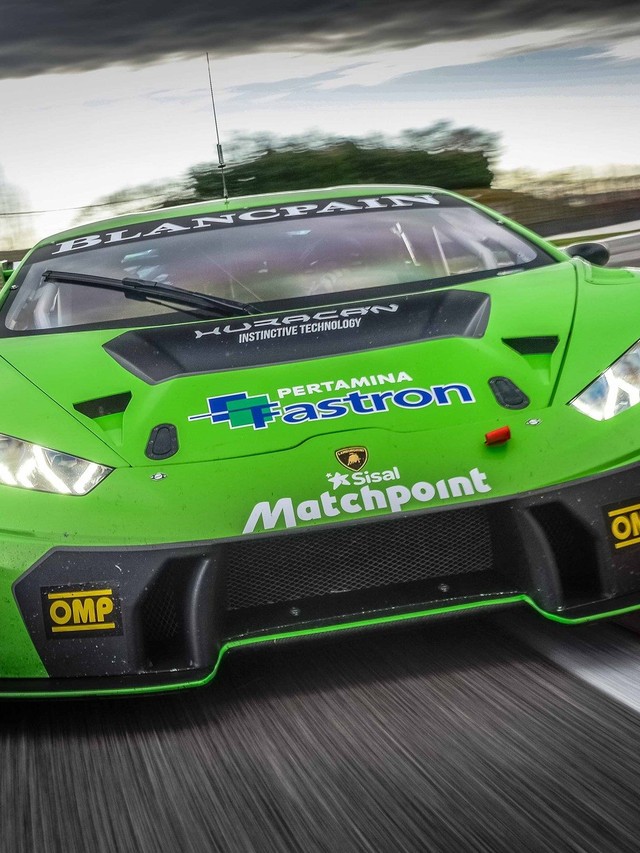
Lamborghini’s First Assault on North American GT3 Racing
When the Lamborghini Huracán GT3 rolled onto the banking at Daytona International Speedway for the 2016 Rolex 24 at Daytona, it carried more weight than its roughly 1,230 kilograms of aluminum and carbon fiber. The car represented Lamborghini’s first entry as a manufacturer in top-level IMSA competition, slotting into the GT Daytona (GTD) class of the WeatherTech SportsCar Championship just as that category adopted full FIA GT3 specifications. Five Huracán GT3s lined up across four customer teams for the season opener, all backed by Squadra Corse’s factory support operation but running without a single factory crew among them.
That arrangement was deliberate, not a budget constraint. Giorgio Sanna, Automobili Lamborghini’s Head of Motorsport, described GT3 as the top tier of Lamborghini’s motorsport strategy and the Daytona entry as a first in the company’s history. The brand was committed exclusively to customer racing. For a marque that spent decades defined more by poster-wall drama than pit-lane presence, showing up at one of the world’s most grueling endurance races with privateer teams and factory engineering support was a statement of long-term intent.
Why Daytona, and Why 2016?
The timing was anything but accidental. IMSA’s GTD class was transitioning to the 2016 FIA GT3 rulebook, which standardized the technical platform across all entries and opened the door for any homologated GT3 car to compete. For Lamborghini, that regulatory alignment created a clean entry point: the Huracán GT3 could arrive on equal footing with Ferraris, Porsches, and McLarens already established in the paddock.
Choosing Daytona for the debut amplified the stakes. A 24-hour race punishes unreliability and exposes engineering weaknesses that sprint events can hide. Bringing an unproven car to that environment, with privateer teams handling the driving, was either confidence or audacity. Probably both. The Huracán GT3 had already won the Blancpain Endurance Series season opener at Monza earlier in 2015, so the platform arrived with some European credibility. But IMSA’s GTD field was deep, and the competition knew Daytona’s concrete walls far better than any team running a Lamborghini for the first time.
Customer Racing as Corporate Philosophy
Lamborghini’s approach to GT3 differed from several rivals in one critical respect: every car on the grid belonged to a customer team. Squadra Corse provided engineering support, parts supply, and technical guidance, but the entries themselves came from independent operations with their own budgets, drivers, and ambitions.
Two of the confirmed teams grew directly out of the Lamborghini Blancpain Super Trofeo North America series. Change Racing, which joined at the Super Trofeo’s North American inception in 2013, brought a team championship and back-to-back driver titles to its GTD effort. O’Gara Motorsport led the Super Trofeo standings in both team and driver categories during its inaugural solo season. Konrad Motorsport added a European dimension, bringing 16 prior Daytona starts and a three-car Super Trofeo Europe program.
This pipeline from single-make series to international GT3 competition is what Lamborghini calls its racing ladder: Esperienza and Accademia experiences at the base, three regional Super Trofeo championships in the middle, and GT3 at the top. The structure gives aspiring drivers and team owners a progression path within the Lamborghini ecosystem, and it gives Squadra Corse a built-in network of experienced operators when a car like the Huracán GT3 needs field depth at launch. For prospective customer teams evaluating the GT3 market, that integrated pathway remains a genuine differentiator against programs where teams buy a car and sort out the rest independently.
The Engineering Milestone Underneath the Livery
Beyond the customer-racing strategy, the Huracán GT3 itself represented a technical turning point. It was the first GT3 car fully engineered, developed, and assembled internally by Automobili Lamborghini. Previous efforts, including the Gallardo GT3 that the Huracán replaced, relied more heavily on external partners. Lamborghini says the Huracán GT3 produced 585 horsepower from its naturally aspirated 5.2-liter V10, paired with a six-speed sequential gearbox and rear-wheel drive.
The chassis retained the road car’s aluminum and carbon fiber hybrid construction but gained an FIA-compliant roll cage extending rearward for additional torsional stiffness, along with a centrally mounted radiator for improved cooling efficiency. Wider bodywork and aggressive aerodynamic elements completed the transformation from road supercar to endurance racer. The car’s first IMSA victory came from pole position at Virginia International Raceway in August 2016, confirming that the engineering translated to competitive pace on North American circuits.
As Road & Track noted in its 2025 retrospective, the Huracán GT3 platform served Lamborghini for a full decade across multiple evolution cycles, while competitors like Porsche cycled through three entirely new GT3 designs in the same period. That longevity speaks to how well the original architecture was conceived.
What Followed: A Decade of Proof
The Daytona debut was a beginning, not a conclusion. In subsequent seasons, the Huracán GT3 platform delivered results that would have seemed optimistic in January 2016: three consecutive Rolex 24 at Daytona victories from 2018 through 2020, back-to-back IMSA GTD manufacturer championships in 2018 and 2019, and driver and team titles in 2018. The platform also captured the WeatherTech Sprint Cup manufacturer championship in 2021.
That record matters for context. When Lamborghini announced its Daytona entry in September 2015, skeptics could reasonably question whether a brand with limited endurance-racing heritage could compete against Ferrari and Porsche programs with decades of GT3 institutional knowledge. The subsequent championship haul answered that question.
The Huracán GT3’s successor, the Temerario GT3, now carries that burden of expectation forward, swapping the naturally aspirated V10 for a twin-turbocharged V8 in a philosophical shift that mirrors the road car’s evolution. For the teams and drivers who built their programs around the Huracán’s linear powerband and distinctive exhaust note, adapting to turbo characteristics and different weight distribution will define the next chapter. But the infrastructure Squadra Corse built during the Huracán era, the customer relationships, the engineering pipeline, the racing ladder, remains the foundation. The 2016 Daytona debut did not just put a new car on a grid. It established Lamborghini as a manufacturer that belongs in GT3 racing.
Gallery


