A GT3 Race Car Arrives at Laguna Seca, and Lamborghini Brings the Full Show
Mazda Raceway Laguna Seca played host to the Lamborghini Huracán GT3’s first North American appearance, with the car displayed inside the Lamborghini and Blancpain Village, the hospitality compound that Lamborghini and its dealer network stage at every Super Trofeo North America event. Rather than simply trucking a race car to a paddock and letting it gather stares, Lamborghini wrapped the debut in the kind of curated VIP experience that turns a static display into a brand statement.
For owners and prospective buyers wandering the Village, the Huracán GT3 sitting on its slicks represented something more interesting than a new race car. It signaled that Lamborghini intended to compete in international GT3 racing on its own engineering terms, using a car built under its own roof in Sant’Agata Bolognese. The Gallardo-era approach of leaning heavily on external partners was giving way to something more ambitious, and Laguna Seca was the stage where Lamborghini chose to tell that story to the North American market.
The timing mattered. The Huracán GT3 was already competing in the 2015 Blancpain Endurance Series in Europe, accumulating real-world race data. Bringing it stateside before its anticipated North American racing debut gave Lamborghini’s dealer network a tangible centerpiece for client conversations and gave enthusiasts their first close look at the machine that would eventually replace the aging Gallardo FL2 in competition.
Inside the Lamborghini and Blancpain Village
At every Super Trofeo North America round, Lamborghini and its dealers host VIP guests within the Lamborghini and Blancpain Village, a trackside hospitality enclosure that functions as a rolling brand embassy. The format serves a commercial purpose well beyond catering and comfortable seating: it places current owners alongside potential customers in an environment where the cars are not abstract showroom objects but working machines on a live circuit.
The Super Trofeo series gives Lamborghini a distinct advantage in this regard. The brand controls the entire racing series, the hospitality, and the customer pipeline in one package. A Lamborghini owner at a Super Trofeo round is a guest of the house, and in many cases a potential entrant in the one-make series itself. The Village is where that conversion happens, and having the Huracán GT3 on display alongside the Super Trofeo cars gave Lamborghini a way to show the full ladder of its motorsport ambitions in one location.
For anyone considering stepping into Lamborghini’s racing ecosystem, the practical takeaway from these events is straightforward: the brand invests in making the entry point feel accessible and exclusive simultaneously. The hospitality is the handshake. The race cars are the argument.
Engineered In-House: Why That Label Carries Real Weight
Lamborghini says the Huracán GT3 is its first GT3 car fully engineered, developed, and assembled internally. That claim deserves more than a passing mention, because it represents a genuine strategic shift for a company that historically outsourced significant portions of its race car development.
The Gallardo-era GT3 and Super Trofeo programs relied more heavily on external technical collaborations. The cars were competitive, but the engineering DNA was shared. With the Huracán GT3, Lamborghini’s Squadra Corse division took ownership of the process from initial concept through final assembly at Sant’Agata Bolognese. Collaboration with Dallara Engineering continued for bodywork and aerodynamic development, a sensible partnership given Dallara’s expertise, but the core architecture, integration, and assembly remained Lamborghini’s responsibility.
Why does this matter to anyone who is not an engineer? Because in-house development creates a tighter feedback loop between the race car and the road car. The Huracán GT3 uses the same 5.2-liter naturally aspirated V10 engine found in the road-going Huracán, managed by a Bosch Motorsport control unit. Lessons learned under racing stress, from cooling solutions to chassis rigidity to brake endurance, feed directly back to the engineers who design the cars that customers drive on public roads. When a manufacturer outsources its racing program, that knowledge often stays with the external partner. When it builds the car itself, the institutional learning compounds.
This approach also set the template for what came next. According to Road & Track, the Huracán GT3 program became a case study in GT racing, and the lessons from its decade of competition directly informed the development of the Temerario GT3, which represents the full realization of Lamborghini’s in-house philosophy. The Huracán GT3 was, in hindsight, the proof of concept.
From Road Car to Race Machine: The Technical Architecture
The Huracán GT3 starts with the road car’s aluminum and carbon fiber hybrid chassis, then diverges sharply. An FIA-compliant roll cage is fully integrated into the structure, not bolted on as an afterthought. The subframe is modified at the front to accommodate a high-performance water radiator and at the rear for optimized gearbox positioning, changes that also improve aerodynamic packaging.
Lamborghini says the car carries a 42/58 front-to-rear weight distribution, a rear-biased setup that suits the rear-wheel-drive layout and the demands of GT3 competition. Composite bodywork developed with Dallara incorporates an adjustable rear wing, adjustable front diffuser, and louvres that collectively improve aerodynamic efficiency and brake cooling. Quick-release bodywork fittings allow faster repairs during endurance events, a practical detail that matters enormously when minutes lost in the pits translate directly to positions lost on track.
The powertrain is where the road car connection is most direct. The 5.2-liter V10 retains its naturally aspirated character and direct injection, though actual power output in racing trim depends on Balance of Performance regulations that vary by series and season. One racing database suggests the output falls in the range of 520 to 550 horsepower under typical BoP conditions, though Lamborghini does not publish a fixed figure for obvious competitive reasons. The engine is rigidly mounted to the chassis (road cars use compliant mounts for comfort) and paired with an FIA-compliant sequential six-speed gearbox and a three-disc racing clutch.
Braking relies on 380 x 34 mm steel discs with six-piston calipers at the front and 355 x 32 mm discs with four-piston calipers at the rear, all governed by Bosch ABS with 12 different settings adjustable from the steering wheel. Traction control is similarly wheel-accessible. For drivers managing tire degradation and fuel strategy over multi-hour stints, the ability to fine-tune ABS behavior without removing a hand from the wheel is a meaningful competitive tool. A pneumatic lifting system rounds out the practical features, allowing the car to clear curbing and pit lane obstacles without damaging the flat underbody.

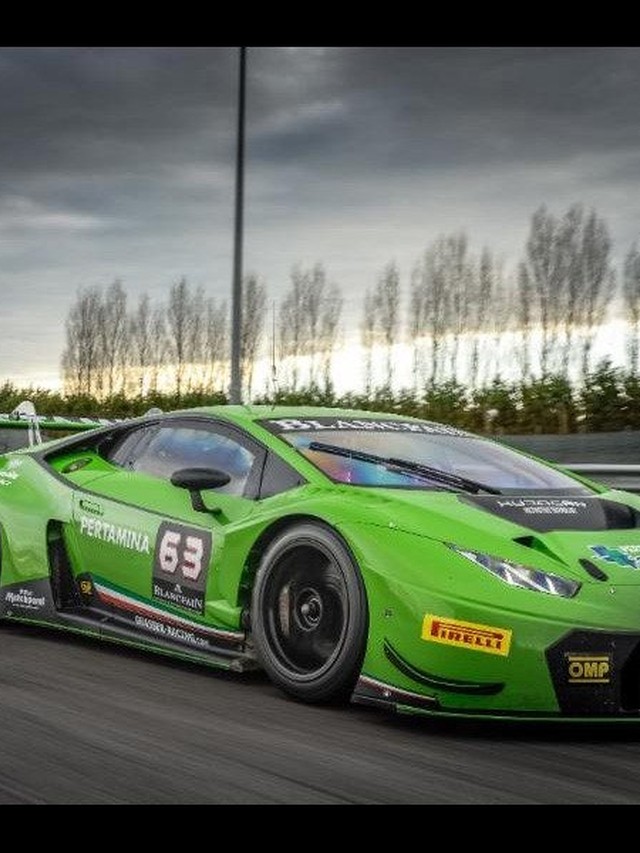
The Lamborghini Huracán GT3 race car, number 63, showcases its speed on the track under a dynamic sky.
The Competitive Landscape: Lamborghini’s GT3 Position Among Rivals
GT3 racing in 2015 was becoming one of the most competitive categories in global motorsport, with factory-backed entries from Porsche, Ferrari, McLaren, Audi, BMW, and Mercedes-AMG all vying for customer team loyalty. Lamborghini’s decision to bring the process in-house with the Huracán GT3 was a statement about where the brand saw itself heading.
The practical challenge for any GT3 manufacturer is that Balance of Performance regulations deliberately equalize the field, so raw horsepower advantages are fleeting. The real competitive differentiators become drivability, reliability, running costs, and the quality of factory support. Lamborghini Squadra Corse is reported to offer comprehensive customer support, including technical assistance and racing parts programs, a critical factor for the gentleman drivers and privateer teams that form the backbone of GT3 grids worldwide.
Reports indicate the Huracán GT3 was slated to make its North American GT3 racing debut in 2016 in the IMSA WeatherTech SportsCar Championship’s GTD class, which would pit it directly against established rivals on circuits like Daytona, Sebring, and Watkins Glen. The car’s European Blancpain campaign served as a proving ground, but the American market, with its deep pool of wealthy amateur racers and professional teams, represented the larger commercial opportunity.
One racing database notes the Huracán GT3 eventually secured multiple victories, including class wins at the Daytona 24 Hours and Sebring 12 Hours, along with championships in series like the Blancpain GT and Pirelli World Challenge. Those results validated the in-house approach and kept the Lamborghini brand visible in the most prestigious endurance events in the world.
What the Huracán GT3 Started, and Where That Path Leads
The Huracán GT3‘s North American debut at Laguna Seca looks, in retrospect, like the opening chapter of a longer story about Lamborghini’s transformation into a serious motorsport manufacturer. The car served Lamborghini for a decade in various evolved forms, an unusually long lifecycle in GT3 racing. Car and Driver reports that the Temerario GT3, revealed at the 2025 Goodwood Festival of Speed, is the first Lamborghini competition car entirely designed, developed, and produced in-house from its inception, conceived in parallel with the road car from the earliest development stages.
That parallel-development approach would not have been possible without the institutional knowledge Lamborghini accumulated through the Huracán GT3 program. Each evolution of the car, from the original to the EVO and EVO2 specifications, pushed more engineering capability inside Sant’Agata’s walls. The Temerario GT3 is the payoff.
For Lamborghini owners and enthusiasts who followed the brand during the years when “Lamborghini racing” meant the Gallardo Super Trofeo and not much else, the Huracán GT3 program represented a genuine change in ambition. The car that sat in the Blancpain Village at Laguna Seca in 2015 was not just a display piece. It was the prototype for a strategy that now defines how Lamborghini competes globally.
One detail worth noting for anyone tracking the market: one racing database lists a current value of $295,000 for the Huracán GT3. Whether that figure reflects a specific specification or era is unclear, but it provides a reference point for the kind of investment required to participate in Lamborghini’s GT3 ecosystem. The real cost extends well beyond the purchase price into spares, engineering support, entry fees, and the inevitable attrition of competitive endurance racing. Lamborghini’s hospitality may be polished, but the racing itself remains an expensive and demanding pursuit.


