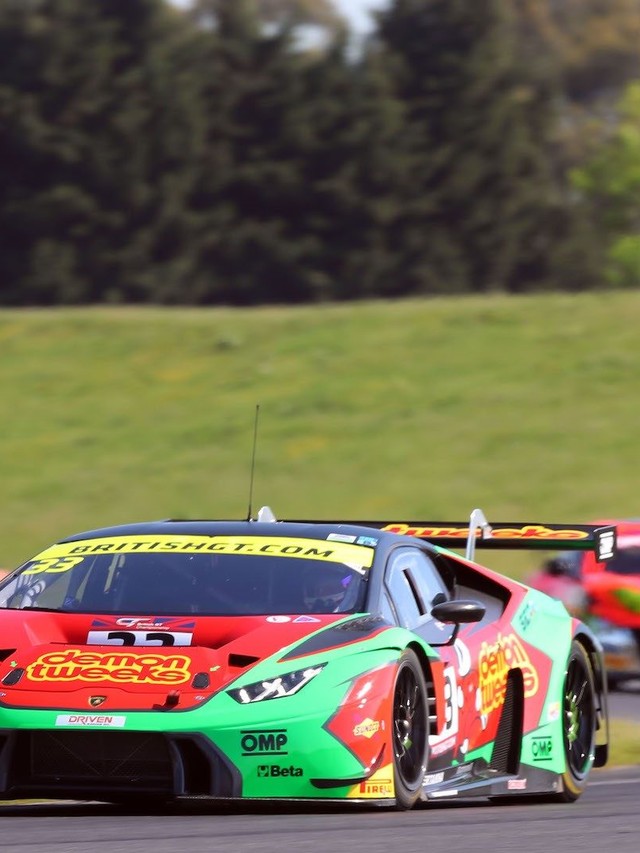
Three Wins From Six Races: Barwell’s Huracán GT3 Commands the British GT
Six races into the 2017 British GT Championship season, Barwell Motorsport’s Lamborghini Huracán GT3 owned the standings. Jon Minshaw and Phil Keen, the 2016 vice-champions who came agonizingly close to the title a year earlier, took victory in Race 1 of the Snetterton 300 on May 28th to claim their third win of the campaign, following a double victory at Oulton Park the previous April. The result left them leading the drivers’ championship by 23.5 points, while Barwell’s advantage in the teams’ standings sat at a commanding 46 points.
The Minshaw/Keen car qualified on pole ahead of Aston Martin and Bentley entries, then converted that pace into a Race 1 win with Barwell’s sister Huracán GT3 #6, driven by Liam Griffin and Sam Tordoff, completing a 1-2 lockout. That kind of formation finish, where a single customer team fills the top two positions against manufacturer-supported rivals, speaks to something deeper than one fast car on one good day. It points to a platform that gives privateer squads genuine, repeatable performance.
Race 2 told a more complicated story. Minshaw and Keen led until a drive-through penalty for exceeding the time limit during their driver change dropped them to sixth. Griffin and Tordoff, meanwhile, collected another second-place finish. The penalty stung, but it barely dented the championship arithmetic. Barwell left Snetterton with a bigger gap than it arrived with, and the Huracán GT3 remained the car to beat.
Why Customer Racing Wins Carry More Weight Than Factory Trophies
Lamborghini’s motorsport operation, Squadra Corse, builds the Huracán GT3 and sells it to independent teams. Barwell Motorsport runs the cars, hires the engineers, manages the strategy, and writes the checks. When Barwell wins, it validates something a factory-backed effort cannot: the car works in somebody else’s hands, with somebody else’s budget, under somebody else’s operational pressure.
For prospective GT3 buyers evaluating which manufacturer’s car to campaign, this distinction matters enormously. A factory team can mask a car’s weaknesses with unlimited resources and dedicated engineering support. A privateer team exposes them. Barwell’s success through the first half of 2017, with wins at Oulton Park and Snetterton against Aston Martins, Bentleys, and the rest of the British GT field, functioned as a live, public reliability and performance audit of the Huracán GT3 platform.
The season-long rivalry between Minshaw/Keen and the Team Parker Racing Bentley Continental GT3 of Seb Morris and Rick Parfitt Jr. underscored just how competitive the British GT grid actually was. Beating factory-supported Bentley and Aston Martin programs with a customer-run Lamborghini carried real credibility, the kind that no press event or spec sheet can replicate. Every Barwell podium was, in effect, a sales pitch written in lap times rather than marketing copy.
The Huracán GT3’s Engineering Argument
The platform drew from Lamborghini’s naturally aspirated V10, a powerplant whose linear delivery and predictable throttle response made it forgiving for the amateur-professional driver pairings that define much of British GT’s Pro-Am format. A gentleman driver like Jon Minshaw, fast and experienced but not a professional, benefits enormously from an engine that delivers its power in a smooth, progressive curve rather than arriving in a sudden turbo-assisted rush.
The car’s aluminum spaceframe chassis, adapted from the road-going Huracán, provided a stiff, lightweight foundation that teams could set up without exotic tooling. Aerodynamic elements, including the prominent rear wing and aggressive front splitter visible on Barwell’s race cars, generated significant downforce within GT3 regulations. Combined with relatively straightforward maintenance requirements compared to some rival platforms, the Huracán GT3 became a car that smaller teams could operate competitively without bleeding money.
Car and Driver reports the later Huracán Super Trofeo Evo2, a related one-make racing variant, produced 612 hp and weighed approximately 2,950 lb. The GT3 version ran under Balance of Performance regulations that equalize cars across manufacturers, but the underlying mechanical quality of the platform, its structural rigidity, cooling efficiency, and suspension geometry, still determined how well a team could exploit the allowed performance window. Barwell’s Snetterton pole and 1-2 finish suggested they were exploiting it better than anyone.
Barwell’s Lamborghini Legacy in British GT
Barwell Motorsport did not stumble into this success. The Norfolk-based team built a sustained relationship with Lamborghini’s customer racing program, campaigning Huracán GT3s in the British GT Championship from 2016 onward and accumulating multiple team and driver championship results across several seasons.
The Minshaw/Keen pairing exemplified the Pro-Am model at its best. Keen, a professional with deep experience in GT racing, provided the qualifying pace and race-craft that put the car in contention. Minshaw, the gentleman driver and team backer, proved quick enough to hold position and manage traffic during his stints. Their 2016 vice-championship showed the combination worked. The 2017 Snetterton result, building on the Oulton Park double victory earlier that spring, suggested they had refined the formula further.
This is where the privateer argument comes full circle. Barwell’s operational knowledge of the Huracán GT3, accumulated across hundreds of race laps and multiple championship campaigns, fed back into the broader ecosystem of teams running the car worldwide. When a team like Barwell wins consistently, it raises the profile of the entire platform and attracts new customers to Squadra Corse’s order book. The car’s accessibility made Barwell’s success possible; Barwell’s success, in turn, made the car more attractive to the next buyer.
Measuring Up Against the Grid
The 2017 British GT field included serious competition. Aston Martin’s Vantage GT3 and Bentley’s Continental GT3 both benefited from significant manufacturer support, and the Bentley program in particular posed a season-long threat. Minshaw and Keen beating both marques to pole position at Snetterton, then converting that into a race win, illustrated the Huracán GT3’s raw pace on a circuit that rewards aerodynamic stability through its fast sweeping corners.
Lamborghini’s position in GT3 racing during this period was that of a relatively young entrant proving it belonged among established competitors. Ferrari, Porsche, and Mercedes-AMG all fielded GT3 machinery in various global championships. Lamborghini’s approach, relying heavily on customer teams rather than factory-backed megaprograms, meant every result carried outsized significance. A Barwell win at Snetterton validated the car’s competitiveness in a way that a factory team’s victory, with all its built-in resource advantages, simply could not.
For buyers considering a GT3 program, the practical takeaway from Barwell’s 2017 campaign was clear: the Huracán GT3 could win races and contend for championships without requiring the budget or infrastructure of a factory operation. That accessibility, combined with genuine pace, defined Lamborghini’s appeal in the customer racing market and gave Snetterton’s result a significance well beyond a single weekend in Norfolk.
From Snetterton to Sant’Agata: The Huracán GT3’s Long Legacy
The Huracán GT3 that Barwell campaigned at Snetterton in 2017 was the beginning of a lineage, not an endpoint. The platform evolved through the GT3 Evo and GT3 Evo2 variants, each refining aerodynamics, cooling, and setup flexibility while retaining the naturally aspirated V10 at its core. Lamborghini kept updating the same fundamental car for a full decade, a testament to how sound the original engineering was.
As Road & Track noted in its analysis of the successor program, eleven different brands introduced entirely new GT3 cars during the Huracán’s tenure. Porsche alone released three separate generations of GT3 machinery in the same period. Lamborghini’s ability to remain competitive with evolutionary updates rather than clean-sheet redesigns speaks to the quality of the original concept.
The Temerario GT3, now set to replace the Huracán platform, represents a fundamental shift. It marks the first race car entirely designed and developed in-house at Lamborghini’s Sant’Agata Bolognese facility, swapping the naturally aspirated V10 for a modified twin-turbocharged engine with the road car’s hybrid system stripped per GT3 regulations. The transition from atmospheric V10 to forced induction will change the character of the car significantly, and teams that built their programs around the Huracán’s predictable power delivery will need to adapt to an entirely different powertrain philosophy.
Barwell’s 2017 Snetterton victory sits in a specific historical context now: it was part of the campaign that proved the Huracán GT3 could anchor a championship-winning program in customer hands, a proof of concept Lamborghini built upon for nearly a decade. The team ultimately clinched the GT3 Teams’ title that year, according to available reporting. The Temerario GT3 inherits that expectation. Whether it can match the Huracán’s accessibility and reliability for privateer teams while delivering the performance gains that turbocharging promises remains the open question. What Barwell proved at Snetterton, and across the 2017 season, was that Lamborghini’s customer racing model worked. The Temerario will need to prove the same thing all over again.
Gallery


