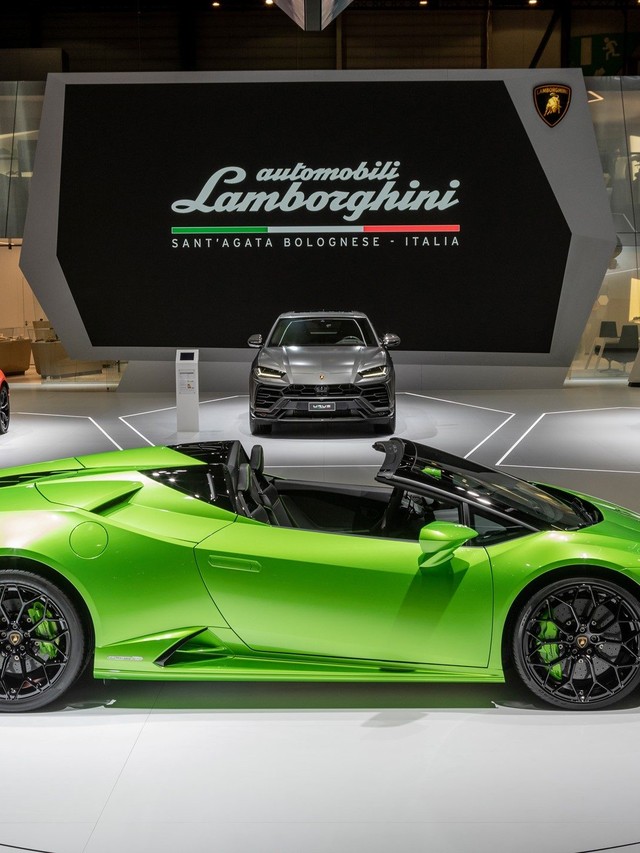
Lamborghini’s Dual Asian Debut at Auto Shanghai 2017
Lamborghini brought the Huracán Performante and the Aventador S to Auto Shanghai 2017 for their Asian premieres, flanked by the Huracán RWD Coupé and RWD Spyder. The choice to debut both cars simultaneously in Shanghai, rather than stagger them across separate regional shows, tells you something about how seriously Sant’Agata viewed the Greater China market by mid-2017.
The regional strategy, though, only frames the deeper story. These two cars represent fundamentally different engineering arguments about how to extract more performance from a supercar. The Performante bets on aerodynamics as the primary lever. The Aventador S bets on chassis geometry. Both approaches worked, and both would feed directly into later models like the Aventador SVJ and the Huracán STO, making this dual premiere less a product launch than the opening chapter of a technology pipeline that still influences Lamborghini today.
Two Engineering Philosophies Under One Roof
Lamborghini could have simply bolted a bigger wing onto the Huracán and called it a day. Instead, the Performante introduced a genuinely novel aerodynamic system, while the Aventador S tackled the V12 flagship‘s long-standing handling character through mechanical means. The pairing was deliberate: one car aimed at lap-time obsessives, the other at drivers who wanted V12 theater with more composure.
For buyers shopping in 2017, the decision came down to philosophy more than price bracket. The Performante rewarded precision and commitment on track. The Aventador S rewarded owners who craved the visceral, old-school V12 experience with enough modern chassis technology to keep the car from feeling agricultural. Some owners on enthusiast forums describe the Aventador S as more brutal and less of a daily driver, noting its heavy character compared to the lighter Huracán variants. That rawness is precisely the point for a certain kind of buyer, and it explains why Lamborghini needed both cars on the same stand to tell a complete story about where the brand was heading.
Huracán Performante: What ALA Actually Does
Aerodinamica Lamborghini Attiva, abbreviated ALA (Italian for “wing”), is the technology that earned the Performante its Nürburgring production car lap record of 6:52.01 minutes. Most coverage at the time focused on the lap time itself. The mechanism behind it deserves closer attention, because it became the seed for Lamborghini’s broader aero strategy.
Lamborghini says the ALA system uses electronically controlled flaps built into both the front splitter and the rear wing, all constructed from the company’s proprietary Forged Composites material. When the flaps close, air flows over the wing surfaces to maximize downforce for cornering. When they open, air passes through the wing structure, stalling it and slashing drag for straight-line speed. The electronic actuators controlling these flaps weigh significantly less than conventional hydraulic systems, which matters when you are counting grams on a car designed to chase tenths of a second.
The genuinely clever part is what Lamborghini calls “aero vectoring.” During a corner, the system can open the flap on one side of the rear wing independently, reducing downforce on the inside rear wheel while maintaining full downforce on the loaded outside wheel. The result is an aerodynamic yaw moment that supplements the mechanical grip of the tires, effectively steering the car with air pressure. Think of it as a differential that operates above the car rather than between the axles. That capability allowed the Performante to carry higher cornering speeds with less steering input, a direct contributor to the Nürburgring time.
The record grabbed headlines, but the engineering underneath it mattered more for Lamborghini’s trajectory. ALA evolved into ALA 2.0 for the later Aventador SVJ, proving that the technology scaled across platforms and engine configurations.
Aventador S: Teaching a V12 Flagship New Geometry
Where the Performante manipulated air, the Aventador S tackled a different problem entirely. The original Aventador LP 700-4 delivered staggering straight-line performance but could feel unwieldy at lower speeds, a consequence of its long wheelbase and considerable mass. Lamborghini’s solution for the S was four-wheel steering, a first for a series-production Lamborghini.
At low speeds, the rear wheels turn in the opposite direction to the fronts, effectively shortening the car’s turning circle and making it feel more agile in tight corners and parking garages, a practical concern for anyone who actually drives a V12 Lamborghini in a city. At higher speeds, the rear wheels turn in the same direction as the fronts, improving stability during lane changes and fast sweepers. The system works in concert with the car’s four-wheel-drive system and a new EGO driving mode that Lamborghini says allows owners to independently configure steering, suspension, and powertrain responses rather than choosing from preset profiles.
The naturally aspirated V12 produces 740 hp, reaches 100 km/h in 2.9 seconds, and tops out at 350 km/h. Those numbers represent a 40 hp bump over the original LP 700-4, but the chassis changes matter more than the power increase. Four-wheel steering transformed the Aventador from a car you managed into a car you drove with genuine confidence, particularly on roads that did not resemble an airstrip. If ALA proved aerodynamics could function as a dynamic chassis tool, four-wheel steering proved that even Lamborghini’s heaviest, most theatrical car could gain real agility without sacrificing its character.
Why Shanghai, and Why Both Cars at Once
Lamborghini identifies Greater China as a key market, and premiering both flagship-level models simultaneously in Shanghai rather than reserving one for a European show underscored that commitment. Francesco Scardaoni, Lamborghini’s Managing Director of Greater China at the time, framed the dual debut as evidence of the brand’s long-term investment in the region.
The product mix on the stand told a specific story. The Performante appealed to track-minded collectors, a growing segment in China’s maturing supercar market. The Aventador S targeted buyers drawn to the drama and exclusivity of a V12 flagship. Rounding out the display, the Huracán RWD Coupé and RWD Spyder offered naturally aspirated V10 power with rear-wheel-drive dynamics and convertible lifestyle appeal, covering the entry points into the Lamborghini range. Pricing for the Chinese market was not disclosed at the event, and allocation details remain unconfirmed, but the simultaneous debut itself carried the message: Chinese customers would receive the same products and priority as European or American buyers.
The Bigger Engineering Legacy
Looking back from 2025, the Shanghai 2017 debut reads as a pivot point. ALA proved that active aerodynamics could be lightweight, effective, and production-viable on a mid-engine V10 platform. Four-wheel steering proved that a heavy, theatrical flagship could gain genuine agility without losing its soul. Both technologies fed directly into subsequent models.
The Performante’s aero vectoring concept matured into the Aventador SVJ’s ALA 2.0 system, and the philosophy of using aerodynamics as a dynamic chassis tool continues to influence how Lamborghini approaches its current hybrid-era cars. The Aventador S’s four-wheel steering validated a technology that competing brands adopted more aggressively in the years that followed, confirming Lamborghini’s instinct was correct even if the execution arrived on a platform some considered overdue for the upgrade.
For enthusiasts who care about the engineering genealogy of current Lamborghini models, Shanghai 2017 is where two critical threads started weaving together. The lap times and the market strategy were the visible results. The real product was the technology pipeline, and every Lamborghini that has followed carries its fingerprints.


