The Myth of the Destroyed Miura: Setting the Record Straight
For more than half a century, one of the most persistent myths in automotive cinema held that Paramount Pictures destroyed a Lamborghini Miura P400 while filming the opening sequence of the 1969 classic The Italian Job. The scene is seared into the memory of anyone who loves cars: an orange Miura gliding through alpine tunnels on the Great St Bernard Pass, Rossano Brazzi behind the wheel, Matt Monro crooning “On Days Like These” on the soundtrack. Then the ambush, the explosion, the car tumbling off the mountainside. Audiences winced. Enthusiasts mourned. And for decades, the story calcified into accepted fact: Paramount wrecked a real Miura for a few seconds of celluloid drama.
Lamborghini says otherwise. Through archival research and firsthand testimony, the company’s heritage division, Polo Storico, confirmed that the orange Miura seen driving through those tunnels was never harmed. The car that tumbled off the cliff was a separate vehicle, already heavily damaged before the cameras ever rolled. Two Miuras, not one, made that film possible. The driving car returned to Sant’Agata Bolognese in perfect condition, was delivered to its first owner, and went on to live a quiet life across multiple collections for nearly five decades before Polo Storico tracked it down and certified its identity.
The distinction transforms the car from a tragic footnote into a verified survivor with extraordinary provenance, and it anchors a larger story about how Lamborghini now uses its heritage program to protect the truth behind its most celebrated machines.
From Sant’Agata to the Set: How Two Miuras Became One Cinematic Legend
The logistics of getting a Miura onto a film set in the late 1960s were more pragmatic than romantic. Paramount Pictures contacted Automobili Lamborghini directly, looking for a car to use in the production. When the studio’s representatives arrived at the factory in Sant’Agata Bolognese, they settled on an orange Miura that was already badly wrecked, its body damage making it suitable for the crash sequence without sacrificing a working car. That wreck became the prop pushed off the mountain. Nobody at Lamborghini would have really ruined what was the most desired car of the moment.
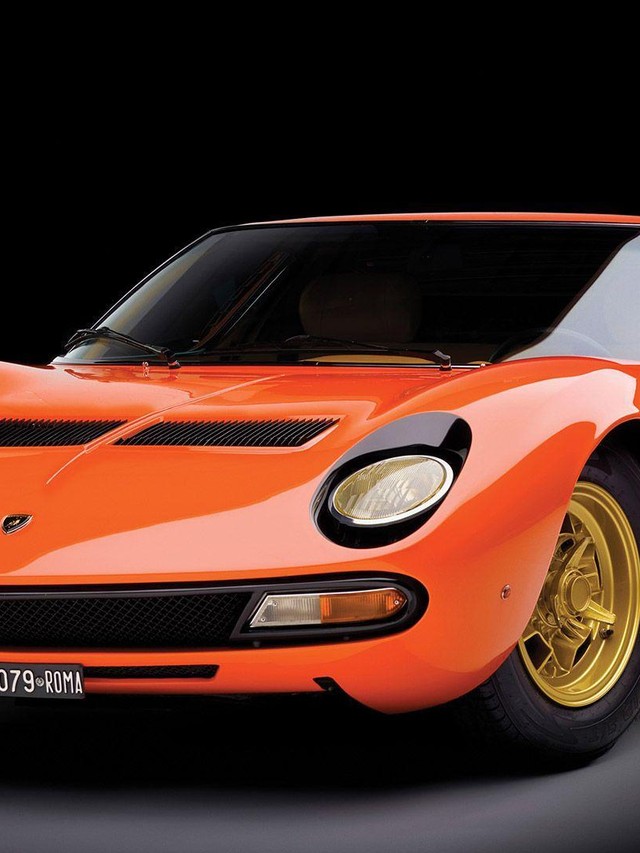
But the film also needed a Miura that could actually drive. Enzo Moruzzi, who regularly transported cars to clients and film sets for Lamborghini, recalled that a Miura P400 sitting nearly complete on the production line happened to match the damaged car’s color, configuration, and interior. It was finished in Arancio Miura, the factory’s own shade of orange, left-hand drive, with a white leather interior. Moruzzi arranged for this car to serve as the driving double.
The factory’s one concern was protecting that white leather. Moruzzi’s solution was straightforward: pull the white seats and substitute a set of black leather test seats. The swap worked for the body of the car, but the Miura’s headrests are mounted to the glass divider between the cabin and the engine bay, not to the seats themselves. Those could not be changed in time. Watch the film closely and the white headrests are visible against the black seats, a small continuity detail that became, decades later, one of the forensic clues Polo Storico used to confirm the car’s identity.
It is a wonderfully practical bit of 1960s filmmaking. No CGI, no elaborate stunt doubles. Just a factory finding a nearly identical car on its own assembly line and a delivery driver careful enough to insist on protecting the upholstery.
The Unseen Star: Why Lamborghini Saved the Real One
Paramount also depicted an identical, crashed Miura for the destruction scene, but the decision to use a pre-damaged car rather than sacrifice a functioning P400 reveals something about how Lamborghini viewed its own product even in 1968. The Miura was already the most pursued car of its era, and the factory understood that destroying one for a film would have been an act of vandalism, not showmanship. By offering a wreck for the stunt and pulling a production-line car for the driving sequences, Sant’Agata protected both its inventory and, inadvertently, a future piece of automotive history.
The arrangement also speaks to the informal, almost familial way Lamborghini operated in its earliest years. Moruzzi was not a logistics coordinator in any modern corporate sense. He was a trusted figure who knew the cars, knew the factory floor, and could spot a color match on the production line without consulting a database. His instinct to swap the seats, and the physical evidence that swap left behind in the form of mismatched headrests, would prove decisive half a century later when Polo Storico set out to verify the car’s identity.
A Life After Film: The Orange Miura’s Journey Through Decades of Ownership
Once filming wrapped, the driving Miura returned to Sant’Agata, its white seats were reinstalled, and the car was prepared for delivery to its first buyer, an Italian collector based in Rome. From that point, the car’s cinematic past faded into obscurity. Lamborghini says the P400 passed through the hands of multiple enthusiasts, both Italian and international, over the following decades. For most of that time, its owners may not have known what they had.
That changed in 2018 when the car was acquired by Fritz Kaiser, a Liechtenstein-based collector who also founded The Classic Car Trust. Kaiser’s purchase set the stage for a proper investigation into the car’s history, one that would ultimately involve Lamborghini’s own archives and the memories of people like Moruzzi who were present at the factory when the film was made.
The Miura’s journey mirrors a pattern familiar to anyone who follows the classic Lamborghini market. Many significant cars from the 1960s and 1970s spent years in relative anonymity, their provenance unrecognized or poorly documented, before the explosion in classic supercar values brought intense scrutiny to chassis histories. Forum discussions among Miura enthusiasts frequently revolve around identifying specific chassis numbers, matching interior specifications to factory records, and debating which cars retain original components. For a car with this particular story, the difference between “believed to be” and “factory certified” represents an enormous leap in both historical significance and collector confidence.

The iconic Lamborghini Miura P400, certified by Polo Storico, gleams in Arancio Miura within a pristine studio setting.
Polo Storico’s Seal of Authenticity: Preserving Cinematic and Automotive Heritage
Lamborghini’s heritage department, Polo Storico, was established in 2015 with a specific mandate: restore and certify all Lamborghinis produced before 2001, manage the company’s historical archives, and reconstruct spare parts for classic models. The division introduced more than 200 new part code numbers in 2018 alone, a figure that speaks to the depth of its commitment to keeping these cars on the road with authentic components.
For this particular Miura, certification represented something more than standard authentication. Factory certification from Polo Storico signifies a documented chain of provenance, authentic materials sourcing, and thorough historical research. In this case, that research included cross-referencing archival production records, examining the physical car, and interviewing former employees who were directly involved in the filming. The white headrests, the Arancio Miura paint, the left-hand-drive configuration, the white leather interior specification: each detail was checked against factory documentation.
What sets this case apart from routine heritage work is the specificity of the claim. Polo Storico is not simply confirming that a car left the factory in a certain color with a certain engine. It is confirming a narrative, tying a specific chassis to a specific cultural moment, supported by testimony from the people who were in the room when the decision was made. Ferrari Classiche operates a similar certification service for pre-modern Ferraris, and Porsche Classic offers comparable authentication for its historical models. But few heritage cases anywhere in the collector car world carry this kind of cinematic weight.
Why This Miura Matters: The Enduring Legacy of a Car, a Film, and a Brand
The Miura’s cultural gravity extends well beyond a single film appearance. The car is widely recognized for defining the modern supercar, primarily due to its revolutionary mid-engine layout, a configuration conceived as an after-hours project by engineers Giampaolo Dallara, Paolo Stanzani, and test driver Bob Wallace, initially without the blessing of Ferruccio Lamborghini himself. Marcello Gandini’s design for Bertone gave the car a shape that remains, by broad consensus among enthusiasts and the automotive press, one of the most beautiful ever produced. Multiple owners on enthusiast forums describe the Miura as the most visually perfect car ever designed, a sentiment that surfaces with remarkable consistency across decades of discussion.
The P400’s transversely mounted 3.9-liter V12 produced 350 PS and could push the car to a top speed that made it the fastest production car in the world at the time of its release. Those numbers feel modest by modern standards, but the architecture they enabled changed everything that followed. Every mid-engine Lamborghini since, from the Countach through the Diablo, the Murciélago, and on to the current Revuelto, traces its fundamental layout philosophy back to the Miura.
The opening sequence of The Italian Job embedded the car in a broader cultural consciousness, reaching audiences who might never visit a motor show or read a road test. That the car survived, rather than being sacrificed for entertainment, feels appropriate. The Miura was too important to destroy, and the people at Sant’Agata in 1968 knew it.
For anyone watching the classic Lamborghini market, this certification reinforces a trend that shows no sign of slowing. Provenance documentation, particularly from factory heritage programs, increasingly separates the cars that command the highest prices from those that merely present well. A Miura with standard factory records is already a seven-figure car. It polo Storico certification and a verified connection to one of the most famous automotive film sequences ever shot occupies a different category entirely. Lamborghini has not disclosed the current market value of this specific car, and no public sale is indicated.
By investing in stories like this one, Polo Storico does more than authenticate individual cars. It reinforces the idea that Lamborghini’s history is worth preserving with the same rigor the company applies to engineering its current models. The Miura that drove through the tunnels of the Great St Bernard Pass in 1968 was never meant to be a museum piece. It was a production car, pulled off the line, pressed into service, and returned to begin its life as someone’s daily driver. That it survived long enough to be found, certified, and celebrated says something about the durability of both the car and the legend.


