3,245 Cars and a Clear Signal: Lamborghini’s 2015 Record Was Just the Down Payment
Lamborghini reported 3,245 vehicles sold globally in 2015, an all-time record that represented a 28 percent jump over the previous high of 2,530 units set in 2014. The numbers were impressive on their own, but the company treated them less as a victory lap and more as a funding mechanism. In the same announcement, Lamborghini confirmed plans to double its production site from 80,000 square meters to 150,000 square meters and hire 500 additional staff, all to support a single forthcoming model: the Urus.
Then-CEO Stephan Winkelmann framed the investment explicitly around the SUV. Over 150 permanent employees joined in 2015 alone, spanning assembly line workers, technicians, and R&D specialists, bringing the five-year hiring total past 600. Another 30 production workers followed in January 2016. Of the 500 Urus-specific hires, 180 contracts were already finalized. For a company whose total headcount stood at 1,300, committing to grow the workforce by nearly 40 percent for one vehicle was not incremental planning. It was a strategic pivot.
Why an SUV, and Why the LM002 Comparison Only Goes So Far
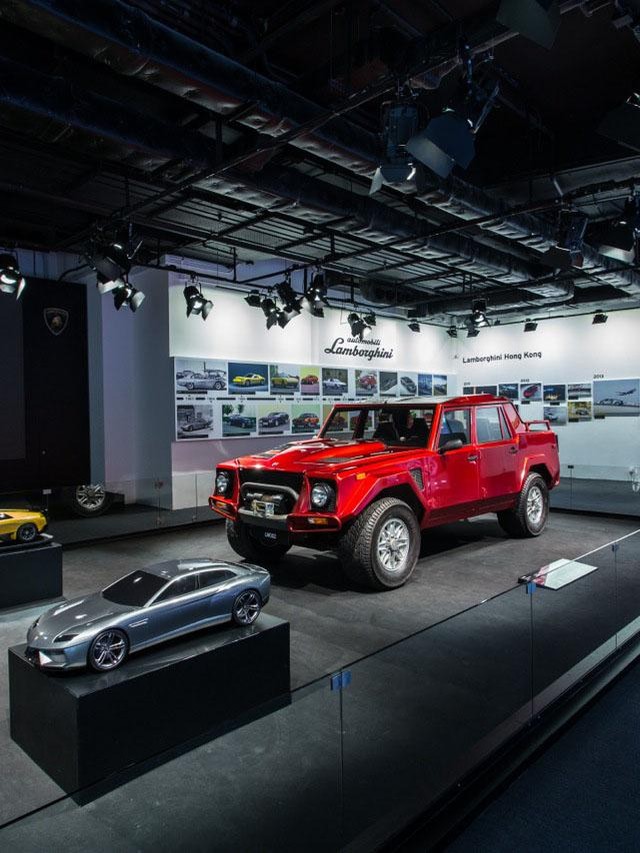
Lamborghini purists sometimes point to the LM002 as proof the brand tried an off-road vehicle before. The comparison is useful but limited. The LM002 was a military-contract offshoot repurposed for civilian sale in small numbers during the late 1980s. It occupied no defined luxury segment, competed with nothing directly, and disappeared without reshaping the company’s finances or identity.
The Urus was conceived as something entirely different: a volume anchor. Lamborghini positioned it as a “super sports SUV” that would join the Huracán and Aventador as the brand’s third model line. Where the LM002 was an eccentric sideshow, the Urus was designed from the outset to outsell both supercars combined. The factory expansion alone telegraphed the ambition. Doubling production space does not happen for a niche curiosity.
Porsche demonstrated the template years earlier with the Cayenne, proving that a performance SUV could fund sports car development without diluting the core brand over time. Lamborghini, operating within the Volkswagen Group, had access to platform-sharing advantages that made the economics even more favorable. The question for enthusiasts was never whether the Urus would sell. It was whether the brand’s identity could absorb the shift.
People First, Then Concrete
What most coverage of Lamborghini’s expansion missed was the sequencing. The company invested in people before it invested in square meters. The hiring surge in 2015 and early 2016 focused on quality, R&D, purchasing, industrial management, and technical production staff, the kinds of roles that define how a car is engineered and built, not just how many roll off a line.
For a manufacturer building roughly 10 cars per day at 2015 volumes, scaling to accommodate an entirely new model with different construction methods, different supply chains, and a different customer demographic is an enormous operational challenge. Luxury automakers cannot simply add a shift and hire temps. Every additional worker at Sant’Agata Bolognese needs to understand carbon fiber layup tolerances, leather-stitching standards, and the particular obsessiveness that separates a Lamborghini interior from a mainstream product. The 500-person hiring plan was not a staffing exercise. It was a quality-preservation strategy disguised as a headcount number.
Buyers who spec a Urus through Ad Personam or who order a limited Huracán variant benefit from this investment in ways that never appear on a spec sheet. The depth of a company’s skilled workforce determines whether a bespoke paint finish is flawless or merely acceptable.
How the Urus Reshaped Lamborghini’s Competitive Position
By 2015, the luxury performance SUV segment was no longer theoretical. Porsche’s Cayenne and Bentley’s Bentayga had proven the business case. Ferrari’s eventual entry with the Purosangue was still years away. Lamborghini’s timing gave it a first-mover advantage among true supercar brands, a window to establish the Urus before Maranello could respond.
The gamble paid off spectacularly. The Urus, upon its 2018 release, featured a 4.0-liter twin-turbocharged V8 delivering 641 horsepower and 627 lb-ft of torque, and it quickly became Lamborghini’s best-selling model in the United States. By 2021, Lamborghini delivered 8,405 cars globally, with the Urus accounting for 5,021 of them. According to Car and Driver, the company surpassed 10,000 annual deliveries for the first time in 2023, reaching 10,112 units. The Urus made up more than half of that total.
For context, the entire company sold 1,305 cars in 2003. Two decades later, the Urus alone outsells what the whole brand once managed in a year.
The Practical Takeaway for Enthusiasts
The 2015 expansion story matters today because it explains why Lamborghini can afford to build cars like the Revuelto and the Temerario. SUV profits fund supercar ambition. Without the Urus, the naturally aspirated V12 flagship and the high-revving hybrid V8 in the Temerario would face much harder business-case scrutiny inside the Volkswagen Group.
Lamborghini’s leadership has since confirmed, per Road & Track, that no second SUV is planned. The Urus remains the volume model, and the company intends to cap production rather than chase unlimited growth. That discipline traces directly back to the 2015 philosophy: invest massively in one strategic bet, then protect exclusivity everywhere else.
For current and prospective owners, the implication is straightforward. The Urus did not dilute Lamborghini. It underwrote the brand’s ability to keep building uncompromising supercars. The factory expansion that started with a 2015 sales record turned out to be the most consequential infrastructure decision in Lamborghini’s modern history.
Gallery


