Lamborghini’s Nürburgring Breakthrough: The First Endurance Cup Win of 2021
On September 5, 2021, the #63 Orange 1 FFF Racing Team Lamborghini Huracán GT3 Evo crossed the finish line at the Nürburgring 1.228 seconds clear of the field, giving Lamborghini its first Fanatec GT World Challenge Europe Endurance Cup victory of the season. Factory drivers Mirko Bortolotti, Andrea Caldarelli, and Marco Mapelli shared the cockpit, breaking a streak of frustrating near-misses at Monza, Paul Ricard, and Spa-Francorchamps earlier that year.
The result carried extra weight because of the car’s pedigree. Lamborghini says the #63 entry previously secured the Teams, Endurance, and Overall GT World Challenge Europe titles in 2019. Returning to the top step after a winless start to 2021 validated both the platform and the driver lineup at a moment when confidence could easily have eroded. What makes the victory worth revisiting is where those same names and that same engineering philosophy ended up: the Huracán GT3 EVO2, the SC63 LMDh prototype, and the forthcoming Temerario GT3. This single race weekend crystallized the factory program’s strengths and foreshadowed the trajectory Squadra Corse would follow for years afterward.
Qualifying Pace and Race Execution: A Masterclass in Three Stints
Before the race even started, the trio made a statement. Lamborghini confirmed that the combined qualifying session yielded their third Endurance Cup pole position in four races, a qualifying conversion rate that speaks to raw single-lap speed rather than race-day luck.
Mapelli opened the race and stretched the gap to over two seconds ahead of Raffaele Marciello in the AKKA ASP Mercedes. Caldarelli then took over at the one-hour pit stop and built the advantage to more than 20 seconds, a margin large enough to absorb almost any disruption. That cushion proved essential. Two separate full-course yellow periods compressed the field and forced safety car restarts during Bortolotti’s closing stint. Each time, Bortolotti pulled away cleanly, rebuilding the gap until the checkered flag.
Pole position in endurance racing is useful, but it rarely wins the race alone. Building a 20-second cushion through the middle stint, then surviving two neutralizations, required the kind of setup consistency and driver discipline that separates factory programs from talented privateers. The pattern here, qualifying dominance paired with race-long tire and fuel management, is precisely the institutional knowledge that Squadra Corse would carry forward into every subsequent GT3 campaign.

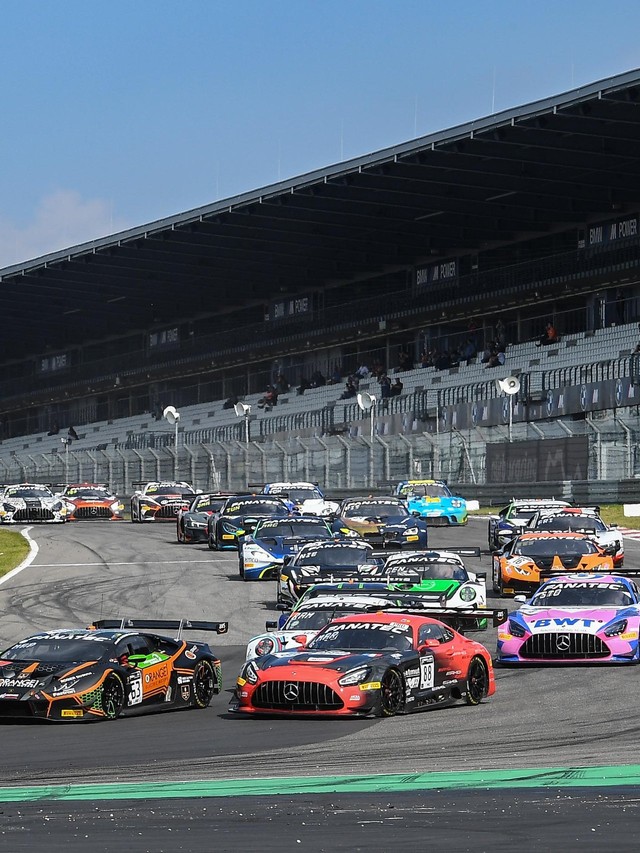
A fleet of GT race cars, led by a Lamborghini Huracán GT3 Evo, charges through a turn at the Nürburgring circuit.
The Huracán GT3 Evo: Why the Platform Kept Winning
The Huracán GT3 Evo sat at the heart of Lamborghini’s customer racing ecosystem for years, and this Nürburgring result illustrated why teams kept betting on it. One web source notes that engineers shifted the aerodynamic downforce balance more toward the front (roughly 40 percent, compared to 33 to 34 percent on the original GT3) to improve front-to-rear balance and drivability. Four-way adjustable Öhlins dampers and a raised roll center contributed to reduced body roll and more predictable handling, refinements that pay dividends over a three-hour race.
Lamborghini did not stop there. According to IMSA, the subsequent Huracán GT3 EVO2 introduced a new splitter, rear diffuser, carbon fiber floor, updated braking system, and 10 electronically actuated throttle bodies feeding the 5.2-liter naturally aspirated V10 with titanium valves. IMSA reports the EVO2 produces 640 horsepower. That car made its competition debut at the 2023 Rolex 24 At Daytona, and Caldarelli, one of the three Nürburgring winners, helped develop it. The continuity between the people who won this race and the people who shaped the next-generation platform is not a coincidence. It is how Squadra Corse operates, feeding race-weekend lessons directly into the engineering pipeline so each evolution of the car arrives sharper than the last.

Three Lamborghini race drivers, wearing their team gear and orange masks, pose for a photo in the pit garage.
Sweeping the Classes: Silver Cup, Pro-Am, and Esports
The overall win was only part of the story. Emil Frey Racing’s Ricardo Feller, Rolf Ineichen, and Alex Fontana claimed a Silver Cup class victory, their second Endurance Cup class win of the year. FFF Racing’s Phil Keen, Stefano Constantini, and Hiroshi Hamaguchi won in Pro-Am. Emil Frey also placed two cars in the overall top five, with Arthur Rougier, Konsta Lappalainen, and newcomer Luca Ghiotto finishing fourth and the #163 of Norbert Siedler, Albert Costa, and Giacomo Altoè taking fifth. For a team recovering from a difficult Spa 24 Hours, that rebound says something about the platform’s accessibility across different driver lineups and skill levels, reinforcing the same thesis the overall victory underscored: the Huracán GT3 Evo rewarded competent preparation with consistent results.
Emil Frey also secured both the Teams and Drivers’ titles in the Fanatec GT World Challenge Europe Esports championship, with Rougier winning the Drivers’ crown. Points from the Esports series contributed to the real-life overall standings, a format detail that blurs the boundary between sim racing and professional motorsport in ways that continue to evolve.

Victorious drivers from various teams, including Lamborghini, celebrate on the podium with their trophies at the GT World Challenge Europe.
From Nürburgring 2021 to the Temerario GT3: Where the Thread Leads
Zoom out, and this Nürburgring result sits at a specific inflection point in Lamborghini’s racing trajectory. The Huracán GT3 platform, across its original, Evo, and EVO2 forms, accumulated a remarkable record: IMSA reports three consecutive Rolex 24 wins from 2018 to 2020, back-to-back manufacturer championships in 2018 and 2019, and multiple driver and team titles. All three EVO2 entries completed the grueling Sebring 12 Hours, according to The News Market, reinforcing the car’s reputation for durability. Every one of those results grew from the same institutional habits on display at the Nürburgring: qualifying aggression, mid-race composure, and relentless platform refinement.
The question now is whether the Temerario GT3, revealed at the 2025 Goodwood Festival of Speed, can carry that legacy forward. Jalopnik reported that Lamborghini stripped the Temerario of its hybrid system for the GT3 version, trading the road car’s electrified complexity for the purity and weight savings that customer racing demands. For teams that built entire programs around the Huracán’s naturally aspirated V10 character, the transition to a twin-turbo V8 architecture means adapting to a fundamentally different powerband and heat management challenge.
The LMDh chapter with the SC63 prototype proved more turbulent. Jalopnik reported that Lamborghini ended the SC63 program after two seasons, citing lackluster results. Factory driver Bortolotti, the same driver who closed out the 2021 Nürburgring win, drove the SC63 at both Daytona and Sebring, another example of Squadra Corse cycling its best talent through every tier of the program. The SC63’s retirement refocuses Lamborghini’s factory racing energy squarely on the GT3 category where it built its modern motorsport credibility.
For buyers considering a Huracán GT3 EVO2 for customer racing, the practical takeaway is straightforward: the platform remains one of the most proven GT3 packages in the field, with years of development data and a deep parts and support network. Car and Driver reported a $360,000 figure for the Super Trofeo EVO2 variant, which gives a rough sense of the investment level for Lamborghini’s dedicated racing hardware. The Temerario GT3 will eventually replace it, but the handover timeline remains unconfirmed. Teams buying now are acquiring a car with a championship pedigree and a support infrastructure that Lamborghini spent a decade refining, starting with wins exactly like this one at the Nürburgring.
Gallery


