A New Supercapacitor Patent Born at MIT
Automobili Lamborghini and the Massachusetts Institute of Technology jointly hold a patent for an innovative synthetic material designed to form the technological backbone of a new generation of supercapacitors. Synthesized by Professor Mircea Dincă’s team in MIT’s Department of Chemistry with support from Lamborghini’s Concept Development Department, the material is built on Metal-Organic Frameworks, or MOFs, and its stated purpose is direct: improve the energy density of supercapacitors so they become viable primary energy storage for future high-performance vehicles.
The patent promises to increase supercapacitor energy density by up to 100% compared to technology currently on the market. That figure matters because it attacks the single biggest weakness of supercapacitors in automotive use. These devices already charge and discharge far faster than lithium-ion batteries, and they tolerate hundreds of thousands of cycles without meaningful degradation. What they lack is the ability to store enough energy per kilogram to power a car for meaningful distances. Doubling that storage capacity, if it translates from lab to production, would reshape the math entirely, and it reveals why Lamborghini has been quietly building toward supercapacitors as a proprietary electrification path rather than adopting the same lithium-ion playbook as its competitors.
Why Supercapacitors Suit a Supercar
A conventional battery excels at sustained energy delivery: long highway cruises, steady-state consumption. A supercapacitor excels at violent bursts of power and near-instantaneous energy recovery. It can dump its entire charge into an electric motor in seconds, then refill itself almost completely during a single braking event. For a car that lives at the extremes of acceleration and deceleration, that profile is far more useful than a heavy battery optimized for range.
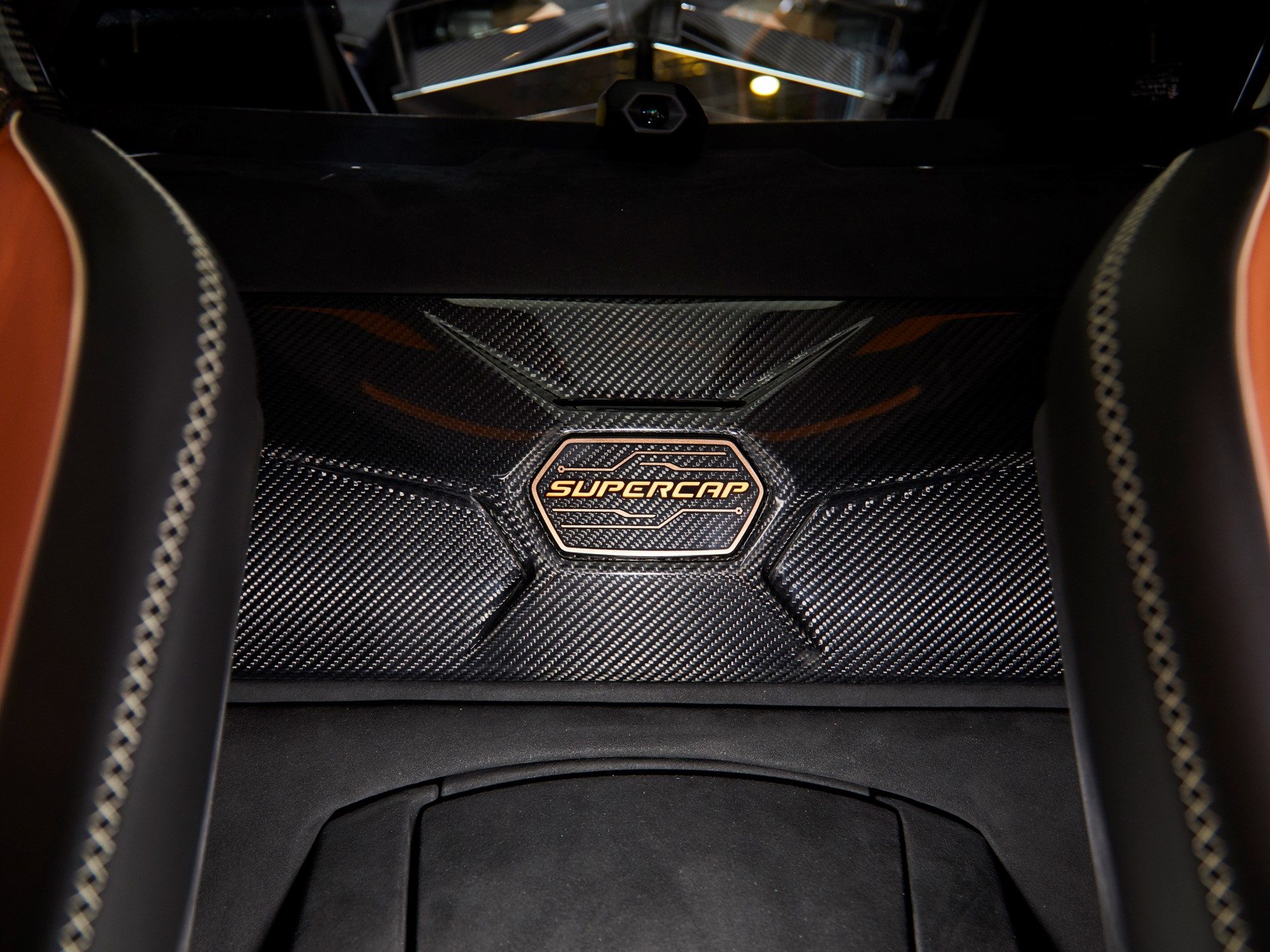
Lamborghini says supercapacitors already represent a proven solution in high-performance motorsport applications due to their exceptional power and durability. The Sián FKP 37 validated this approach in production: its 48-volt e-motor drew from a supercapacitor unit integrated into the gearbox, adding 34 horsepower to the naturally aspirated V12. Lamborghini described that supercapacitor as three times more powerful and three times lighter than a battery of equivalent weight. The limitation was energy density. The Sián’s supercapacitor provided a burst of assistance, not sustained electric-only driving. Doubling energy density through the MOF patent would push supercapacitors closer to territory where they could meaningfully extend electric driving capability without the weight penalty of a large battery pack.
The Science Behind MOFs: Why This Material Matters
Metal-Organic Frameworks are a class of crystalline materials composed of metal ions connected by organic linker molecules, forming highly porous three-dimensional structures. Picture a microscopic scaffolding where the gaps between structural members are precisely engineered at the molecular level. Lamborghini states that this molecular structure maximizes the specific surface area exposed to electric charge relative to the mass and volume of the sample.
Surface area is critical because, unlike batteries, which store energy through chemical reactions, supercapacitors store energy electrostatically, accumulating charge on the surface of their electrode material. More surface area means more room to park electric charge, which directly translates to higher energy density. MOFs offer an almost absurd amount of internal surface area: a single gram of certain MOF compounds can contain surface area equivalent to a football field.
While some initial reporting around the Terzo Millennio concept suggested graphene-enhanced supercapacitors, an MIT professor clarified that the technology would be MOF-based, not graphene. The distinction matters because MOFs can be tuned at the molecular level. Researchers can adjust the metal nodes, the organic linkers, and the pore geometry to optimize for specific performance characteristics, giving Lamborghini a bespoke material rather than an off-the-shelf solution. That tunability is what connects the chemistry to the broader thesis: Lamborghini is not borrowing electrification technology, it is engineering its own.

Two executives pose in front of the distinguished Massachusetts Institute of Technology seal.
From Terzo Millennio to Sián: The Research Trajectory
This patent sits within a research arc Lamborghini initiated when it joined the MIT-Italy Program three years before the patent announcement. The collaboration took a further step forward in 2017 with the launch of two research projects, one with Professor Dincă and the other with Professor Anastasios John Hart in MIT’s Department of Mechanical Engineering. That same year, the Terzo Millennio concept proposed something radical: a fully electric supercar powered entirely by supercapacitors, with no conventional battery at all. Reports from its unveiling described a vehicle capable of charging in minutes without a bulky battery pack. It was aspirational, a research target more than a production preview, but it established supercapacitors as central to Lamborghini’s electrification identity.
The Sián, unveiled at the 2019 Frankfurt Motor Show, brought supercapacitor technology into production for the first time. Lamborghini indicates the newly patented MOF material holds even greater potential than the supercapacitors used in the Sián, which the company positions as the current state of the art. Stefano Domenicali, who was then Chairman and CEO of Automobili Lamborghini, framed the MIT partnership as embodying the company’s values and vision for a hybridized future. The interesting subtext: Lamborghini was not simply buying off-the-shelf electrification components from within the Volkswagen Group. It was co-developing proprietary energy storage chemistry with one of the world’s leading research universities.
A Different Path Than Ferrari or Porsche
Most of Lamborghini’s competitors chose conventional lithium-ion battery packs for their electrified flagships. Ferrari’s SF90 Stradale and McLaren’s Artura both use battery-electric hybrid architectures where lithium-ion cells provide stored energy to electric motors. These systems work well for adding low-speed electric driving and filling torque gaps, but they add significant weight and require active thermal management systems that consume packaging space.
Lamborghini’s supercapacitor focus represents a philosophically different approach. Rather than optimizing for electric-only range, it optimizes for instantaneous power delivery and regenerative efficiency. A supercapacitor-equipped Lamborghini recovers energy during braking and deploys it during acceleration with minimal conversion losses and virtually no thermal management overhead. The trade-off, historically, was that supercapacitors stored too little energy to contribute meaningfully beyond short bursts. If the MOF patent delivers on its promise of doubling energy density, Lamborghini could offer a hybrid system that is lighter, faster-responding, and more durable than battery-based alternatives, while closing the gap on sustained electric assistance.
For prospective buyers watching Lamborghini’s electrification strategy unfold, the practical takeaway is this: Lamborghini is building proprietary energy storage technology designed to preserve the violent, immediate character of its cars rather than simply adding electric range for its own sake. Whether this MOF material scales from laboratory to production remains an open question Lamborghini has not publicly answered with a timeline, but the patent itself signals serious intent rather than concept-car theater.

Two individuals stand on the steps of the iconic Massachusetts Institute of Technology building.
What Remains Unknown, and What Enthusiasts Should Watch
Lamborghini confirmed the patent and the MOF material’s potential but did not disclose a production timeline, a target vehicle beyond referencing the Terzo Millennio’s performance goals, or specific packaging details for how MOF supercapacitors would integrate into a production chassis. Weight implications, charging infrastructure requirements, and cost per unit at automotive scale all remain unaddressed. Those gaps are normal for laboratory-stage intellectual property.
The more telling signal is that Lamborghini chose to co-author and publicly announce the patent rather than quietly licensing existing technology. In the supercar world, where buyers increasingly expect electrification to enhance rather than dilute the driving experience, owning proprietary energy storage chemistry is a competitive moat. Ferrari develops its own battery management systems. Porsche invested heavily in 800-volt architecture for the Taycan. Lamborghini’s equivalent strategic asset may turn out to be a crystalline powder synthesized in a chemistry lab in Cambridge, Massachusetts, engineered to store charge on surfaces measured in football fields per gram.
Gallery