The Harvard Invitation: Why a Business School Wanted Lamborghini’s CEO in Front of 143 Executives
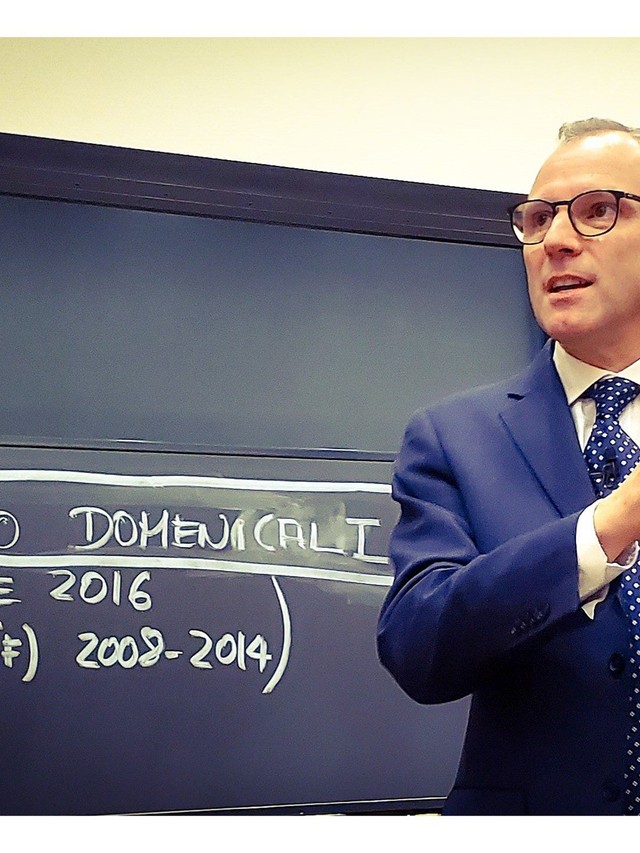
Stefano Domenicali, then Chairman and CEO of Automobili Lamborghini, stood in front of a blackboard at Harvard Business School in November 2019 and did something unusual for a supercar executive: he taught a class. Lamborghini says Domenicali was invited to address the school’s General Management Executive Education Program, directed by Professor Stefan Thomke, where 143 selected executives from around the world prepare for senior leadership positions. His subject was Lamborghini’s history and the strategic decisions that reshaped the company from a niche Italian sports car maker into what Domenicali described as a luxury-segment leader.
Harvard does not typically summon supercar CEOs to lecture on manufacturing exotica. The school wanted a case study in brand transformation, and Lamborghini under Domenicali offered a particularly clean example: a small company that, in the space of roughly three years, rewrote its financial profile without abandoning its core identity. Whether that last part is entirely true depends on whom you ask. But the academic interest was real, and it centered on a single vehicle.
Domenicali assumed leadership of Lamborghini in 2016, succeeding Stephan Winkelmann, who had held the CEO role since 2005. Winkelmann’s era saw significant growth of its own, with the introduction of the Gallardo, Huracán, and Aventador driving a tripling of turnover and a doubling of sales between 2004 and 2015. Domenicali inherited a healthy company. What he did next changed its scale entirely.

Stefano Domenicali, CEO of Automobili Lamborghini, engages an audience while presenting his career highlights.
The Urus Catalyst: One SUV, a 40 Percent Revenue Spike, and a New Kind of Lamborghini Customer
The numbers Domenicali presented at Harvard deserve close attention, because they illustrate the sheer velocity of the Urus effect. Lamborghini says that under his leadership, the company first crossed one billion euros in revenue in 2017, a milestone for a manufacturer that, for most of its existence, operated at a fraction of that figure. Then the Urus arrived for the 2018 model year, and the trajectory steepened dramatically.
Revenue climbed 40 percent year-on-year, from 1,009 million euros to 1,415 million in 2018. Customer deliveries rose 51 percent to 5,750 units, with record sales across all major markets. Lamborghini projected over 8,000 worldwide deliveries for 2019. For context, the entire company delivered around 3,500 cars in 2016. The Urus, in practical terms, more than doubled the business.
The more revealing statistic is the customer composition. Lamborghini says 70 percent of Urus buyers were new to the brand. That figure captures the strategic logic behind the entire project: the Urus was never primarily about giving existing Aventador or Huracán owners a family hauler. It was about creating a pipeline of first-time Lamborghini customers, many of whom might eventually cross-shop into the two-door range. The Urus marked Lamborghini’s return to the SUV segment since the LM002, but the business rationale was fundamentally different from that military-derived curiosity. This was a calculated play for scale.
For enthusiasts who already owned Lamborghinis before 2018, the Urus was a mixed blessing. It brought financial stability and development budgets that a 3,500-unit company could never sustain on its own. It also meant that the raging bull badge became far more common in school pickup lines and suburban parking garages. That tension between growth and exclusivity is precisely what made Domenicali’s story interesting to a room full of Harvard executives.
Redefining Luxury: Lamborghini’s Strategic Shift Beyond the Two-Model Supercar Company
Domenicali’s Harvard address reached beyond revenue charts. He positioned Lamborghini as what the company calls a reference point in the global luxury car industry, asserting that the brand had become, in his words, “a true trendsetter in the luxury segment.” Strip away the corporate polish and the underlying argument is interesting: Lamborghini was claiming that it no longer competed solely on horsepower and design drama. It competed on cultural influence.
The social media numbers Lamborghini cited support that claim, at least in one dimension. The company says it leads the automotive sector in social media following, with over 38 million fans globally. Instagram followers alone grew to 23.6 million in the three years before the Harvard address. Those figures reflect something broader than marketing spend. Lamborghini’s visual identity, the angular bodywork, the screaming colors, the theatrical doors, translates to digital platforms in a way that more restrained luxury brands struggle to replicate. A Bentley Continental GT is a beautiful automobile. It does not stop a teenager mid-scroll.
This cultural gravity matters commercially because it feeds the aspirational pipeline. The 23-year-old who puts a Huracán poster on a dorm room wall is, in Lamborghini’s long game, the 43-year-old who walks into a dealership for an Urus. Few other automakers can claim that kind of multi-generational brand desire, and Domenicali clearly understood its value when he framed the company’s growth as a luxury-sector phenomenon rather than a pure automotive story.
Federica Sereni, Consul General of Italy in Boston, reinforced the cultural framing. She noted the appreciation for Italian companies in the United States, particularly those in the automotive industry, for combining passion, tradition, research, and innovation. In a city like Boston, where research and technological innovation rank among the most advanced worldwide, Sereni observed that Lamborghini’s history and future “aroused such interest” among students at one of the most prestigious universities in the country.
Beyond Sales Figures: Motorsport Wins and the Credibility They Buy
Domenicali did not limit his Harvard presentation to balance sheets and Instagram metrics. He also pointed to Lamborghini’s motorsport record, and the specific achievement he highlighted is genuinely rare. Lamborghini says it was the only company in the world to win the double victory at the 24 Hours of Daytona and the 12 Hours of Sebring in both 2018 and 2019. Back-to-back doubles at two of North America’s most prestigious endurance races is a statement that resonates well beyond the paddock.
For a brand that built its identity on road cars rather than racing, these victories served a particular strategic purpose. They provided engineering credibility that complements the lifestyle appeal. Porsche, by comparison, built its brand on motorsport first and expanded into luxury SUVs second. Lamborghini reversed that sequence with the Urus and then used customer racing success to reinforce the performance bona fides. The Squadra Corse program, which grew substantially during Domenicali’s tenure, gave Lamborghini a competitive narrative that could stand alongside its commercial one.
Owners who track their cars, or who simply want to know that their manufacturer takes competition seriously, pay attention to results like these. A Daytona class win is not a marketing slogan. It is an engineering validation that filters down into how the road cars are perceived, and eventually, how they are developed.
What This Means for Lamborghini’s Future: The Urus Funded What Comes Next
The practical takeaway for anyone following Lamborghini’s trajectory is straightforward: the Urus did not just pad the quarterly earnings reports. It created the financial foundation for everything the company built afterward. The Revuelto, Lamborghini’s hybrid V12 flagship, and the Temerario, with its 10,000-rpm twin-turbo V8 and triple electric motors, are direct beneficiaries of the revenue surge Domenicali engineered. A company delivering 3,500 cars a year cannot fund the transition to hybrid and eventually electric powertrains at the pace the industry now demands. It 8,000-plus cars can.
Domenicali later transitioned from his role as Lamborghini CEO to become the CEO of Formula 1, leaving behind a company in a fundamentally different financial position than the one he inherited. During his tenure, Lamborghini’s sales doubled, and the strategic architecture he put in place, a three-model lineup anchored by a high-volume SUV funding low-volume supercar development, became the template his successors continued to execute.
Lamborghini has not publicly detailed how the Urus revenue specifically allocates to future R&D budgets, and any precise figures would be speculative. What the company’s trajectory confirms is that the financial cushion exists. According to Road & Track, Lamborghini achieved record deliveries and revenue in 2025 and plans multiple new car debuts for 2026, with its first EV model potentially back in consideration. That kind of product cadence would be unimaginable for the pre-Urus company.
For buyers on waiting lists or considering their next Lamborghini, the implication is encouraging. The financial health Domenicali built means Lamborghini can invest in the kind of engineering that keeps its supercars competitive against Ferrari’s hybrid lineup, McLaren’s evolving architecture, and Porsche’s relentless iterative improvement.
The Competitive Lens: How Lamborghini’s Growth Model Differs from Ferrari’s Playbook
Domenicali’s Harvard lecture gains sharper focus when placed alongside Ferrari’s approach to the same fundamental challenge: how does a low-volume luxury manufacturer grow without eroding the exclusivity that justifies its pricing?
Ferrari chose deliberate production restraint, famously building fewer cars than demand would support, and layering profitability through personalization programs, limited editions, and aggressive brand licensing. Ferrari’s IPO in 2015 gave it access to public capital markets, and its stock price performance became a validation metric in its own right. The Maranello strategy is, in essence, to grow revenue per unit rather than unit volume.
Lamborghini, under Domenicali, chose a different path. Rather than squeezing more margin from each Aventador or Huracán, he expanded the addressable market by launching an entirely new product category. The Urus brought in customers who would never have considered a two-seat supercar, whether due to family obligations, daily-driving requirements, or simply preference. The risk was brand dilution. The reward was the financial scale to compete on technology with manufacturers many times Lamborghini’s size.
Both strategies work. Ferrari’s market capitalization speaks for itself. Lamborghini’s product cadence and engineering ambition speak for its approach. The interesting question, and one that Domenicali’s Harvard audience was presumably well-equipped to debate, is which model proves more durable as the industry shifts toward electrification, where development costs escalate dramatically and economies of scale become increasingly important.
Enthusiast forums remain divided on this point. Multiple owners and followers on enthusiast platforms describe the Urus as a necessary commercial vehicle that funds the cars they actually care about, while others view it as an overpriced platform-sharing exercise that cheapens the badge. The Porsche Cayenne analogy surfaces frequently in these discussions, and it is apt: Porsche faced identical criticism when the Cayenne launched in 2002, and the brand’s subsequent supercar output suggests the SUV money was well spent. Lamborghini appears to be following a similar arc, with the Revuelto and Temerario as early evidence.
What Domenicali presented at Harvard was, at its core, a vindication story. A small Italian manufacturer, operating under the Volkswagen Group umbrella, found a way to grow by a factor of two without losing the visual and emotional intensity that makes a Lamborghini recognizable from a city block away. Whether the next chapter, electrification, autonomous capability, tightening emissions regulations, can be navigated with the same elegance remains the open question. The financial foundation, at least, is no longer in doubt.


