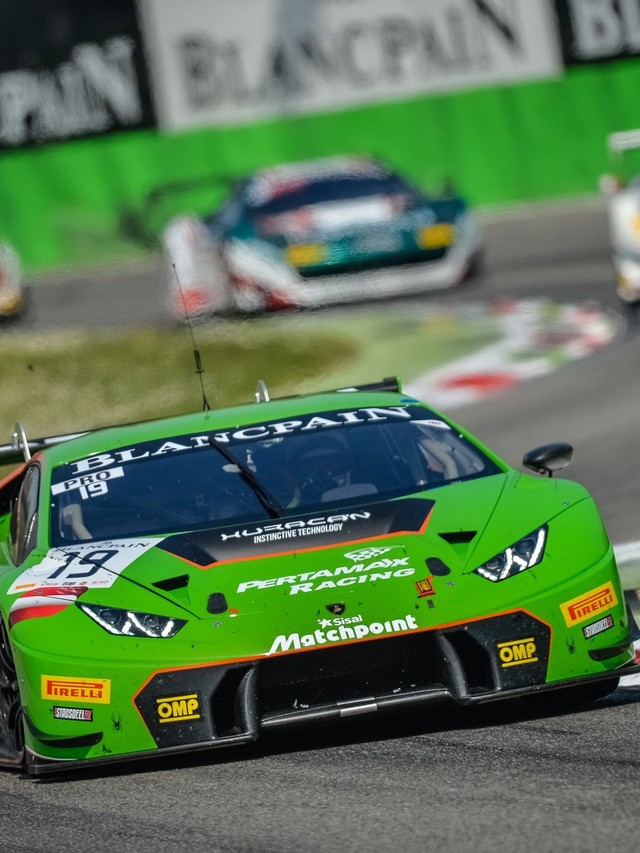
Victory Reinstated: The #19 Huracán GT3 Gets Its Win Back
Lamborghini Squadra Corse‘s #19 Huracán GT3 crossed the finish line first at the opening round of the 2015 Blancpain Endurance Series at Monza, beating sixty other cars to the checkered flag. Then the stewards took it away. A post-race technical inspection flagged an alleged irregularity in the car’s fueling tower restrictor, and the result was struck from the record. Italian Fabio Babini, American Andrew Palmer, and Dutchman Jeroen Mul went from race winners to disqualified in the time it took to file a protest.
Months later, the FIA International Court of Appeal overturned that decision entirely, setting aside rulings from both the Monza stewards and the Belgian national court that initially upheld the disqualification. The victory was restored. For Lamborghini’s motorsport division, this was far more than a corrected line on a results sheet. It was a vindication of the Huracán GT3’s competitive legitimacy in the car’s debut season of endurance racing, and a declaration that Squadra Corse would not quietly absorb a ruling it believed was wrong.
Giorgio Sanna, Head of Motorsport for Automobili Lamborghini, framed the outcome as confirmation of what the team knew from the start:
“We have always advocated our regularity and we were confident from the beginning in the successful outcome of our appeal. It’s like winning a second time, again the result of a great team effort.”
The confidence was warranted. But the path to reinstatement required Lamborghini and its partner team, Austria’s GRT Grasser Racing Team, to escalate through multiple levels of motorsport judiciary, a process that consumed nearly four months and involved a formal hearing in Paris.
From Dominant Performance to Post-Race Controversy
What made the disqualification sting was the manner of the on-track victory itself. The #19 car qualified third fastest, then systematically worked its way to the front over the course of the three-hour race. Beating a field of sixty GT3 machines at Monza, a circuit that rewards raw power and aerodynamic efficiency in equal measure, was a statement result for a car making its competitive debut in the Blancpain Endurance Series.
The problem surfaced only after scrutineering. Officials determined that the Huracán GT3’s fueling tower restrictor did not conform to regulations. In GT3 racing, fuel restrictors form part of the Balance of Performance system, the set of technical constraints (including power output limits, minimum weight, and refueling flow rates) that the SRO Motorsports Group uses to equalize different manufacturers on the grid. A non-conforming restrictor, even by a small margin, can theoretically allow faster refueling stops, which in endurance racing translates directly into track position.
The accusation was not trivial. It implied a competitive advantage gained through equipment that fell outside the rulebook. Lamborghini and GRT Grasser contested that characterization from the outset, arguing the restrictor was compliant. When the initial appeal to the Belgian National Court of Appeal failed, the Austrian national sporting authority, acting on behalf of Grasser, took the case to the FIA’s International Court of Appeal in Paris. That willingness to keep climbing the judicial ladder tells you everything about how seriously Squadra Corse took the charge.
Why the Fueling Restrictor Carries So Much Regulatory Weight
For readers unfamiliar with GT3 technical regulations, the fueling tower restrictor might sound like an obscure plumbing detail. In endurance racing formats organized by SRO Motorsports Group, though, pit stop strategy can decide races. The restrictor governs how quickly fuel flows into the car during a stop, and the mandated flow rate is calibrated to each manufacturer as part of the broader Balance of Performance framework. A restrictor that allows even marginally faster flow could shave seconds off every pit stop, compounding over a three-hour or longer race into a meaningful advantage.
Scrutineers examine these components closely for exactly that reason, and a finding of non-conformity triggers automatic disqualification rather than a time penalty. The rules treat it as a binary question: compliant or not. Lamborghini’s successful appeal effectively demonstrated that the component met the required specification, overturning the stewards’ original assessment.
Understanding the restrictor’s functional role clarifies why Lamborghini was willing to pursue the appeal through three levels of adjudication rather than accept the penalty and move on. A disqualification on these grounds, left unchallenged, would have implied the Huracán GT3 needed an illegal advantage to win. For a car in its debut endurance season, that implication was intolerable.
What the Appeal Reveals About Squadra Corse’s Character
Winning an appeal before the FIA International Court of Appeal is not routine. The process is expensive, time-consuming, and carries reputational risk: if the appeal fails, the manufacturer looks like it was trying to dodge a legitimate penalty. Lamborghini chose to pursue it anyway, and the decision to escalate past the Belgian national court to the FIA’s highest sporting tribunal signals institutional confidence that goes beyond competitive stubbornness.
The stakes extended well beyond a single race result. With the Huracán GT3 in its debut year, a disqualification for a technical infringement at the very first endurance round could have cast a shadow over the entire customer racing program, raising questions among privateer teams about whether the car’s homologation paperwork was in order. Clearing the record at the highest level removed that doubt comprehensively.
Anyone who followed Lamborghini’s later SC63 LMDh program knows that Squadra Corse’s motorsport ambitions do not always go smoothly. That prototype effort, which represented Lamborghini’s first foray into top-tier sports car racing, faced significant performance challenges. Road & Track reported the program was paused for the 2026 season. The contrast is instructive. Where the LMDh effort exposed the growing pains of a manufacturer learning a new category, the GT3 operation demonstrated a mature, battle-tested infrastructure capable of defending its results through the sport’s legal channels. The Monza appeal was an early and defining expression of that maturity.
The Huracán GT3: A Platform That Proved Itself Over a Decade
The reinstated Monza victory reads now as an early chapter in one of GT3 racing’s most durable platform stories. The Huracán GT3 went on to compete for a full decade, evolving through Evo and Evo 2 specifications while remaining fundamentally the same naturally aspirated V10 machine that won at Monza in its first endurance start. Car and Driver confirmed the Temerario GT3 will replace the Huracán GT3 Evo 2 as Lamborghini’s factory-backed GT3 contender, marking the first race car entirely designed and developed in-house at Sant’Agata Bolognese.
That transition represents a generational shift. The Temerario GT3 will use a modified twin-turbocharged engine derived from its road car, as GT3 regulations require. For privateer teams that built their programs around the Huracán’s characteristics, the move to a turbocharged powerplant means adapting to a fundamentally different powerband and thermal management challenge. The Huracán’s naturally aspirated V10 delivered linear, predictable power that amateur and professional drivers alike found confidence-inspiring. Whether the Temerario’s turbo V8 can replicate that quality remains one of the more interesting open questions in customer racing.
GRT Grasser Racing Team, which fielded the #19 car at Monza, also ran a sister #63 Huracán driven by South African Adrian Zaugg and Italians Mirko Bortolotti and Giovanni Venturini. Both cars were scheduled to compete in the season’s final round at the Nürburgring on September 19 and 20, carrying the momentum of the reinstated result into the championship’s closing stages.
A Quiet Precedent for Lamborghini’s Racing Credibility
Motorsport appeals rarely generate the same excitement as on-track battles, but their outcomes can shape a manufacturer’s reputation for years. Lamborghini’s successful appeal at Monza established an early precedent for Squadra Corse as an organization that would defend its competitive position through proper channels rather than accept a questionable ruling.
For the brand’s enthusiast base, that matters. Owners and fans invest emotionally in Lamborghini’s racing efforts, and knowing the team fought through three levels of adjudication to clear its name reinforces the credibility of the entire GT3 program. The Huracán GT3’s debut victory, once stripped and then formally restored by the FIA’s highest court, became a stronger statement than an uncontested win ever could have been. No asterisk. No lingering doubt about the fueling restrictor. Just a confirmed result that validated the car, the team, and the department that built them both.
That foundation proved sturdy enough to support a decade of competitive GT3 racing, and the Temerario GT3 will inherit it when it takes the grid for its own debut.
Gallery


