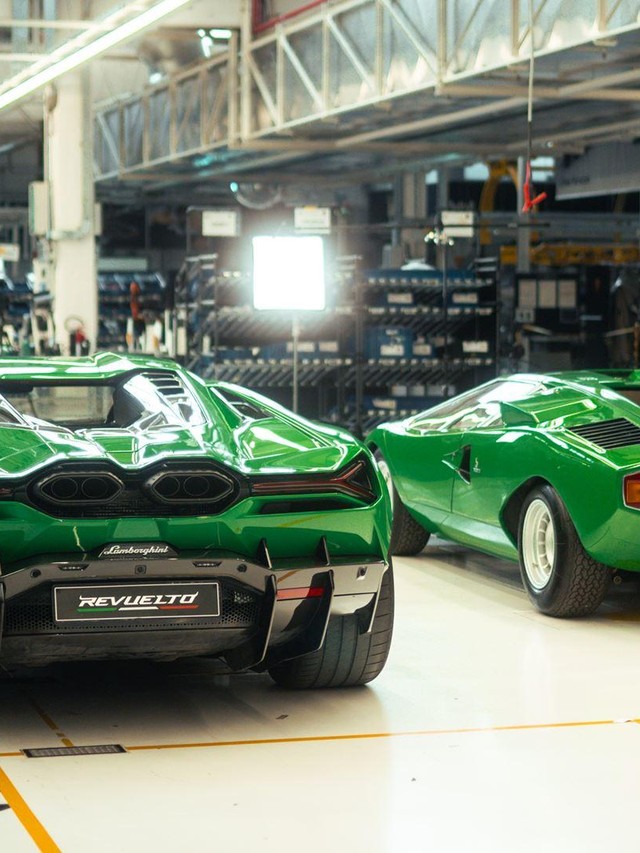
A European Energy Award for the Company That Builds V12 Supercars
Automobili Lamborghini, in collaboration with CPL CONCORDIA, won the COGEN Europe Recognition Award 2019 in the Market Development for Organizations category. Presented at a gala ceremony in Madrid, the award recognized the trigeneration and district heating systems operating inside the Sant’Agata Bolognese factory. COGEN Europe, the European Association for the Promotion of Cogeneration, selected the pair from a field judged by industry professionals, policymakers, and researchers.
The reason this matters to anyone who cares about Lamborghini goes well beyond a plaque on a wall. These energy systems were instrumental in achieving CO2 neutral certification for the factory in 2015, making Lamborghini the first company in the world to do so through the DNV GL “Carbon Neutrality” program. That means the place where Aventadors and Huracans are assembled reached carbon neutrality four years before this award even existed.
Ranieri Niccoli, Lamborghini’s Chief Manufacturing Officer, framed the achievement in strategic terms rather than purely environmental ones. According to Niccoli, environmental commitment is integrated into the company’s broader operational strategy, not bolted on as a public relations exercise. The distinction matters: when a manufacturer treats sustainability as infrastructure rather than marketing, the results tend to be more durable and harder for competitors to replicate quickly. That philosophy of solving problems with hardware rather than paperwork runs through every layer of this story, from the trigeneration plants themselves to the underground pipes carrying biogas heat six kilometers to the factory floor.
What Trigeneration Actually Means (and Why a Supercar Factory Needs It)
A conventional power plant burns fuel to generate electricity and throws away the leftover heat. A cogeneration plant captures that heat and uses it. A trigeneration plant, also called combined cooling, heat, and power (CCHP), goes one step further: it generates electricity, captures heat for warming, and uses absorption chillers to produce cooling, all from a single fuel source.
For a supercar factory, this triple output is remarkably well suited. Paint booths need precise temperature and humidity control. Composite layup rooms for carbon fiber require stable, cool environments. Assembly halls need heating in Emilia-Romagna’s damp winters. Instead of running separate electrical, heating, and cooling systems, each burning its own fuel or drawing from the grid independently, Lamborghini’s two trigeneration plants handle all three from natural gas.
The combined installed power of 2.4 MW produces approximately 20,000 MWhe annually. Lamborghini illustrates the scale by noting that this output could supply the yearly energy needs of every home in the town of Sant’Agata Bolognese. The CO2 savings from the trigeneration system alone total roughly 1,640 tons per year, according to Lamborghini. The plant is equipped with two MWM cogen units, and the system was designed with a future conversion to biogas in mind, which Lamborghini says could push annual CO2 reductions up to 11,400 tons.
CPL CONCORDIA, Lamborghini’s partner on the project, brings approximately 30 years of cogeneration experience to the table. That kind of institutional knowledge matters when you are engineering energy infrastructure that needs to run reliably alongside a precision manufacturing line producing cars worth several hundred thousand dollars each. The hardware commitment here is the point: rather than purchasing grid electricity and offsetting the emissions on a spreadsheet, Lamborghini chose to build the solution into the factory itself.

The modern architecture of the Lamborghini facility showcases advanced design and sustainable energy solutions under a bright sky. Image: Automobili Lamborghini.
District Heating: Piping Biogas Energy Six Kilometers Underground
The trigeneration plants are only half the story. Lamborghini also holds the distinction of being the first automotive company in Italy to implement a district heating system, a concept borrowed from Nordic municipal infrastructure and adapted for an Italian supercar factory.
The system distributes hot water through a network of underground pipes from a biogas cogeneration plant located six kilometers from the factory. That biogas plant was already generating energy that would otherwise be wasted. Lamborghini chose to capture the surplus and route it to Sant’Agata Bolognese, turning someone else’s thermal byproduct into factory heating. The emissions savings from the district heating system alone total approximately 1,800 tons of CO2 per year, according to Lamborghini.
Combined with the trigeneration savings, the two systems together eliminate roughly 3,440 tons of CO2 annually. One report from 2020 stated that Lamborghini covered 34% of its energy demand from these combined systems in the preceding year. The company’s broader environmental portfolio also includes photovoltaic solar arrays and reforestation projects, though those fall outside the scope of this particular award. What earned the COGEN Europe recognition was the core infrastructure: purpose-built, capital-intensive hardware that generates measurable results year after year.
Carbon Neutrality in 2015: What That Certification Actually Required
The phrase “carbon neutral” gets thrown around loosely in corporate communications, which is why Lamborghini’s 2015 CO2 neutral certification through DNV GL deserves closer scrutiny. The DNV GL Carbon Neutrality program is a third-party verification scheme, not a self-declared label. It requires an organization to measure its total greenhouse gas emissions, reduce what it can through operational changes, and offset the remainder through verified projects.
What made Lamborghini’s achievement notable was the combination of on-site energy generation through trigeneration, external renewable sourcing through district heating from biogas, and supplementary measures like the oak forest the company planted near the factory for carbon offsetting and biodiversity research. The first trigeneration plant came online in 2015, directly supporting the certification timeline. A second plant followed in 2017, expanding capacity.
For context, this certification arrived the same year Lamborghini launched the Huracan LP 610-4 Spyder. The company was simultaneously refining a naturally aspirated V10 to produce 610 horsepower and engineering its factory to produce zero net carbon emissions. That juxtaposition captures something essential about the modern Lamborghini identity: the cars remain uncompromising in performance, but the manufacturing operation behind them runs on a different, quieter set of engineering ambitions. The trigeneration and district heating systems are the physical proof that carbon neutrality, in this case, was earned through infrastructure investment rather than accounting maneuvers.
How Lamborghini’s Green Footprint Compares to Supercar Rivals
The competitive landscape for factory sustainability among ultra-luxury automakers is surprisingly opaque. Ferrari, Porsche, and McLaren all publish sustainability reports, but direct comparisons are difficult because each company uses different scopes, baselines, and certification bodies.
What can be said with confidence is that Lamborghini’s 2015 factory carbon neutrality certification predates comparable announcements from most of its direct competitors. Ferrari committed to ambitious environmental targets in subsequent years, but Lamborghini’s head start in on-site energy generation gave it a structural advantage: the trigeneration and district heating infrastructure was already operational and generating measurable savings before the broader industry began treating factory sustainability as a competitive differentiator.
Porsche, operating at a much larger production scale, faces a fundamentally different challenge. Its Taycan factory in Zuffenhausen achieved carbon-neutral production, but Porsche builds tens of thousands of vehicles per year compared to Lamborghini’s roughly 10,000. The economics and logistics of carbon neutrality scale very differently at those volumes. McLaren’s Woking facility is compact and relatively modern, but the company’s public disclosures on energy systems are less detailed than Lamborghini’s.
The honest assessment is that Lamborghini’s smaller production volume makes factory carbon neutrality more achievable in absolute terms, but the company deserves credit for investing in sophisticated on-site energy infrastructure rather than simply purchasing carbon offsets. Building a trigeneration plant is a capital-intensive, long-term commitment. Buying offsets is a line item on a spreadsheet. The engineering approach reflects the same philosophy Lamborghini applies to its vehicles: solve the problem with hardware, not paperwork.
What Factory Sustainability Signals for Lamborghini’s Electrified Future
The COGEN Europe award arrived in 2019, the same year Lamborghini was deep in development of the Sian, its first hybrid production car. Lamborghini’s “Direzione Cor Tauri” electrification roadmap, which led to the Revuelto’s V12 hybrid powertrain and the Urus SE’s plug-in system, required not just new vehicle architectures but also a factory capable of supporting more complex, energy-intensive manufacturing processes.
Hybrid and electric vehicle production demands more from a factory’s energy systems. Battery assembly requires climate-controlled clean rooms. Electric motor testing rigs draw significant power. The trigeneration infrastructure Lamborghini built starting in 2015 provided a foundation that could absorb these new demands without proportionally increasing the factory’s carbon footprint.
The system was also designed with forward compatibility in mind. The potential conversion to biogas, which Lamborghini says could reduce CO2 emissions by up to 11,400 tons annually, represents a second phase of decarbonization that aligns with the timeline of the company’s electrification push. As production complexity increases with hybrid models, the factory’s energy backbone becomes more strategically important, not less.
For buyers and enthusiasts, the practical takeaway is straightforward: Lamborghini invested in factory sustainability infrastructure years before it became an industry expectation, and that infrastructure now supports the manufacturing of the hybrid supercars rolling out of Sant’Agata Bolognese. The COGEN Europe award recognized a specific engineering achievement, but the broader story is about a company that treated its factory’s energy systems with the same seriousness it applies to a V12’s intake manifold geometry. The results, measured in megawatt-hours and tons of CO2 avoided rather than horsepower and lap times, are no less real.


