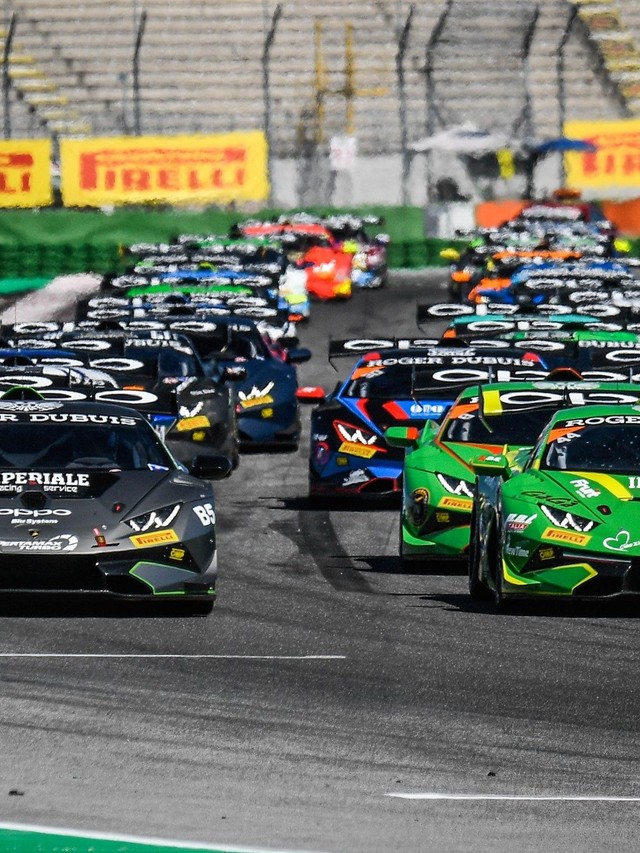
A Double-Header at the World’s Only Figure-Eight Grand Prix Circuit
Lamborghini’s Super Trofeo Asia series returns to Japan’s Suzuka Circuit this weekend for its second round of the 2019 season, a double-header that pairs one of motorsport’s most technically demanding layouts with a grid full of Huracán Super Trofeo EVO race cars and a crop of drivers whose careers may hinge on what happens over two 50-minute sprints.
Suzuka is the only figure-of-eight circuit on the Formula 1 calendar. Its crossover design, where the track literally passes over itself, creates elevation changes and sightline challenges that flat-plan circuits simply cannot replicate. The 5.807 km layout strings together tight esses, a long sweeping curve section, a hairpin, a chicane, and fast straights. Each element tests a different aspect of car setup and driver skill, which is precisely why Lamborghini keeps bringing its one-make series here. A track that punishes both mechanical weakness and driver hesitation in equal measure is exactly the kind of proving ground that separates the serious from the merely fast.
Practice opens on Friday, June 21, with two hour-long sessions. Qualifying follows on Saturday, with Race 3 of the season starting at 16:55 local time. Race 4 goes green on Sunday at 13:30.
The Huracán Super Trofeo EVO: 620 Horsepower, Rear-Wheel Drive, and a Deliberate Philosophy
The car doing all the talking at Suzuka is the Huracán Super Trofeo EVO, and its engineering tells you something important about how Lamborghini thinks about racing development. The 5.2-liter naturally aspirated V10 produces 620 CV at 8,250 RPM, paired with a sequential six-speed X-Trac gearbox and sent exclusively to the rear wheels. That rear-wheel-drive layout is not a cost-saving compromise. It is a deliberate pedagogical choice.
Lamborghini says the dry weight sits at 1,270 kg, yielding a weight-to-power ratio of 2.05 kg/CV. The road-going Huracán LP610-4 on which the Super Trofeo platform is based weighs roughly 335 pounds more and sends power to all four wheels. Stripping out the all-wheel-drive system, the interior, and the road-car safety equipment, then bolting on a hybrid carbon-aluminum frame, an FIA-spec roll cage weighing 95 lbs, and a complete quick-fix aero kit transforms the car into something that demands a fundamentally different driving approach.
Double-wishbone suspension with rigid bushings leaves very little compliance to mask driver error. Braking comes from Brembo/PFC components: 380x35mm steel discs up front with six-pot monoblock calipers, 355x32mm rears with four-pot units. From the cockpit, drivers can adjust a 12-position racing ABS, 9-position traction control, and brake bias, all logged through a MoTeC Pro data system. The point of all this adjustability is not to make the car easier. It is to teach drivers how to read data and make engineering decisions under pressure, skills that translate directly to GT3-level competition.
The rear-wheel-drive configuration is the key detail most coverage glosses over. In a world where GT3 cars increasingly rely on sophisticated traction management systems, learning to manage a 620 CV rear-drive car through Suzuka’s esses builds the kind of throttle sensitivity and car control that no simulator can fully replicate.
Squadra Corse’s Young Guns and the Talent Pipeline That Actually Matters
Four drivers in the Suzuka field carry the additional weight of being Lamborghini Squadra Corse Young Driver Program selections for 2019. Evan Chen (24, Chinese Taipei) and Juuso Puhakka (20, Finland) were recently announced as program members. Chen, racing with Gama Racing alongside experienced Kiwi Chris van der Drift, currently leads the Pro category after sweeping both wins at the season-opening round in Malaysia. Puhakka partners Takashi Kasai at FFF Racing Team, and the pair sit second in the Pro standings.
The other two Young Driver Program representatives compete in Pro-Am. Brendon Leitch (23, New Zealand) made his Super Trofeo Asia debut in Malaysia and returns at Suzuka alongside Massimo Vignali for Leipert Motorsport. Australian Richard Muscat pairs with Daniel Stutterd at GDL Racing.
What makes this program worth watching is its track record of producing real careers, not just press-friendly announcements. One report indicates that alumni such as Maximilian Paul and Mattia Michelotto were promoted from the Lamborghini Young Professional Driver ranks to full factory driver status, with Paul securing a DTM race victory and Michelotto winning dominantly at the Lamborghini World Finals in his maiden Super Trofeo Europe season. The program functions as a structured motorsport ladder: perform well in Super Trofeo, earn Young Driver status, prove yourself against increasingly serious competition, and potentially graduate to factory-backed GT3 drives.
For Lamborghini, the strategic calculus is straightforward. The Temerario GT3, revealed at the 2025 Goodwood Festival of Speed as Lamborghini’s first competition car fully designed, developed, and built in-house, will need a roster of proven drivers who already understand how Lamborghini builds and races its cars. The Super Trofeo series is where that roster gets built, season by season, corner by corner.
Championship Battles Across Four Classes
The multi-class format spanning Pro, Pro-Am, Am, and Lamborghini Cup is one of the series’ underappreciated structural strengths. Professional-caliber drivers and gentleman racers sharing the same grid and the same track time creates unpredictable racing and forces every driver to manage traffic, strategy, and risk simultaneously.
In Pro-Am, two entries share the lead after the Malaysian opener. The Hojust Racing pairing of Afiq Yazid and Toshiyuki Ochiai and the No. 66 Vincenzo Sospiri Racing car each took a win and a second place. For Suzuka, the No. 66 entry pairs Hong Kong driver Alex Au with Japanese driver Yuki Nemoto. Several Japanese crews will race on home soil: Takamichi Matsuda and Daijiro Yoshihara (yH Racing Team), and Satoshi Furuta with Jun Tashiro (Promotion Racing).
Han Huilin of T Squared Racing leads the Am class as a solo driver, notable given that most entries run driver pairings with mandatory pit-stop driver changes. Brothers Sarun and Saravut Sereethoranakul sit second. Samson Chan, returning to the series for the first time since 2017, joins Vincent Wong at GDL Racing. Sam Fillmore of New Zealand, a 2018 Bathurst 12 Hour Class B podium finisher, makes his series debut with the same team.
In the Lamborghini Cup, Paul Wong and Clement Li of Hong Kong lead with two victories from two starts. Gabriele Murroni (Italy, GDL Racing) and Kumar Prabakaran (Malaysia, Vincenzo Sospiri Racing) are both chasing their first category wins.
The Malaysian double-header set up several categories where a single strong weekend at Suzuka could completely reshape the championship picture. With four races down and the bulk of the season ahead, this round is less a mid-season check-in and more a statement weekend.
Super Trofeo’s Strategic Role in Lamborghini’s Racing Architecture
Lamborghini describes the Super Trofeo as the world’s fastest one-make GT series, and while that claim is difficult to verify precisely, the broader point holds: this is not a gentleman-driver hospitality exercise dressed up as racing. The cars are fast, the competition is real, and the series sits at a specific, intentional position in Lamborghini’s motorsport ladder.
The Gallardo model marked Lamborghini’s return to one-make racing with the original Super Trofeo series. The Huracán LP 620-2 Super Trofeo, revealed in 2014, replaced the Gallardo platform and brought the naturally aspirated V10 architecture that still defines the current EVO2 generation. Each evolution refined the aerodynamics, data systems, and chassis, but the fundamental philosophy stayed consistent: rear-wheel drive, naturally aspirated power, minimal electronic intervention, maximum driver exposure.
That philosophy stands apart from how other manufacturers structure their one-make ladders. Ferrari Challenge uses mid-engine turbocharged V8 platforms. Porsche Carrera Cup runs rear-engine turbo flat-sixes. Lamborghini’s approach, building its feeder series around a naturally aspirated, rear-drive, mid-engine car, creates a specific kind of driver who understands throttle response without turbo lag, weight transfer without electronic masking, and car control at the mechanical limit. Whether that philosophy survives the transition to the Temerario platform and its twin-turbo V8 remains one of the most interesting open questions in customer racing.
The Temerario GT3’s in-house development signals that Lamborghini sees its racing future as more vertically integrated than ever. In that context, the Super Trofeo series is the foundation layer: the place where teams learn Lamborghini’s engineering language, where drivers prove they can handle the brand’s cars at speed, and where the company tests ideas that may eventually filter into its GT3 and even road-car programs. According to Autoblog, the Temerario GT3 is Lamborghini’s first competition car fully designed, developed, and built in-house, a shift that makes the feeder-series pipeline more important than ever.
What Suzuka Reveals About the Series’ Real Value
Lamborghini does not publicly disclose what it costs teams to compete in Super Trofeo Asia, and the company provides no production figures for the Huracán Super Trofeo EVO. What the source material does confirm is a series structure built around six double-header weekends across Asia, culminating in the Lamborghini World Finals where regional champions from Asia, Europe, and North America compete for a global title. That structure gives the series genuine competitive stakes beyond any single weekend.
For Lamborghini owners and enthusiasts who follow the brand’s motorsport efforts, the Suzuka round offers something specific: a chance to see how the Huracán Super Trofeo EVO’s naturally aspirated V10 character performs on a layout that rewards mechanical grip and driver precision over raw straight-line speed. The esses at Suzuka are a sequence of rapid direction changes that load and unload the car’s 42/58 front-to-rear weight distribution in quick succession. A car that is poorly set up, or a driver who lacks confidence in the rear end, gets exposed immediately.
Enthusiast forums reflect genuine interest in the Super Trofeo cars as collectible objects, too. Multiple discussions on Lamborghini-Talk track the series’ history from the Gallardo era through the current Huracán platform, and the cars occasionally surface on the secondary market with remarkably low mileage. The racing pedigree and the naturally aspirated V10 give these machines a kind of analog authenticity that resonates with collectors who see the broader industry moving toward electrification and forced induction.
As the Huracán platform enters its final competitive seasons before the Temerario generation takes over, each Super Trofeo round becomes a small piece of closing history. Suzuka, with its unique layout and its reputation for separating the prepared from the hopeful, is a fitting stage for that chapter.
Gallery


