A Record Grid and a Finn Who Won’t Stop Winning
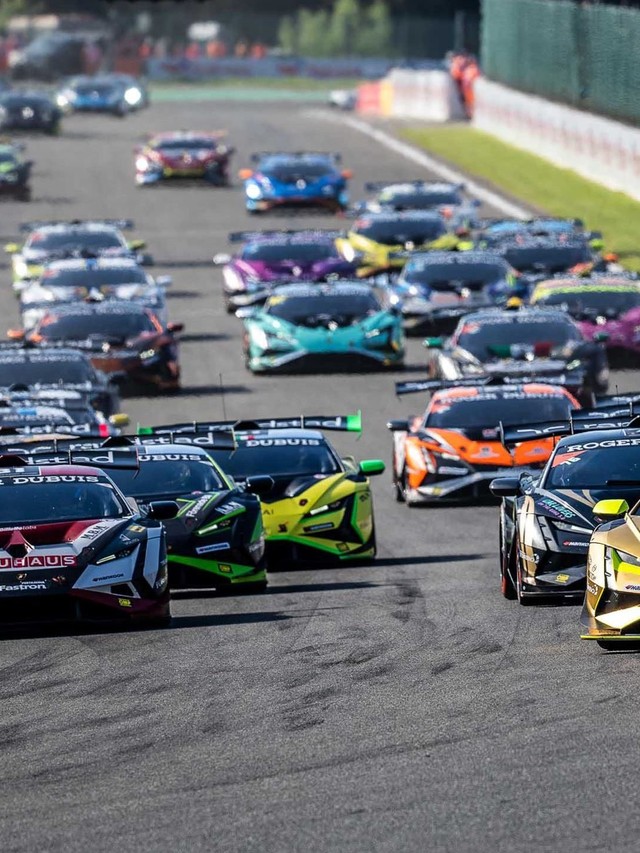
Thirty-four Lamborghini race cars will line up on the 5.842 km Paul Ricard circuit for the third round of the Lamborghini Blancpain Super Trofeo Europe, the largest grid the series has ever assembled. Twenty-eight of those entries are Huracán LP 620-2 Super Trofeo machines, with the remaining slots filled by older Gallardo competitors still fighting for class honors. For a one-make customer racing championship that started with just 11 cars in 2009, that growth tells a story far more interesting than any single race result, because the size of this grid is the clearest measure of whether Lamborghini’s motorsport ladder is actually working.
The competitive narrative heading into southern France sharpens the point. Patrick Kujala, the young Finnish driver representing Bonaldi Motorsport, holds a 20-point advantage over his nearest challengers after winning three of the first four races. He took both victories at Silverstone in May and the season opener at Monza in April. The Team Lazarus pairing of Sergio Campana and Fabrizio Crestani sits second in the standings after consistent third-place finishes at Silverstone, while Kujala’s own Bonaldi teammate Florian Spengler lurks close behind. Kujala’s dominance is impressive on its own terms, but it matters more in context: he is exactly the kind of young talent the Super Trofeo was built to develop, racing in a field deep enough to prove that his speed is genuine.
Why a Bigger Grid Means More Than Bragging Rights
Grid size in a customer racing series functions as a health indicator for the entire program. More entries mean more teams purchasing cars, more sponsors investing, and a deeper talent pool competing. The Super Trofeo’s expansion from those original 11 cars to 34 at Paul Ricard reflects sustained demand for what Lamborghini Squadra Corse offers: a professionally organized championship where gentleman drivers and aspiring professionals race identical machinery on the same weekends, feeding the same pipeline.
The series expanded into Asia in 2012 and North America in 2013, creating a global ecosystem that culminates each year in a World Finals event. One report from the 2015 World Finals at Sebring noted 66 cars on the combined grid, drawing competitors from all three regional championships. That convergence builds a community around the brand that no marketing campaign can replicate. Owners who race together, travel to circuits together, and share pit lane hospitality become the most loyal brand advocates Lamborghini could ask for.
For prospective buyers weighing a Super Trofeo entry against a Ferrari Challenge or Porsche Carrera Cup commitment, the record grid is a practical signal. A healthy field means closer racing, better resale values for used race cars, and a more robust support infrastructure at every round. The strength of the grid suggests the value proposition is resonating with the kind of high-net-worth individuals who can choose any racing program in the world.
The Huracán LP 620-2: Purpose-Built for This Fight
None of this growth happens without the right car. The Huracán LP 620-2 Super Trofeo debuted at the 2014 Geneva Motor Show as a purpose-built successor to the Gallardo Super Trofeo, stripping the road car’s all-wheel-drive system in favor of rear-wheel drive. That deliberate engineering choice sharpens throttle response and rewards precise driver inputs. In a one-make series where every car produces the same power, chassis balance and driver skill become the primary differentiators, which is precisely why the series works as a talent filter.
Lamborghini says the “LP 620-2” designation reflects the car’s output and driven wheels, a naming convention that tells you everything about the philosophy: enough power to be genuinely fast, delivered to two rear tires that demand respect. The aerodynamic package, visible in the aggressive body kit and substantial rear wing, generates meaningful downforce without burying the car in drag on Paul Ricard’s long Mistral straight.
What makes the platform succeed for customer racing is its accessibility. The Huracán Super Trofeo needs to be fast enough to thrill experienced drivers and forgiving enough that an AM class competitor can push hard without constant fear of the car snapping sideways. That balance between excitement and approachability is what separates a successful one-make series from a cautionary tale. The record grid suggests Lamborghini found the sweet spot, and the four-class structure built around this car ensures the field stays deep across every skill level.
The Championship Battle Across Four Classes
The multi-class structure is central to why the grid keeps growing. Beyond Kujala’s PRO class dominance, the Antonelli Motorsport pairing of Daniel Zampieri and Roman Mavlanov earned second-place finishes at both Monza and Silverstone, while Raton Racing’s Edoardo Liberati and Patric Niederhauser broke through for their first podium with a second place in Race One at Silverstone. The PRO class fight behind Kujala is tight enough that a strong weekend at Paul Ricard could reshape the standings.
In PRO-AM, Swiss driver Adrian Amstutz of Konrad Motorsport leads after claiming his first class victory at Silverstone. The AM class belongs to Shota Abkhazava of Artline Team Georgia, who recorded first and second place finishes at both Monza and Silverstone, building a nine-point cushion. In the Gallardo AM Cup, where older machinery still competes, Argentinian Andres Josephsohn from Bonaldi Motorsport leads after four podiums from four races. Carina Lima of Imperiale Racing, the sole female driver entered at Paul Ricard, races alongside veteran Andrea Palma in the Gallardo class.
A gentleman driver battling for the AM title experiences the same pit lane, the same circuit, and the same Lamborghini hospitality as the PRO frontrunners, but with competition calibrated to their skill level. That inclusivity is by design, and it is the structural reason the grid number keeps climbing. Each class creates its own championship story, its own heroes, and its own reasons for teams to return the following season.
From Super Trofeo to GT3: Where the Ladder Leads
All of this participation feeds a strategic purpose that extends well beyond the series itself. Lamborghini’s customer racing ladder is designed so that drivers who prove themselves in the one-make championship can graduate to GT3 competition, where Huracán GT3 cars compete against machinery from Ferrari, Porsche, McLaren, and Mercedes-AMG in international endurance and sprint series.
This pipeline becomes even more significant with the arrival of the Temerario GT3, which Lamborghini describes as its first competition car fully designed, developed, and built in-house. Previous GT3 efforts involved external partners for development and construction. The in-house approach signals that Squadra Corse views customer motorsport as a core competency, not an outsourced marketing exercise. Drivers entering the Super Trofeo today are training on the bottom rung of a ladder that now leads to a factory-engineered GT3 program with genuine works ambition.
The practical takeaway for anyone watching the Super Trofeo from the outside is straightforward: the health of this series directly influences the quality of Lamborghini’s GT3 effort. More entrants mean a deeper talent pool, which means stronger driver lineups in GT3, which means better results at races like the 24 Hours of Spa and the Rolex 24 at Daytona. The record grid at Paul Ricard is a leading indicator, not just a statistic. It is the foundation on which Lamborghini’s entire competitive future is being built.
How to Watch the Paul Ricard Weekend
The Paul Ricard schedule opens with two one-hour free practice sessions on Friday. Qualifying runs Saturday morning at 9:15 CET, split into two 15-minute sessions with a five-minute break between them. Race One follows Saturday afternoon at 14:30 CET over the standard 50-minute distance, with Race Two set for Sunday at 10:50 CET.
Both races will be live-streamed on the official Lamborghini Squadra Corse website and broadcast live on Nuvolari in Italy and Motors TV across Europe. Full replays typically appear on Lamborghini’s digital channels within days of each event.
Gallery


