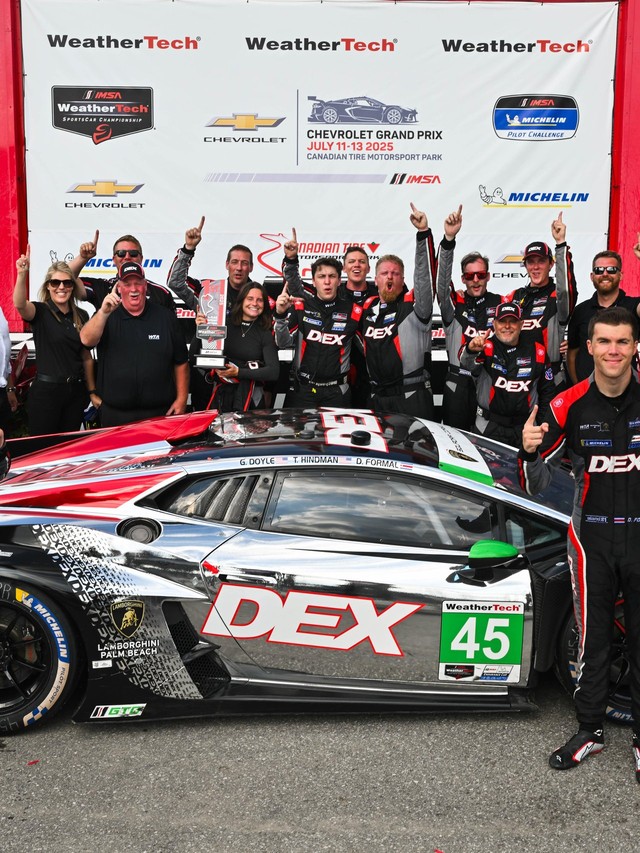
A Back-to-Front Victory at Mosport
Danny Formal took the green flag at Mosport’s Canadian Tire Motorsport Park on July 14 from fifth on the grid, a reasonable starting position for the #45 Wayne Taylor Racing Lamborghini Huracán GT3 EVO2. Nine corners later, the race looked over. Contact from the #021 Ferrari at turn nine sent Formal spinning to the back of the GTD field, and the car picked up a cracked rim in the process. What followed over the next two hours and forty minutes was one of the more audacious strategic recoveries in recent IMSA WeatherTech SportsCar Championship memory, and a case study in how a team can win not by outrunning the field but by outsmarting it.
The result was Lamborghini’s first IMSA victory of the 2025 season and Wayne Taylor Racing’s inaugural IMSA GTD win with the marque. For both Formal, a Lamborghini Young Professional Driver, and co-driver Trent Hindman, a past Lamborghini Super Trofeo World Finals winner at Imola in 2017, it marked a maiden IMSA triumph. That it arrived through a combination of mechanical misfortune, physical endurance, and a pit wall gamble most teams would have rejected tells you everything about where the Huracán GT3 EVO2 stands in its final competitive chapter: still capable of winning, but only when the humans around it refuse to accept the car’s on-paper disadvantages as the final word.
The Gamble: Staying Out When Everyone Else Pitted
The strategic architecture of this win came down to one call. After Formal nursed the Huracán through the opening stint on a damaged rim, he later described the vibration as so severe he lost feeling in his right arm and leg, and Hindman climbed in for what became an extended second stint. The team needed track position, and they needed it without the pace to simply drive through the field on raw speed.
When a Full Course Yellow bunched the pack, conventional wisdom dictated a pit stop: fresh tires, a full fuel load, and a restart from somewhere in the middle of the pack. Most of the GTD field followed that playbook. Wayne Taylor Racing went the other direction. They kept Hindman on track, gambling that used tires and a lighter fuel load would be enough to hold position if, and only if, another caution period arrived before the car ran dry.
Hindman emerged from the restart with a 30-second advantage over the next GTD competitor. The margin was enormous, but also fragile. Without at least one more neutralization, the fuel math would not work. Hindman would have to pit under green, surrendering everything the team had just gained.
The caution came. The #78 Forte Racing Lamborghini Huracán GT3 EVO2, running second in GTD at the time, was hit by an LMP2 car and crashed out of the race. A second neutralization followed shortly after, and the race ultimately finished under yellow. Hindman never had to make that green-flag stop.
WTR’s pit wall had essentially identified that the car’s deficit after the opening-lap incident was too large to recover through pace alone. The only viable path to a win was asymmetric strategy: accepting the risk of running out of fuel in exchange for the possibility of a caution that would compress the field and eliminate the time lost. In sprint-format IMSA races, where caution periods are less frequent than in endurance events, that is a genuinely bold call. It also reveals something important about the Huracán GT3 EVO2’s competitive position. When the heaviest car on the grid cannot fight its way forward on raw lap time, the team’s strategic intelligence becomes the decisive weapon.

The Lamborghini Huracán GT3 EVO navigates a sharp turn on the track, showcasing its racing prowess.
The Heaviest Car on the Grid Still Won
Lamborghini acknowledged something unusual in its account of the weekend: the Huracán GT3 EVO2 arrived at Mosport as the heaviest car on both the GTD and GTD Pro grids. In a category governed by Balance of Performance regulations, where organizers adjust power, weight, and aero to equalize competition, carrying the most mass is a meaningful disadvantage, particularly at a circuit defined by elevation changes and high-speed corners that reward low inertia.
The car’s listed dry weight sits at 1230 kg, according to Wayne Taylor Racing’s published specifications. Its 5204 cc naturally aspirated V10 delivers power through a six-speed sequential Xtrac gearbox to the rear wheels only, with a Bosch Motorsport traction control system offering ten adjustable positions. The chassis combines aluminum and carbon fiber, with carbon composite external panels. None of that is new for anyone who follows Lamborghini’s customer racing program, but the weight context matters because it frames the strategic decision. A heavier car on older tires, driven by a co-driver who had been in the cockpit for an extended stint without water, should not have won this race on pure pace. It won because the team recognized its limitations and built a strategy around them.
Mosport’s layout, with its fast sweeping corners and significant elevation changes, typically rewards cars that can carry speed through transitions. The Huracán GT3 EVO2’s aerodynamic package, featuring revised splitters, diffuser, and adjustable rear wing elements, appears well suited to generating the downforce needed for stability in those sections. But carrying more weight through those same corners costs time on every lap. WTR’s approach essentially minimized the number of competitive laps Hindman needed to run against lighter, fresher rivals, turning a hardware disadvantage into a strategic premise rather than an excuse.

The Lamborghini Huracán GT3 EVO showcases its powerful rear design as it speeds down the race track.
Formal and Hindman: Iron Man Stints and a Broken Rim
No strategy survives without drivers willing to suffer for it. Formal drove the entire opening stint on a cracked rim after the turn-nine contact. The vibration, by his own account, was severe enough to numb his right arm and leg. Most drivers would have pitted immediately. The team told him to keep pushing.
“The vibration was abnormal. The team told me to keep on going and push through. Kind of had no feeling on my right arm and leg due to the vibration but the car was fantastic at race pace.”
That is not a comfortable situation in any racing car, but it is especially demanding in a rear-wheel-drive GT3 machine where feel through the steering and pedals is essential for managing traction. Formal’s ability to maintain competitive lap times while essentially driving partially blind to feedback from the right side of the car is the kind of detail that separates a race report from a race story.
Hindman’s contribution was different but equally taxing. He drove the elongated second stint, the one that made the entire strategy possible, without water. In a closed-cockpit GT3 car during a summer race in Ontario, cockpit temperatures routinely exceed 50 degrees Celsius. His post-race comment was characteristically understated:
“Whatever those Wayne Taylor Racing guys up on that pit box tell me, I believed. I trust them.”
That level of driver-to-engineer trust is what makes asymmetric strategies possible. If Hindman had questioned the call, pitted early, or lost pace from dehydration at the wrong moment, the entire plan collapses. Teams that run customer GT3 programs often talk about the importance of driver confidence in the pit wall. This race was a textbook example of what that actually looks like under pressure, and further proof that the Huracán GT3 EVO2’s results increasingly depend on the quality of the people operating it.

Two victorious Lamborghini drivers proudly display their trophies on the podium after a successful race.
What Mosport Means for Lamborghini’s IMSA Season and the Huracán’s Final Chapter
This win carries weight beyond the points table. The Huracán GT3 platform, in various evolutionary forms, has been Lamborghini’s sole GT3 weapon for a decade. As Road & Track noted in its analysis of the successor, eleven different manufacturers introduced entirely new GT3 cars during that same period, while Lamborghini continued refining the same basic architecture. The Temerario GT3, which debuted at the 2025 Goodwood Festival of Speed as Lamborghini’s first competition car fully designed, developed, and built in-house at Sant’Agata Bolognese, represents the end of that long evolutionary road.
For customer teams currently running the Huracán GT3 EVO2, the Mosport result is a useful data point. The car can still win in IMSA’s GTD class, even with a weight penalty, even after a lap-one disaster, provided the team and drivers execute at a high level. That matters because the transition to the Temerario GT3 will take time, and teams need confidence that their current equipment remains competitive during the overlap period.
WTR’s broader trajectory with Lamborghini reinforces the point. The team boasts nine Lamborghini Super Trofeo North America Championship titles, and Indianapolis 500 winner Marcus Ericsson is slated to join the #45 Huracán GT3 EVO2 for the 2026 Rolex 24 at Daytona. The Mosport win, WTR’s first in IMSA GTD, validates the team’s investment in the Lamborghini GT3 program at precisely the moment when that program is about to undergo its most significant hardware change in a decade.
In GTD Pro, the #9 Pfaff Motorsports Huracán GT3 EVO2 of Lamborghini Factory Drivers Andrea Caldarelli and Marco Mapelli finished fifth in their home race after topping opening practice on Friday. The result was solid if unspectacular, but it reinforced the car’s baseline competitiveness at a circuit that, on paper, should not favor the heaviest entry.

The victorious Lamborghini racing team celebrates their win with the Huracán GT3 EVO at the awards ceremony.
Lamborghini’s GT3 Competitive Position: Reading Between the BoP Lines
Whenever a GT3 car wins despite being the heaviest on the grid, Balance of Performance looms over the conversation. BoP adjustments are designed to create parity, but they are imperfect instruments. Lamborghini has not publicly commented on whether it expects BoP changes following the Mosport result, and the company’s official account of the race focuses on strategy and driver performance rather than any mechanical advantage.
The more interesting question for Lamborghini enthusiasts watching the GT3 landscape is what happens next. The Huracán GT3 platform competes against newer-generation machinery from several manufacturers, and the weight penalty at Mosport suggests the current BoP tables are not working in the car’s favor. Winning despite that handicap is impressive, but it also underscores the reality that the Huracán GT3 EVO2 is fighting with one hand tied behind its back in certain configurations.
The Temerario GT3, with its twin-turbocharged V8 architecture (the hybrid system from the road car is stripped for racing, as Car and Driver reported), will arrive as an entirely different proposition. Whether it receives more favorable BoP treatment as a new entrant remains to be seen. What the Mosport result proves is that Lamborghini’s customer racing infrastructure, the relationship between Squadra Corse and teams like WTR, remains strong enough to extract results from aging hardware. That institutional knowledge transfers to new platforms. The engineering changes; the people and the culture do not.
The practical takeaway is straightforward: the Huracán GT3 EVO2 can still compete at the sharp end of IMSA GTD, but it increasingly depends on strategic creativity and driver execution rather than outright pace advantage. That is both a testament to the car’s fundamental soundness and a clear signal that the Temerario GT3 cannot arrive soon enough.

The Lamborghini Huracán GT3 EVO car skillfully takes a corner on the track, watched by a distant crowd.
Gallery


