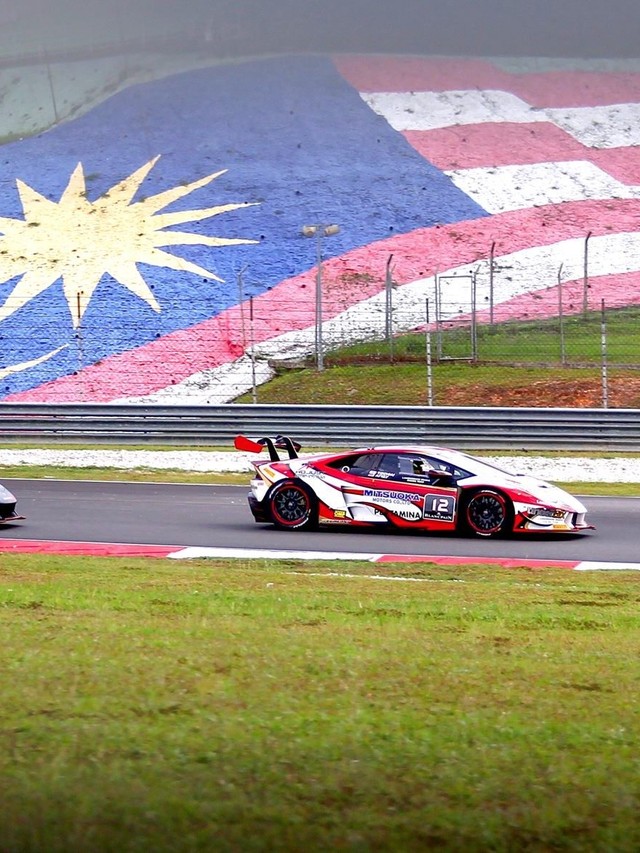
Yazid and Ochiai Sweep Sepang in a Commanding Double-Header
When a driver graduates from a manufacturer’s young-talent pipeline and then dominates a round of that manufacturer’s own racing series, the result is more than a trophy haul. It is a vindication of the entire system. On August 14, 2016, Malaysian driver Afiq Yazid and Japanese teammate Toshiyuki Ochiai delivered exactly that, winning both races at Round 4 of the Lamborghini Blancpain Super Trofeo Asia series at Sepang International Circuit.
The pair secured pole position for both races and converted those front-row starts into clean victories, a result that looks dominant on paper but required genuine racecraft to execute. Race 1 started with Sri Lankan driver Dilantha Malagamuwa and Indian teammate Armaan Ebrahim on pole after qualifying. Zen Low and Italian co-driver Max Wiser sat second, while Yazid and Ochiai qualified third, more than 1.5 seconds off the pace. That gap evaporated once the lights went out. Yazid and Ochiai moved past Malagamuwa and Ebrahim to take the lead, while the pairing of Yudai Uchida (Japan) and Jono Lester (New Zealand) produced one of the day’s most impressive drives, climbing from tenth on the grid to finish third.
Race 2 followed a similar script. Yazid and Ochiai locked out pole in qualifying this time and never relinquished it, holding off Uchida and Lester, who again charged through the field to claim second. Malagamuwa and Ebrahim slipped to third. In the AM class, Vincent Wong and Sanghwi Yoon delivered a strong Race 2 performance, finishing fifth overall and first in class after starting eighth. Andrew Haryanto, a likely AM class favorite, did not finish Race 2 due to an unforced error. Sam Lok claimed the Lamborghini Cup class win in the second race after Supachai Weeraborwornpong took that honor in Race 1.
From Young Driver Program Graduate to Series Contender
What makes Yazid’s dominance worth examining beyond the podium photos is the path that brought him to Sepang’s top step. A graduate of Lamborghini’s Young Driver Program, he represents exactly the kind of outcome Squadra Corse designed the initiative to produce: a raw talent, identified early, given structured seat time in identical machinery, and developed into a consistent front-runner capable of overcoming a 1.5-second qualifying deficit to win.
Lamborghini says Yazid competed in the Super Trofeo Asia series for four consecutive years by 2016, a tenure that transformed him from a promising newcomer into a genuine contender. The Young Driver Program functions as a talent filter. Lamborghini scouts emerging drivers across its regional series, provides coaching and development resources, and gives selected participants the opportunity to prove themselves in competitive, well-supported racing environments. The program does not guarantee a factory contract, but it builds the foundational skills and brand relationship that make a driver visible when seats open in higher categories.
Few competitor one-make series offered a comparable formal development structure at the time. Ferrari Challenge and Porsche Carrera Cup both run robust customer racing platforms, but Lamborghini’s explicit branding of its pipeline as a “Young Driver Program” gave it a distinct identity, one that connected the grassroots Super Trofeo grid directly to the company’s professional motorsport ambitions. For aspiring racers in the Asia-Pacific region, the Super Trofeo series represented one of the few manufacturer-backed pathways that combined competitive racing with genuine developmental support. Yazid’s Sepang sweep was the clearest evidence yet that the pathway worked.
The Huracán Super Trofeo: Built to Teach as Much as to Win
The car underneath Yazid and every other driver at Sepang played its own role in that developmental story. The Huracán Super Trofeo LP 620-2 is a rear-wheel-drive, naturally aspirated V10 race car stripped to its competitive essentials. That rear-drive layout is a deliberate choice in a one-make series: it rewards throttle control, punishes laziness, and exposes the gap between a competent driver and a quick one. Every Lamborghini road car in the Huracán family offered all-wheel drive as standard, so the race car’s rear-drive configuration tells you something about what Squadra Corse prioritized. Driver development, not safety nets.
The car bodies extensively utilize carbon fiber for components like bumpers, wings, and diffusers. Safety features include an FIA FT-3 fuel cell, a full roll cage, a Brembo Racing brake system, and HANS device compatibility. The adjustable rear wing allows for track-specific aerodynamic tuning, a detail that matters at a circuit like Sepang where long straights and tight, technical corners create competing aerodynamic demands. Lightweight Makrolon polycarbonate replaces glass for the windscreens and windows, and inside, Alcantara trim surrounds racing bucket seats constructed from Kevlar and carbon fiber.
The series format reinforces the developmental mission just as deliberately as the car’s engineering. Each event features a 50-minute practice session, a 35-minute qualifying session, and two 50-minute races with a compulsory driver change. That structure tests consistency and teamwork across an entire weekend rather than rewarding a single hot lap, which is precisely why a pairing like Yazid and Ochiai, refined over multiple seasons together, could overcome a qualifying deficit and still dominate.
Super Trofeo Asia as Lamborghini’s Regional Brand Builder
Sepang International Circuit holds a particular significance in the Super Trofeo timeline. Lamborghini says it hosted the championship’s Asian debut in 2012 and the global World Final in 2014, making it the circuit most closely associated with the series’ expansion beyond Europe. The 2012 Asian series reportedly featured 18 teams from countries including China, Malaysia, and Japan, establishing a regional footprint that grew steadily over subsequent seasons.
The strategic logic is straightforward. Asia-Pacific represents one of Lamborghini’s fastest-growing markets, and customer racing serves a dual purpose: it gives wealthy enthusiasts a structured, manufacturer-supported way to use their cars at ten-tenths, and it keeps the Lamborghini brand visible in motorsport contexts where Ferrari Challenge and Porsche one-make series also compete for attention and participants. The grid at Sepang in 2016 reflected this international ambition, with drivers from Malaysia, Japan, Sri Lanka, India, Indonesia, Singapore, Hong Kong, Taiwan, Korea, and New Zealand all competing under the same Lamborghini banner.
For prospective participants, the financial commitment of entering a Super Trofeo season remains a question Lamborghini does not publicly detail. What the series does offer is a turnkey racing experience: identical cars, manufacturer logistics, professional event organization, and a clear championship structure that culminates in a global World Final. That package competes directly with Ferrari’s and Porsche’s customer racing offerings, and the diversity of nationalities on the 2016 Sepang grid suggests it found a receptive audience. More importantly for the developmental thesis, a grid this international means Young Driver Program graduates like Yazid are tested against a genuinely varied competitive field, not a narrow regional talent pool.
From One-Make Grids to Factory Programs: The Bigger Motorsport Picture
Lamborghini’s motorsport ecosystem operates on a ladder principle, and the Super Trofeo series sits at its base. Above it, the Huracán GT3 (and later the GT3 Evo) competed in international endurance and sprint series like the Blancpain GT Series, IMSA, and the Asian Le Mans Series. The connection between these tiers is not abstract. Drivers who prove themselves in Super Trofeo gain the visibility, the racecraft, and the manufacturer relationship needed to move into GT3 programs, either as funded young drivers or as experienced gentleman racers stepping up.
By 2016, this pipeline was already producing results, and its importance only grew as Lamborghini’s motorsport ambitions expanded. The company would eventually enter top-tier prototype racing with the SC63 LMDh car and develop the Temerario GT3 as its next-generation customer racing platform. According to Autoblog, the Temerario GT3 represents Lamborghini’s first competition car to be fully designed, developed, and built entirely in-house, a significant evolution from the outsourced development model used for earlier GT3 machinery.
Without a robust customer racing base generating revenue, developing driver talent, and keeping the brand embedded in motorsport culture across multiple continents, that leap into prototype racing and in-house GT3 development would lack the institutional foundation it now relies on. Yazid’s double win at Sepang is a small data point in that larger story, but it illustrates the mechanism at its most visible: identify talent through a formal program, give it a competitive platform in identical rear-drive machinery, and let results speak.
Next Stop: Fuji, Then Valencia for the World Final
The 2016 Super Trofeo Asia season continued at Fuji International Speedway in Japan on September 17th and 18th, the fifth and final Asian round before the World Final in Valencia, Spain, scheduled for early December. Since 2013, the World Final brought together drivers from all three continental championships (Europe, North America, and Asia) to compete for an overall Lamborghini world champion title, giving regional series results direct consequences on a global stage.
For anyone following Yazid’s trajectory, the practical question after Sepang was whether his double-win momentum could carry through Fuji and into Valencia. The Young Driver Program connection made him more than a privateer chasing trophies; he was a proof-of-concept for Lamborghini’s talent development model. Whether that translated into a factory GT3 opportunity or a long Super Trofeo career, the Sepang results confirmed that the investment was producing competitive drivers who could dominate a multi-national field on a circuit with genuine F1 pedigree.
Gallery


