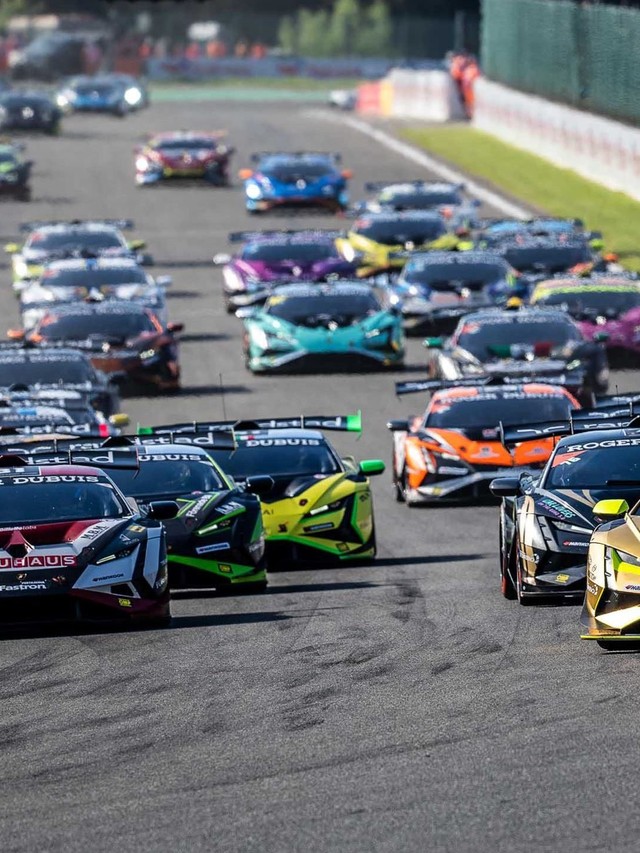
Spinelli, Abkhazava, and a Last-Lap Pass: The 2015 Super Trofeo Finale That Set the Tone
Loris Spinelli clinched the 2015 PRO-AM title racing with Antonelli Motorsport, and the way he did it tells you everything about the kind of series Lamborghini was building. Two podium finishes alongside new entry Riccardo Agostini, including first and second place class results on the day, sealed a championship that rewarded consistency and racecraft over raw machinery advantages. In the AM category, Georgian driver Shota Abkhazava took the title with Artline Team Georgia, while the Imperiale Racing pairing of Carina Lima and Andrea Palma claimed the Gallardo AM crown.
The racing itself delivered the sort of unpredictable drama that one-make series thrive on. Race One saw Swiss driver Patrie Niederhauser cross the finish line first, only to lose the result to a penalty for violating the mandatory pit stop window. A safety car period, triggered by the retirement of Mavlanov (who had taken over from Zampieri in the other Antonelli Motorsport entry), compressed the field and turned the closing laps into a parade behind the pace car. Laurent Jenny and Cedric Leimer of X Bionic Racing Team collected the AM Class win, while Andres Josephsohn and Ricardo Vera took the Gallardo Class.
Race Two was wilder still. Kujala retired early, heavy rain brought out the safety car again, and Niederhauser led from pole until his mandatory pit stop reshuffled the order. Agostini inherited the lead, with the Leipert Motorsport car of Mikko Eskelinen and Kelvin Snoeks right behind him. Then Schegelmilch passed both of them on the final lap. That kind of finish, a last-corner lunge in mixed conditions with a championship on the line, was exactly the sort of story the Super Trofeo needed to build its reputation. Alberto Di Falco won the Pro Class after fighting from the back of the grid to sixth overall, and the Jenny-Leimer duo doubled up with another AM Class victory. Ivan Benvenuti of Imperiale Racing rounded out the Gallardo Class.
Why Early Huracán GT3 Wins Mattered More Than the Trophies Suggest
A customer racing series lives or dies on participation, and participation depends on credibility. In 2015, Lamborghini Squadra Corse was still proving that the Huracán platform could anchor a professional racing ecosystem. The Gallardo had served well, and the fact that a dedicated Gallardo AM class still ran alongside the Huracán entries showed Lamborghini supporting its older hardware rather than abandoning teams that had invested in the previous generation. That decision mattered commercially: it told prospective customer teams that buying into a Lamborghini racing program carried long-term value.
The Huracán GT3’s early results gave Squadra Corse the competitive proof it needed to attract more teams and more serious driver talent. Antonelli Motorsport, Raton Racing, Leipert Motorsport, Imperiale Racing: these were real privateer operations committing real budgets. When those teams won races and championships, the effect rippled outward. Prospective entrants could see that the car was competitive, that the series delivered genuine racing, and that Lamborghini provided the organizational infrastructure to make it work across multiple continents.
The Super Trofeo today runs three continental championships (Europe, Asia, and North America) culminating in a World Final, all using the Huracán Super Trofeo EVO2. Over 20 customer teams now field Huracán GT3 variants in FIA-regulated championships worldwide. That scale did not appear overnight. It grew from seasons like 2015, where results, drama, and team loyalty built the foundation.
From Gallardo to Huracán to Temerario: Lamborghini’s GT3 Platform Evolution
The 2015 season captured a generational handover in real time. The Gallardo AM class represented the end of one era, while the Huracán GT3 entries represented the beginning of another. Lamborghini managed that transition more gracefully than most manufacturers handle platform changes in customer racing, keeping both car types competitive and relevant within the same event weekends.
The Huracán GT3 went on to become one of the most successful and widely campaigned GT3 cars in the world, evolving through EVO and EVO2 specifications. Each iteration refined aerodynamics, cooling, and driver aids while maintaining the naturally aspirated V10 that gave the car its distinctive character on track.
Lamborghini recently unveiled the Temerario GT3 at the Goodwood Festival of Speed, and as Jalopnik noted, the racing version strips out the road car’s hybrid system entirely. The successor faces a tall order: the Huracán GT3 platform accumulated nearly a decade of development, race wins, and team familiarity. For customer teams that built their programs around the Huracán’s V10 characteristics, the transition to the Temerario’s twin-turbo V8 means adapting to an entirely different powerband and weight distribution. Lamborghini’s track record of managing exactly this kind of platform transition, visible as far back as 2015, will be the best argument it can make to retain those teams’ loyalty.
Lamborghini’s Customer Racing Strategy Compared to Ferrari and Porsche
Customer racing programs serve a dual purpose for every manufacturer that runs one: they generate revenue from car sales, parts, and series fees, and they build brand credibility that filters back to the showroom. Lamborghini, Ferrari, and Porsche all operate one-make championships and supply GT3 machinery to privateer teams, but their approaches differ in emphasis.
Porsche fields the largest volume of customer race cars globally, with decades of Carrera Cup infrastructure. Ferrari runs the Ferrari Challenge as a tightly controlled brand experience that doubles as a feeder system for its GT3 efforts. Lamborghini’s Super Trofeo occupies a middle ground: smaller in total car count than Porsche’s ecosystem, but more directly integrated with Squadra Corse’s GT3 ambitions. The SC63 LMDh program, which Jalopnik reported Lamborghini wound down after two seasons, represented the brand’s first factory-entered prototype effort in a world championship. Its struggles do not erase the customer racing foundation, but they highlight how different factory prototype racing is from the customer-team model that Lamborghini executes well.
The practical takeaway for anyone considering a Lamborghini customer racing program: the Super Trofeo remains one of the most accessible entry points into serious GT racing, with strong organizational support and a competitive grid. The question going forward is whether the Temerario GT3 can replicate the Huracán’s dominance quickly enough to keep teams from looking at rival GT3 options during the transition period.
What the 2015 Season Still Means for Lamborghini’s Racing Future
Seasons like 2015 rarely get remembered individually. Spinelli’s PRO-AM title, Abkhazava’s AM championship, the Gallardo class winners: these belong to the historical record. What endures is the structural proof that Lamborghini could run a multi-class, multi-team customer racing series with genuine competitive integrity, manage a platform transition without alienating existing teams, and produce the kind of on-track drama that attracts new entrants and sponsors.
That blueprint still operates today. The Super Trofeo continues to crown PRO-AM and AM champions across three continents. The Temerario GT3 will need to earn its credibility the same way the Huracán did: one race weekend, one customer team, one championship at a time. Lamborghini’s 2015 season was the proof of concept. Everything since, the global expansion, the GT3 dominance, the World Final format, grew from that foundation.
Gallery


