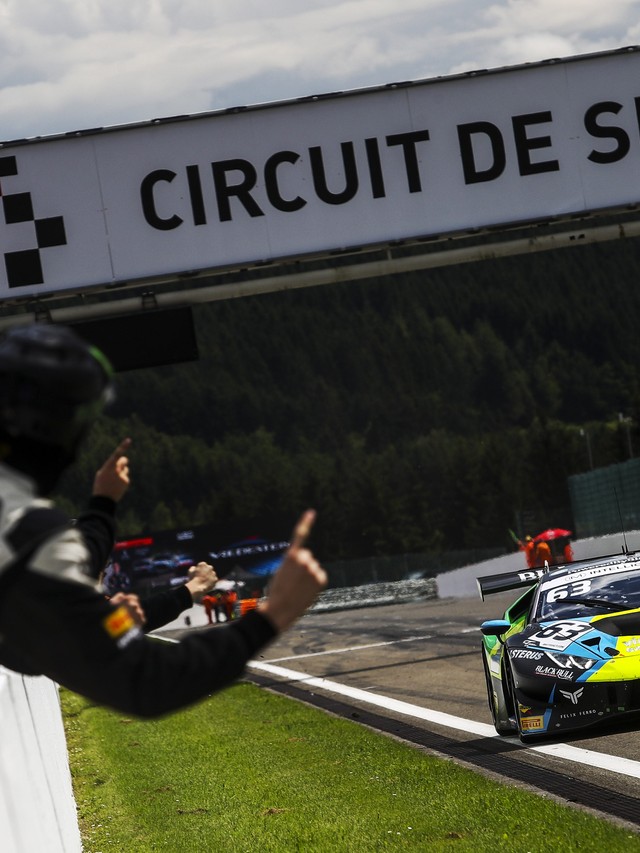
A 48-Second Lesson at Spa-Francorchamps
Winning a two-hour British GT Championship race is one thing. Winning it by 48 seconds, with your sister car filling the second step of the podium, tells a different story altogether. At Spa-Francorchamps on 25 July 2021, Barwell Motorsport’s #63 Lamborghini Huracán GT3 Evo, driven by Dennis Lind and Leo Machitski, did exactly that, while WPI Motorsport’s #18 entry with Michael Igoe and Phil Keen completed a Lamborghini lockout of the top two positions. That margin works out to nearly a second per lap over a field that included Aston Martins and other GT3 machinery, pushing well past a comfortable win into outright dominance.
Lind and Machitski started from pole, and the gap only grew. Machitski posted several fastest laps during his opening stint, building a 21-second cushion before the pit window. Lind then stretched that advantage beyond 30 seconds after the stops, eventually crossing the line with 48 seconds in hand. The result gave the pair their second British GT victory of the season and moved them to the top of the championship points standings heading into the next round at Snetterton.
Locking out the top two positions at a 7.004km circuit renowned for punishing mechanical weakness and rewarding aerodynamic efficiency amounts to a statement about the Huracán GT3 Evo as a complete package. Not just a quick car on a short sprint track, but a platform whose engineering depth becomes more visible the longer and harder you push it.
What Makes the Huracán GT3 Evo Work at Spa
Spa-Francorchamps is one of the most demanding circuits on any GT3 calendar. Eau Rouge’s compression loading, the high-speed Blanchimont kink, and the tight La Source hairpin force a car to perform across the entire speed range. A GT3 machine that excels here cannot be a one-trick aero car or a low-drag straight-line special. It needs balance, and the 48-second margin suggests the Huracán GT3 Evo had it in abundance.
According to TopSpeed, the car represents an evolution of the original Huracán GT3 and can be purchased either as a standalone model or as an upgrade kit for existing Huracán GT3 chassis. That upgrade path matters commercially: customer teams can evolve with the platform rather than buying entirely new cars every cycle, lowering the barrier to competitive racing. At the heart of the Evo sits a version of Lamborghini’s 5.2-liter naturally aspirated V10, a powerplant whose lineage traces directly to the road-going Huracán. One source reports power output figures around 620 hp at 8,250 rpm, paired with a six-speed sequential gearbox.
The aerodynamic package features a redesigned front splitter, dive planes for additional front-axle downforce, and a manually adjustable rear wing with optimized endplates. The carbon fiber hood borrows its central cooling rib from the Huracán Super Trofeo Evo, illustrating how Lamborghini’s various racing programs feed components laterally across platforms. A dry weight reported at 1,230 kg keeps the power-to-weight ratio competitive, but the real advantage at Spa is likely the naturally aspirated engine‘s throttle response. Turbo lag, even the small amounts present in modern GT3 turbocharged cars, can cost time in the rapid on-off throttle transitions that Spa’s middle sector demands. The V10’s linear power delivery gives drivers like Lind and Machitski a precise tool for managing traction out of slow corners and confidence at high-speed entries.

The red Lamborghini Huracán GT3 Evo, number 18, takes a corner with precision at Spa-Francorchamps.
From the Track to the Showroom: Why Customer Racing Results Matter
Lamborghini’s customer racing philosophy operates on a simple principle: if privateer teams can win races with your car, the engineering credibility flows back to the road car brand. When a gentleman driver like Leo Machitski can set fastest laps at Spa in a Huracán GT3 Evo, it validates both the car’s accessibility and the support infrastructure that Squadra Corse provides to its customer teams.
The GT3 class exists specifically to let manufacturers prove their engineering in a regulated, cost-controlled environment. Balance of Performance rules ensure no single manufacturer can simply outspend the field on horsepower. Victories come from chassis balance, aerodynamic efficiency, reliability, and the quality of factory support. A one-two finish reflects more than raw speed. It reflects a mature, well-developed platform and a support network that helps teams extract the car’s full potential.
For prospective Lamborghini road car buyers, this connection is more direct than it might seem. The Huracán STO, the most track-focused road-legal Huracán, shares significant aerodynamic and suspension philosophy with the GT3 program. When Lamborghini says the STO’s development was informed by racing, results like this Spa lockout provide the receipts. Buyers who want to know whether the engineering behind their road car is genuinely race-proven can point to specific weekends, specific circuits, and specific margins of victory. Forty-eight seconds at Spa is a particularly convincing receipt.

Two Lamborghini race drivers celebrate in their green suits and masks, with their Huracán GT3 Evo race car in the background.
Lamborghini’s Broader Motorsport Push Beyond British GT
The Spa result did not arrive in isolation. Lamborghini says that VS Racing’s Michele Beretta and Frederik Schandorff maintained their lead in the International GT Open points standings after the latest round at Imola, carrying a five-point cushion into the summer break. Consistent championship contention across multiple series demonstrates platform strength rather than a single lucky weekend, reinforcing the same engineering depth that produced the Spa margin.
Squadra Corse was also preparing for the Spa 24 Hours, fielding eight crews and 28 drivers in what remains one of the most grueling GT3 endurance events on the calendar. Running a car hard for two hours at Spa is one thing. Running it for 24 is an entirely different engineering exam, testing cooling systems, gearbox durability, and brake longevity under sustained load. The commitment of eight entries signals confidence in the platform’s mechanical endurance, not just its outright pace.
This multi-series presence positions Lamborghini competitively against Ferrari and Porsche, both of which run extensive customer GT3 programs. The difference for Lamborghini in 2021 was the Huracán’s naturally aspirated V10, a philosophical outlier in a class increasingly populated by turbocharged engines. That engine character, the immediate throttle response and the unmistakable high-rpm wail, gave customer teams a distinctive tool and gave spectators a reason to pay attention.

A fleet of GT race cars, including a Lamborghini Huracán GT3 Evo, battle through a smoky turn at Spa-Francorchamps.
The Huracán GT3 Platform’s Legacy and What Comes Next
Every dominant racing platform eventually faces succession. Car and Driver reports that the Lamborghini Temerario GT3, designed to replace the Huracán GT3 Evo 2, represents the first race car entirely designed and developed at Lamborghini’s Sant’Agata Bolognese facility. The Temerario GT3 will use a modified version of the road car’s twin-turbocharged V8, marking a fundamental shift away from the naturally aspirated V10 that defined the Huracán’s racing identity.
That transition raises genuine questions for customer teams. Squads like Barwell Motorsport and WPI Motorsport built their programs around the Huracán’s characteristics. Adapting to an entirely new powerband, different weight distribution, and the complexities of turbo management in wheel-to-wheel racing will require significant recalibration. The upgrade-kit approach that TopSpeed notes for the current GT3 Evo, where teams could evolve existing chassis, will not carry over to a fundamentally new platform.
Results like this Spa one-two become part of the Huracán’s permanent record. The platform’s racing resume, built across British GT, International GT Open, Super Trofeo championships, and endurance classics, will serve as the benchmark against which the Temerario GT3 is measured. For Lamborghini enthusiasts watching the brand navigate its transition to hybrid and turbocharged powertrains, these final-era Huracán GT3 victories carry extra weight. They represent the closing chapter of Lamborghini’s naturally aspirated racing era, and the 48-second margin at Spa suggests the V10 still had plenty left to say.
Gallery


