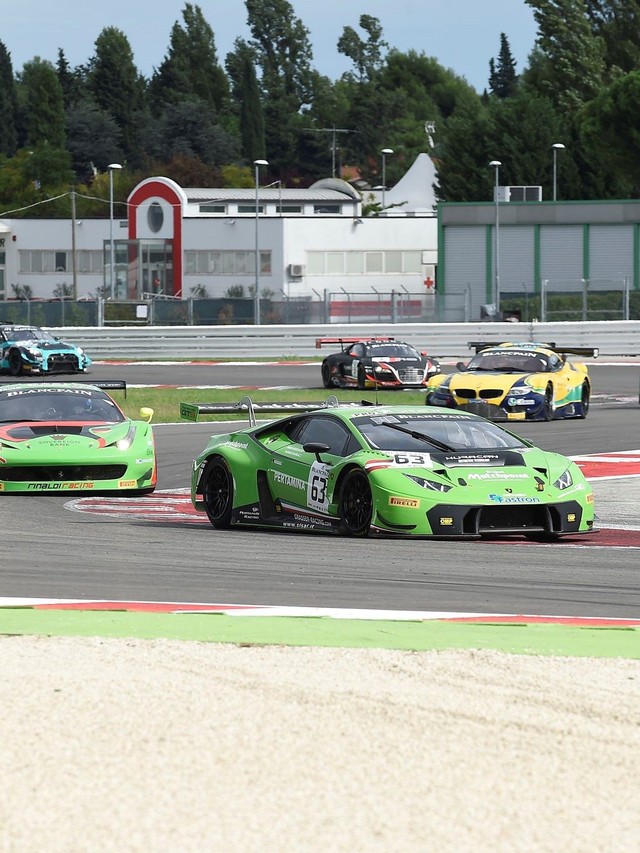
Third Place at Misano, First Time on the Grid
On October 5, 2015, the Lamborghini Huracan GT3 finished third overall in its Blancpain Sprint Series debut at Misano. The result alone would have been noteworthy for any new GT3 platform, but the identity of the drivers who delivered it told a deeper story about Lamborghini’s motorsport ambitions. Official Squadra Corse driver Mirko Bertolotti shared the #63 Grasser Racing Team entry with 19-year-old Patrick Kujala, a participant in the Automobili Lamborghini Young Drivers Program who had never turned a lap at Misano or raced under floodlights before that weekend.
Saturday night’s qualifying race set the tone. Lamborghini says Bertolotti climbed from eighth to fourth in his opening stint before handing the car to Kujala, who held second position through to the flag. Starting from the front row for Sunday’s main race, Kujala dueled for the outright lead before Bertolotti climbed back aboard and brought the car home in third. For a platform launched only months earlier, the pace was immediate and unambiguous.
A second Huracan GT3 entry, the #19 car shared by Jeroen Mul and Alberto Di Folco (another Young Drivers Program member), showed similar raw speed. Di Folco posted the fastest Silver Cup lap in the qualifying race but was hit from behind by a rival and ended up in the gravel. The contact prevented the car from taking the main race start, robbing the program of what could have been a double-car result.
The Young Drivers Program as a Competitive Weapon
A podium finish makes for a clean headline. The more revealing story at Misano was how Lamborghini chose to staff that podium car. Kujala and Di Folco were not seasoned GT3 professionals parachuted in for a one-off appearance. Both came directly through Lamborghini’s own pipeline, the Young Drivers Program run by Squadra Corse, which identifies promising talent in the Super Trofeo one-make series and accelerates them into international GT3 competition.
Kujala’s credentials by October 2015 were already substantial: Lamborghini says he had clinched the PRO title in the Lamborghini Blancpain Super Trofeo Europe that year with a round still to go. Di Folco, the 2014 PRO-AM Super Trofeo Champion, added a Race Two victory at Spa during the 2015 season. Both drivers were young, both were fast, and neither had any prior experience at Misano or in night racing conditions. That they performed at this level on an unfamiliar circuit, under lights, in a car making its sprint series debut, says something concrete about the program’s ability to prepare drivers for pressure.
“We are very pleased at our debut in the Blancpain Sprint Series, and particularly with the performance of the two drivers who are part of our youth program,” said Giorgio Sanna, Head of Motorsport for Automobili Lamborghini, who also acknowledged the challenging Balance of Performance regulations the car faced.
Lamborghini’s approach at this stage was notably direct: take Super Trofeo champions, put them in the GT3 car at a major international event, and let the results speak. The risk was real. A poor showing would have undermined the entire narrative. The fact that it worked gave Squadra Corse something no press event could manufacture: credibility earned on track.
The Huracan GT3’s Competitive Edge in Context
Misano was not the Huracan GT3‘s first significant result, but it was the car’s first outing in the sprint format of the Blancpain series, a discipline that rewards outright pace and aggressive racecraft more than the endurance series rewards consistency. Lamborghini says the Huracan GT3 had already taken an opening-round win in the Blancpain Endurance Series at Monza the previous month, with Fabio Babini, Andrew Palmer, and Jeroen Mul sharing driving duties. Two different formats, two strong results, within weeks of each other.
The Huracan GT3 replaced the Gallardo FL2 race car, and the transition mattered commercially as well as competitively. GT3 racing operates as a customer program: private teams buy or lease the cars, and their willingness to invest depends on whether the machinery is competitive out of the box. A debut podium in sprint racing, combined with an endurance win, gave prospective customer teams exactly the data point they needed. For anyone weighing a Huracan GT3 purchase against a rival manufacturer’s offering, Misano provided an answer that no brochure could replicate.
Sanna’s reference to a “demanding BOP” deserves a brief note. Balance of Performance regulations in GT3 racing aim to equalize different manufacturers’ cars through weight penalties, power restrictions, and other adjustments. A new entrant often faces conservative BoP settings until organizers accumulate enough race data to calibrate properly. Finishing on the podium under those conditions suggests the car’s underlying pace was stronger than the result alone indicated.
What Misano Signaled for Lamborghini’s Motorsport Trajectory
Viewed from 2015, the Misano podium looked like a promising start. Viewed with the benefit of hindsight, it looks like the opening chapter of a sustained competitive run. One report indicates the Huracan GT3 went on to claim the 2017 Blancpain GT Series championship, and according to another source, the evolved GT3 EVO captured the 2019 overall Blancpain title. The car that debuted at Misano with a pair of young drivers and a challenging BoP became one of the most successful GT3 platforms of its generation.
For LamboCars readers who follow the brand’s road car development, the connection between track and showroom matters. The Huracan STO, which arrived years later as a road-legal track weapon, drew directly from the aerodynamic and chassis lessons learned through the GT3 program. Squadra Corse’s work at circuits like Misano fed real engineering data back into Sant’Agata Bolognese, a feedback loop that distinguishes manufacturers who race seriously from those who simply sponsor cars with their badges.
The Young Drivers Program, meanwhile, created a visible pathway from Lamborghini’s one-make series into international competition, giving the Super Trofeo championship higher stakes and more prestige. A young driver choosing between manufacturer programs could see, concretely, where a Super Trofeo title might lead. Kujala’s trajectory from one-make champion to GT3 front-row starter within the same calendar year made the argument more persuasive than any recruitment brochure.
Lamborghini’s GT3 Strategy Versus the Established Order
By 2015, Porsche and Ferrari had been running customer GT3 programs for years. Porsche’s 911 GT3 R was a fixture on every major GT3 grid worldwide, backed by a parts and support infrastructure that few could match. Ferrari’s 458 Italia GT3 (and later the 488 GT3) benefited from deep motorsport heritage and a network of experienced customer teams. Lamborghini, by comparison, was the newer entrant, building its GT3 credibility from the ground up with the Gallardo and now the Huracan.
What Lamborghini brought to the fight was a different kind of energy. The Super Trofeo series, which launched in 2009, gave the brand a built-in feeder system that competitors lacked in exactly the same form. Porsche’s Carrera Cup and Ferrari’s Challenge series served similar functions, but Lamborghini’s willingness to funnel young Super Trofeo talent directly into GT3 machinery, and to stake its reputation on their performance at a major Blancpain round, showed a commitment to integration that went beyond simply selling race cars to wealthy gentlemen drivers.
Multiple enthusiast forums and sim racing discussions describe the Huracan GT3 as a car with a notably short wheelbase and nervous rear-end characteristics, rewarding precise inputs but punishing mistakes harshly. The consensus among sim racers is that the car performs well on technical, agile circuits (Misano among them) but demands respect. Whether that translates perfectly to the real car is debatable, but it aligns with the kind of driver who thrives in the platform: someone with sharp reflexes and confidence, exactly the profile the Young Drivers Program aimed to cultivate.
For buyers and fans tracking Lamborghini’s competitive positioning, the practical takeaway from Misano in 2015 was straightforward. Lamborghini was no longer a manufacturer that dabbled in racing to burnish its brand image. With the Huracan GT3, Squadra Corse demonstrated it could build a car capable of fighting at the front from day one, staff it with homegrown talent, and deliver results against entrenched rivals. The championship titles, the EVO upgrades, the road car derivatives that followed all trace their lineage to weekends like this one.
Gallery


