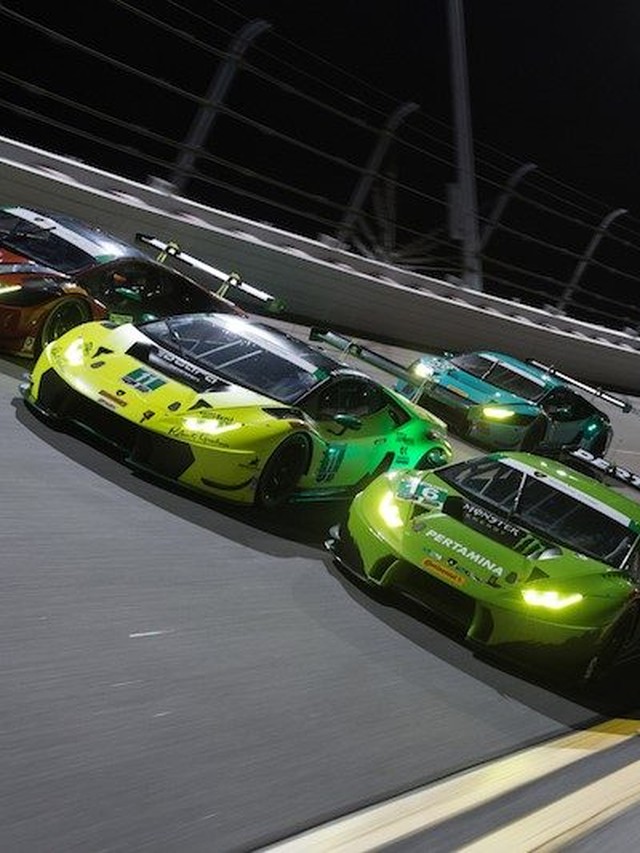
Lamborghini’s Privateer Army Swept the GTD Class at The Roar
Four Lamborghini Huracán GTD entries, all fielded by private teams with Squadra Corse backing, locked out the top of the GTD class timing sheets across multiple sessions during The Roar Before the Rolex 24, the collective test held January 8 through 10 at Daytona International Speedway.
The numbers tell a clean story. In Practice 3, factory driver Fabio Babini posted a 1’48.553 in the #28 Konrad Motorsport car, the fastest GTD class lap of that session. Team Change’s #16 Huracán GTD slotted in just six thousandths behind at 1’48.559. Babini then lowered his own mark to 1’48.309 in Practice 4, again topping the class. Practice 5 belonged to Mirko Bortolotti, who wheeled the #48 Paul Miller Motorsport entry to a 1’48.230, the quickest GTD class lap of the entire test weekend. Paul Miller’s car also recorded the second-fastest GTD class time across all Roar sessions.
Three sessions, two factory drivers, two different teams on top. That kind of consistency across a test weekend deserves attention, because raw qualifying pace and race pace at Daytona are very different animals. What it reveals is something deeper than speed: a platform advantage that stretches across every team running the Huracán GTD.
Why Roar Test Pace Tells Only Part of the Story
Fastest laps at The Roar build anticipation, but experienced endurance racing watchers know the caveats. Balance of Performance regulations govern the GTD class, and organizers can adjust restrictor sizes, minimum weights, and other parameters between testing and the race itself. A dominant test result sometimes triggers a BoP correction before the green flag drops, which means the very speed Lamborghini demonstrated could, paradoxically, work against the teams when it counts.
What the lap times do confirm is that the underlying car and its setup are in a strong window. Babini and Bortolotti are experienced enough to use a test weekend for race preparation rather than outright glory runs. Babini’s improvement of nearly a quarter of a second between Practice 3 and Practice 4 suggests genuine development work, not a single hero lap on fresh tires. Bortolotti’s session-topping time in Practice 5 came in a different car from a different team, reinforcing the idea of a platform advantage rather than one crew finding a trick setup.
The real question for Daytona is whether the Huracán GTD can sustain competitive pace over 24 hours, manage tire degradation through Florida’s unpredictable January weather, and survive the mechanical attrition that claims cars every year. Testing pace is a prerequisite, not a guarantee. But when the prerequisite is this emphatic, it tells you the foundation is sound.

A blue Lamborghini Huracan GT3 speeds down the track under the night lights at Daytona.
Squadra Corse’s Factory-to-Privateer Pipeline
Generic Daytona previews tend to skip how Lamborghini’s customer racing support actually works, and that omission hides the real reason the Huracán GTD looked so strong across the board at The Roar. All four entries are private teams: Konrad Motorsport, Team Change, Paul Miller Motorsport, and a fourth squad. Squadra Corse embeds factory drivers like Babini and Bortolotti within these operations, providing not just driving talent but engineering data, setup guidance, and operational expertise refined across a global GT3 program.
Bortolotti, who holds the title of Lamborghini Squadra Corse Factory Driver, brings particular weight to this arrangement. He was part of the GRT Grasser Racing lineup that won a previous Rolex 24 at Daytona in the #11 Huracán GT3 Evo, a result that contributed to what one report describes as Lamborghini’s historic achievement of consecutive Daytona victories, a first in the GTD class era. That institutional knowledge flows directly into the teams he joins for testing and race weekends.
More than 60 Huracán GT3 Evo cars compete in top GT championships worldwide, according to one report, and Squadra Corse provides support to all of them. The scale of that operation means every team benefits from a data pool far larger than any single privateer effort could generate on its own. When Babini finds three tenths in a session, that information propagates across the entire customer network. Lamborghini’s motorsport engagement grew steadily since the Super Trofeo series was established in 2009, and the customer racing infrastructure built over that period is now a genuine competitive weapon, one that explains why four separate teams can all run at the sharp end of the same class.
The Competitive Landscape Lamborghini Faces at Daytona
The GTD class at Daytona is one of the most contested fields in global sportscar racing. Ferrari’s 296 GT3, Porsche’s 911 GT3 R, and Mercedes-AMG’s GT3 Evo all bring factory support and deep development budgets to the same grid. Lamborghini’s Roar Test results position the Huracán GTD favorably, but the 24-hour race rewards reliability, pit strategy, and driver depth as much as outright speed.
Context makes Lamborghini’s position particularly interesting. The Huracán GT3 platform, in various evolutions, first appeared in IMSA competition in the GTD class back in 2016. As Road & Track noted, Lamborghini stuck with updated versions of the same basic car for a decade while rivals released entirely new platforms. That the Huracán remains competitive at the sharp end of the field after all that time speaks to how well the original architecture was conceived and how effectively Squadra Corse refined it.
For buyers and fans tracking the brand’s racing credibility, the Huracán’s Daytona record already includes double victories at both the 24 Hours of Daytona and the 12 Hours of Sebring in consecutive years, making Lamborghini the only manufacturer to win both races in the same season. That pedigree is not theoretical. It translates directly into the confidence private teams place in the platform when writing seven-figure checks to go racing, and it is the foundation on which those Roar Test lap times were built.

The vibrant yellow Lamborghini Huracan GT3 navigates the wet track with precision and speed.
The Huracán’s Final Chapter and the Temerario GT3 Waiting in the Wings
Every strong result the Huracán GTD posts now carries a bittersweet edge. The platform is approaching the end of its competitive life cycle. Lamborghini confirmed the Temerario GT3 as the successor, and Car and Driver reported that it will be the first race car entirely designed and developed at Lamborghini’s Sant’Agata Bolognese facility. The Temerario GT3 drops the road car’s hybrid system in favor of a modified version of the same twin-turbocharged V8, a move required by GT3 regulations but one that also represents a fundamental shift from the naturally aspirated V10 that defined the Huracán’s character on track.
For the privateer teams currently running Huracán GTDs, the transition will mean adapting to an entirely new powerband, different weight distribution, and the complexities of turbo management in wheel-to-wheel racing. Squadra Corse’s ability to support that transition smoothly will determine whether Lamborghini’s GT3 momentum carries forward or resets. The same factory-to-privateer pipeline that produced those Roar Test results will need to deliver again with unfamiliar hardware.
Lamborghini is also set to join the top tier of endurance racing with a hybrid LMDh prototype, a program that will run a twin-turbo V8 paired with an electric powertrain. The ambition is unmistakable: Squadra Corse wants to compete at every level of sportscar racing simultaneously, from one-make Super Trofeo series to the pinnacle of prototype competition.
For now, the Huracán GTD still needs to finish the job it started at The Roar. The 24 Hours of Daytona will reveal whether those session-topping lap times translate into a result worth celebrating. Given the platform’s track record at this circuit, at least one of those four cars should be fighting for the podium when the sun comes up on race morning.
Gallery


