The 400th Huracán Race Car Rolls Off a Very Familiar Assembly Line
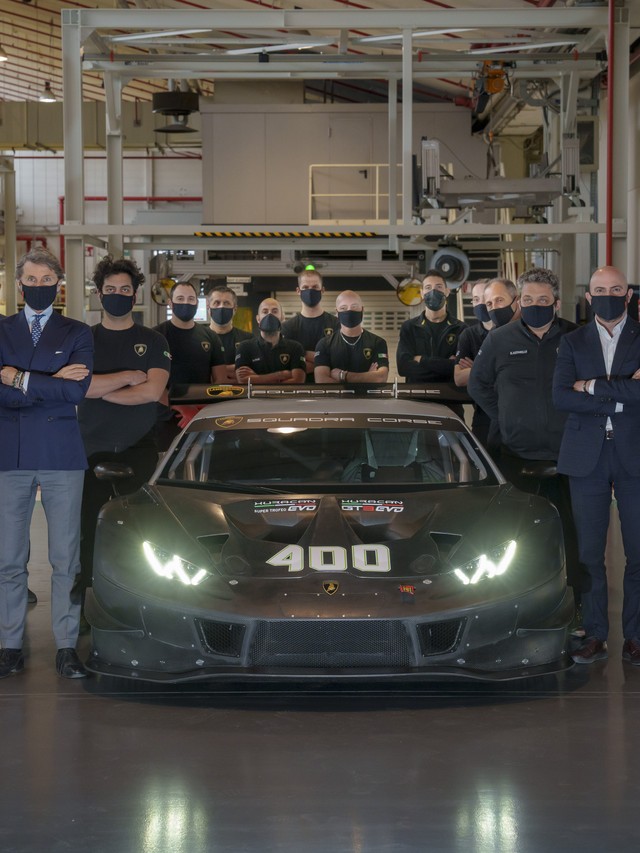
Lamborghini marked a quiet but significant milestone at its Sant’Agata Bolognese headquarters: the 400th Huracán racing car, combining both Super Trofeo Evo and GT3 Evo variants, rolled off the same production line where every road-going Huracán is assembled. Stephan Winkelmann, Maurizio Reggiani, manufacturing chief Ranieri Niccoli, and motorsport head Giorgio Sanna gathered with the technicians who build these machines daily to celebrate the number.
The number itself matters less than the method. All 400 of these race cars were produced on the identical line as their road counterparts, a detail the company clearly wants the world to notice. Most automakers farm out competition car assembly to specialist partners or dedicated satellite facilities. Lamborghini keeps it under one roof, in the same building where Ferruccio started bolting cars together in 1963. That choice is deliberate, and its consequences ripple through everything from quality control to engineering feedback loops. It is also the thread that connects every chapter of the Huracán racing story: the victories, the customer teams, and the credibility Squadra Corse earned in barely a decade all trace back to this shared factory floor.
Shared DNA: Why Building Road and Race Cars Side by Side Changes Both
The concept sounds romantic, but the engineering logic is harder-edged than the marketing. When the same technicians handle both versions of the Huracán, they develop an intuitive understanding of how the platform behaves under radically different demands. A technician who torques the subframe on a GT3 Evo in the morning and fits the interior of a road car in the afternoon carries knowledge between those two worlds that no engineering document fully captures.
The Huracán Super Trofeo employs a hybrid carbon and aluminum frame construction, according to one report, the same fundamental architecture as the street car but stripped and reinforced for circuit duty. That shared skeleton means lessons about stress points, fatigue patterns, and assembly tolerances flow in both directions. When Squadra Corse discovers a weakness at Daytona, the fix can inform the road car’s next evolution without the translation losses that plague organizations where racing and production operate as separate fiefdoms.
Few competitors replicate this model at the same scale. Ferrari’s GT3 program and Porsche’s extensive customer racing operations both involve significant specialist preparation outside the main road car line. Lamborghini’s approach is smaller in total volume but more tightly integrated, and that integration is the real competitive advantage the company is advertising with this milestone.

Lamborghini celebrates the production of its 400th Huracán racing car with a team photo in the factory.
A Victory Record That Earned Its Own Momentum
If the shared production line is the foundation, the results sheet is the proof that it works. The Huracán GT3 debuted in 2015, marking Lamborghini’s official entry into GT racing. Within six seasons, the GT3 and its successor, the GT3 Evo, accumulated nearly 100 victories across international championships. The headline results tell the story efficiently: three consecutive wins at the Daytona 24 Hours (a record), two victories at the Sebring 12 Hours, and the GT World Challenge Europe’s combined overall, Sprint, and Endurance titles in 2019.
By 2020, 24 different customer teams were campaigning GT3 Evos across 15 national and international championships, with 88 drivers covering a combined 20,000 kilometers. That breadth of adoption matters because GT3 racing is a customer sport. The cars need to be fast enough to win, reliable enough to finish, and accessible enough that privateer teams can operate them without a factory engineering army on standby. The Huracán’s naturally aspirated 5.2-liter V10, managed by a Motec control unit in race trim, proved remarkably suited to that brief.
Sim racers, interestingly, echo the real-world reputation. Discussion across racing simulation communities consistently describes the virtual Huracán GT3 Evo as rewarding but unforgiving, a car that demands precise rear tire management and punishes sloppy inputs. That characterization aligns with what real-world teams report: the car rewards committed driving and careful setup work, but it will not flatter a lazy approach.

The Lamborghini Huracán GT3 EVO, adorned in a striking black and yellow livery, is ready for the track.
Squadra Corse’s Rise from Outsider to GT Powerhouse
None of those victories would have been possible without the organizational infrastructure Lamborghini built around the car. Squadra Corse was formally established in 2013, though its roots trace back to the launch of the original Super Trofeo one-make series in 2009. The Gallardo Super Trofeo served as the platform for that initial championship, which expanded from Europe to Asia in 2012 and North America in 2013 before the Huracán took over in 2014.
The progression from single-make series to international GT3 contender happened faster than most observers expected. Lamborghini secured its first 24-hour race victory at Daytona in 2018 with the Grasser Racing Team, and the wins kept coming. The Super Trofeo series itself grew into a global operation, with continental champions converging annually at the Lamborghini World Finals, a tradition that began at Vallelunga in 2013.
What separates Squadra Corse’s trajectory from a typical manufacturer racing program is the speed of credibility. Ferrari and Porsche carried decades of racing heritage into the modern GT3 era. Lamborghini built its reputation from scratch in under a decade, using a mid-engine V10 platform that many initially dismissed as a showroom piece rather than a serious racing tool. The 400-car production milestone is the company’s way of quantifying that credibility, and the shared factory line is the mechanism that made such rapid scaling possible.
The Competitive Landscape: Where 400 Cars Fit in the GT3 Ecosystem
GT3 racing is the most commercially important category in global sportscar competition, and the grid is crowded. Porsche, Ferrari, Mercedes-AMG, Aston Martin, BMW, and McLaren all field factory-backed customer programs. Lamborghini’s position within that field is distinctive: it competes at the sharp end of results despite being one of the smallest manufacturers by volume.
One report from Autoblog notes that the Huracán Super Trofeo can occasionally surface with road-legal titles, a quirk that underscores how close the race car sits to its road-going sibling in fundamental construction. A reported weight reduction of 335 pounds separates the LP620-2 Super Trofeo from its road counterpart, achieved through the usual race car diet of stripped interiors, lexan windows, and carbon bodywork rather than wholesale re-engineering of the platform.
For prospective customer racers, the practical question is cost. Lamborghini does not publicly list pricing for its competition models. What can be said is that GT3 racing demands significant budgets regardless of manufacturer, and the Huracán’s reliability record across 24 teams and 15 championships in a single season suggests operating costs that competing teams found manageable enough to sustain multi-year programs.
What 400 Race Cars Mean for the Temerario and Lamborghini’s Next Chapter
The Huracán reached the end of its production cycle, replaced by the Temerario, a plug-in hybrid that represents Lamborghini’s most significant powertrain shift in the entry-level supercar segment. The naturally aspirated V10 that defined the Huracán’s character, both on road and track, gives way to a twin-turbo V8 with electric assistance.
For Lamborghini’s racing program, this transition carries real stakes. The engineering knowledge accumulated across 400 race cars, the chassis understanding, the aerodynamic development, the customer support infrastructure, transfers to whatever GT3 platform Squadra Corse develops next. The production philosophy of building race and road cars on the same line becomes even more valuable when the underlying technology is new and unproven in competition. Lamborghini also launched its SC63 prototype in 2023, signaling ambitions beyond GT3 into top-class endurance racing. That program and the eventual Temerario-based customer racing car will need to prove that the hybrid era can deliver the same kind of privateer-friendly reliability and competitive results that made the Huracán GT3 a 400-unit success story.
For buyers watching from the sidelines, the takeaway is straightforward: the Huracán’s racing legacy is now locked in, and low-mileage Super Trofeo and GT3 examples represent the final chapter of Lamborghini’s naturally aspirated competition era. Autoblog recently featured a Super Trofeo EVO with just 84 miles on the clock appearing at auction, the kind of listing that tends to become more interesting as a platform’s replacement settles in. The 400 cars that left Sant’Agata in race trim validated a decade of engineering on one shared factory floor. Whether the Temerario can build the next decade’s worth of trophies on that same floor is the question Squadra Corse now has to answer.

The Lamborghini Huracán GT3 EVO is dramatically presented in a dark studio with striking green neon hexagonal lighting.
Gallery


