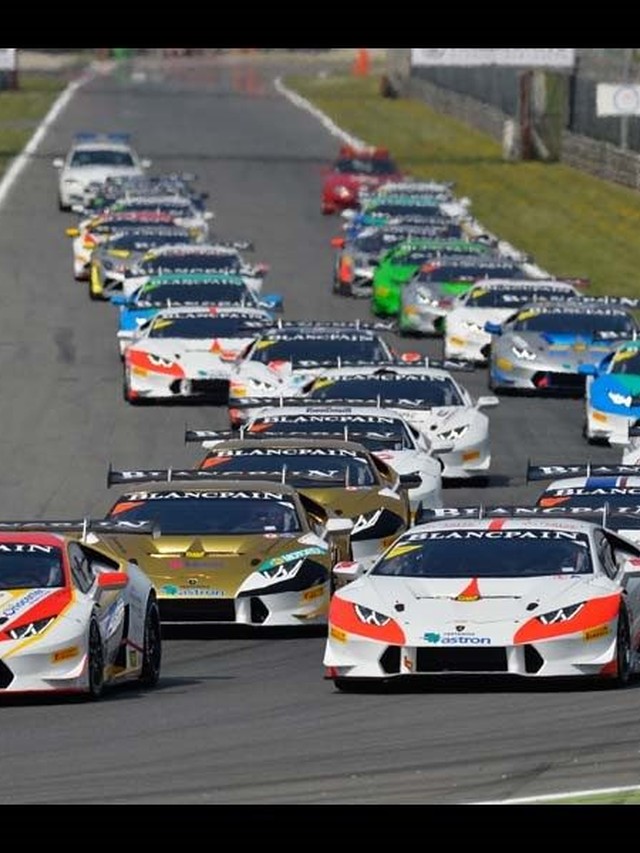
A Debut Victory for the Huracán LP 620-2 Super Trofeo at Monza
When Matteo Bobbi and Jay Palmer crossed the finish line at Monza in their Bonaldi Motorsport entry, they handed the brand-new Lamborghini Huracán LP 620-2 Super Trofeo something no amount of pre-season testing could guarantee: a class victory on its very first race day. Monza Race One of the Lamborghini Blancpain Super Trofeo European series marked the car’s competitive debut, and the PRO AM class win confirmed that the shift from the outgoing Gallardo-based racer to a Huracán-derived platform was more than cosmetic.
The overall race belonged to an 18-year-old Bonaldi Motorsport driver who defended the lead from lights to flag, finishing ahead of Team Lazarus’s Sergio Campana and Fabrizio Crestani, with Florian Spengler of Bonaldi Motorsport completing the overall podium. Yet the real headline for anyone tracking Lamborghini’s motorsport trajectory was what happened in the PRO AM category, where the LP 620-2 proved immediately competitive against a field still largely running Gallardo machinery.
Why a Rookie Podium Matters More Than the Trophy
The PRO AM podium at Monza was composed almost entirely of rookie drivers, with only Finn Mikko Eskelinen (Leipert Motorsport, partnered with Kelvin Snoeks) bringing prior championship experience. Swiss racer Adrian Amstutz of Konrad Motorsport completed the top three. Lamborghini says over half the drivers competing at Monza were championship newcomers.
That ratio deserves attention. A one-make series lives or dies by its ability to attract new entrants, and a field stacked with first-timers signals that the Super Trofeo is functioning as intended: a relatively accessible proving ground where gentlemen drivers and ambitious amateurs can race real Lamborghini hardware without needing a decade of single-seater credentials. Mark Ineichen (Konrad Motorsport) won the AM Class, Shota Abkhazava (Artline Team Georgia) took second, and the Sportec Motorsport pairing of Siegfried Vanema and Michael Schaal rounded out that podium. Carina Lima, the series’ sole female driver, and Andrea Palma won the category reserved for the outgoing Gallardo LP 570-4 Super Trofeo, racing with Imperiale Racing. The breadth of nationalities and team sizes on display at Monza underscored the series’ global reach across Europe, Asia, and North America.
620 Horsepower, Rear-Wheel Drive, and the Dallara Connection
The engineering argument for the LP 620-2 starts with a number and a letter. The “2” in its name denotes rear-wheel drive, a deliberate departure from the all-wheel-drive layout found in most Huracán road cars. Lamborghini and its development partner Dallara Engineering chose RWD specifically to sharpen driver skill development. Without a front axle to mask mistakes, the car demands cleaner inputs and better throttle management, qualities that translate directly when a driver moves up to GT3 competition.
Dallara’s involvement carries more weight than a typical supplier relationship. Giampaolo Dallara’s history with Lamborghini stretches back to 1963, when he joined the company as an engineer and contributed to the development of the Miura. That lineage lends the collaboration a gravity few partnerships in motorsport can match. Together, the two companies built the LP 620-2 around a hybrid carbon fiber and aluminum chassis that brings the car’s weight down to 2,800 lbs. Paired with the direct-injected V10 producing 620 horsepower in race trim, the result is a power-to-weight ratio of 4.5 lbs per horsepower.
The aerodynamic package reflects serious track intent. A ten-position adjustable rear wing, front and rear diffusers, and adjustable front air intakes give teams meaningful setup flexibility from circuit to circuit. Pirelli developed bespoke tires exclusively for this application, removing one more variable from the equation and keeping the competitive focus on driver and setup rather than tire strategy.
A Stepping Stone to GT3, and a Mirror for the Road Car
The Super Trofeo series occupies a specific rung on Lamborghini’s motorsport ladder. Below GT3 in complexity and cost, it offers customer teams a controlled environment where the car is the constant and the driver is the variable. For Lamborghini, the series doubles as a live engineering laboratory: lessons about chassis behavior, aero efficiency, and powertrain durability feed back into both the GT3 program and, eventually, road car development.
The Huracán’s racing career laid foundations that Lamborghini is now building on with the Temerario GT3 program. According to Autoblog, the Temerario GT3 is the first competition car fully designed, developed, and built in-house by Lamborghini Squadra Corse, replacing the Huracán GT3 Evo2 as the brand’s flagship GT racer. The LP 620-2 Super Trofeo’s rear-drive philosophy anticipated that direction. Drivers who learned throttle discipline in a 620 hp, naturally aspirated, RWD race car at Monza were, in effect, training for the kind of precision that higher-tier GT competition demands.
For prospective buyers of Huracán road cars, the LP 620-2’s debut success reinforced something spec sheets alone cannot: the platform works under sustained competitive stress, not just on a press launch. The fact that rookies could extract class-winning pace from the car on its first outing suggests that Lamborghini and Dallara built genuine accessibility into the chassis, not just raw speed.
What Monza Proved, and What It Left Unanswered
Race One was not without attrition. Several expected frontrunners retired or lost positions to mechanical issues and driver errors, a reminder that debut weekends test reliability as much as outright pace. The LP 620-2 passed that test in the PRO AM class. Whether it can sustain that form across a full season, against teams that accumulate setup data and driver experience, is the question the rest of the calendar will answer.
Lamborghini has not disclosed the purchase price for customer teams entering the Super Trofeo with the new car, nor has the company published comparative lap times against the outgoing Gallardo-based machinery. Those gaps matter for anyone evaluating the series as a racing investment. What the Monza result does confirm is that the car arrived competitive, that the rookie-heavy field validates the series’ accessibility pitch, and that the Huracán platform’s transition from road to race produced immediate results rather than a painful development season. For a car making its first public appearance under race conditions, that is a strong opening argument.
Gallery


