The 2014 Dubai Debut: Lamborghini Opens a Fashion Flagship in the World’s Most Conspicuous Mall
When Lamborghini opened the doors of its first dedicated Collezione Automobili Lamborghini flagship store inside Dubai Mall in 2014, the company was testing a proposition that no amount of horsepower could answer: whether the raging bull’s appeal could survive the leap from carbon fiber monocoques to carbon fiber handbags.
The event centered on a runway fashion show debuting the Automobili Lamborghini Fall/Winter 2014-2015 collection, with models walking through a space designed to feel less like a souvenir shop and more like a brand embassy. On display alongside the clothing: carbon fiber bags, a children’s line, and Lamborghini’s first fragrance, Lamborghini L, offered in four distinct scents.
Boris Puddu, Head of Collezione Automobili Lamborghini in Sant’Agata Bolognese, framed the ambition plainly:
“Our aim is to communicate the strength of our brand in terms of style, materials and cutting edge design through our fashion and accessory collection.”
Abdulaziz Al Rasheed, CEO of Al Rasheed Group and the local partner behind the venture, positioned Dubai as the natural launchpad for Middle Eastern expansion, with plans to roll out additional stores across the region. The choice of venue was deliberate. Dubai Mall attracts a clientele that treats luxury consumption as a daily practice, not a special occasion. Placing a Lamborghini fashion store in that ecosystem was the first real test of whether the brand’s identity could hold its charge outside the showroom.
Beyond the Supercar: Decoding Lamborghini’s Luxury Lifestyle Ambition
Strip away the runway lighting and perfume bottles and the Dubai store opening was a declaration of intent: Lamborghini wanted recognition as a luxury lifestyle brand, not merely a manufacturer of very fast, very loud automobiles. The commercial logic is straightforward. A supercar company sells a few thousand units per year to a narrow band of ultra-wealthy buyers. A lifestyle brand can monetize the vastly larger population of people who admire the marque, aspire to own one, or simply want to signal affiliation.
Puddu made this explicit in later comments reported by FashionNetwork USA, stating: “We are not a derivative product, but a real fashion brand.” He was not defending the quality of a polo shirt; he was staking a claim that Collezione Automobili Lamborghini deserved evaluation on the same terms as standalone fashion houses. The collection went on to appear at Milan Fashion Week and Milano Moda Uomo, placing Lamborghini’s apparel in front of industry critics who would not be impressed by a shield badge alone.
Whether that ambition fully landed is another question. Selling T-shirts for north of $100 and leather jackets approaching $1,200 requires more than brand cachet; it requires the kind of material innovation and fit that justifies the price without the V12 soundtrack as a backdrop. For Lamborghini owners, these items function as tribal markers. For the broader luxury consumer, the value proposition gets considerably more complicated, and that tension sits at the heart of everything the Collezione line attempts.
From Hexagons to Handbags: Translating the Raging Bull’s Design Language into Fashion
The credibility of any automotive fashion line hinges on whether the design translation feels authentic or merely decorative. Lamborghini says the Collezione draws directly from the design vocabulary of its supercars, and the hexagon is the most visible example. That motif, which appears in the Huracán’s air intakes, the Aventador’s taillights, and across the interior surfaces of nearly every modern Lamborghini, shows up in fabric patterns, jacket linings, and accessory detailing throughout the collection.
Carbon fiber bags represent the most literal crossover. Carbon fiber is not just a visual signature for Lamborghini; it is a structural material central to the brand’s engineering identity. Translating it into an accessory at least attempts to carry functional meaning rather than slapping a logo on a generic product. The fragrance line, Lamborghini L, occupies softer territory. Four scents offer variety, but perfume is a category where automotive heritage provides almost no competitive advantage. The nose does not care about lap times.
The children’s line, which includes items in Squadra Corse racing team colors, is a shrewder play than it might appear. Dress a seven-year-old in Lamborghini green and you are planting an aspiration that may not pay off for two decades, but the seed costs almost nothing relative to the potential lifetime value of a future customer. Each of these product categories tests the same underlying question the Dubai flagship posed on opening night: how far can the raging bull’s design language travel from the car that generated it?

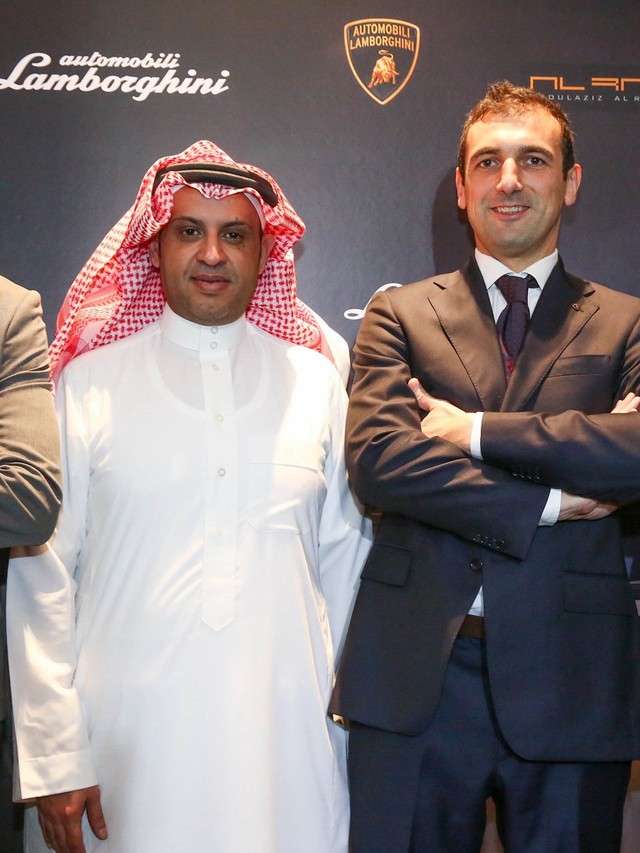
Four men, including one in traditional attire, pose with crossed arms in front of a dark background with Lamborghini branding.
Who Is the Collezione Automobili Lamborghini Actually For?
Lamborghini says the collection targets both existing owners and “the luxury consumer who values quality, style and elegance.” That dual audience creates an inherent tension. An owner who parks a Huracán in the garage does not need a branded polo to prove brand loyalty; the car does that work. For that buyer, the fashion line is a convenience, a way to pick up a gift at a dealership visit or express fandom at a concours. The real commercial opportunity lies with the second group: affluent consumers who want proximity to the Lamborghini identity without the six-figure entry fee of a supercar.
Customer feedback on the broader Lamborghini retail experience, based on available reports, is mixed. Online shoppers highlight a wide selection and fast shipping. Some visitors to physical boutiques, however, describe staff attitudes that fall short of the warmth you might expect from a brand trying to welcome non-owners into its world. If Lamborghini genuinely wants to build a fashion constituency beyond its existing car buyers, the in-store experience needs to match the aspiration of the product.
For LamboCars readers who already own the cars, the practical takeaway is straightforward: the Collezione line works best as a curated extension of your existing relationship with the brand, not as a standalone fashion discovery. The carbon fiber pieces and Squadra Corse items carry genuine design DNA. The more generic apparel competes in a crowded luxury casualwear market where the Lamborghini name alone may not justify premium pricing.
Dubai’s Role: Why the Middle East Anchors Lamborghini’s Lifestyle Expansion
Lamborghini did not choose Dubai at random. The UAE, and Dubai in particular, represents one of the densest concentrations of supercar ownership and luxury spending on the planet. The brand already maintained a strong automotive retail presence in the region, and adding a fashion flagship inside Dubai Mall allowed Lamborghini to reach a daily foot traffic count that dwarfs most standalone boutiques.
The strategic logic extends beyond retail square footage. Dubai functions as a cultural crossroads for wealthy consumers from across the Gulf states, South Asia, and East Africa. A flagship in Dubai Mall serves as a regional billboard, establishing the Collezione brand in the consciousness of shoppers who may encounter it for the first time while browsing between Gucci and Louis Vuitton. Lamborghini’s stated intention to expand across the Middle East in subsequent years underscores the point: this was a beachhead, not a one-off. And for a brand built on spectacle, planting its flag in the world’s most conspicuous retail environment carried a message that mattered as much as any product on the shelves.
Competitive Landscape: How Lamborghini’s Fashion Approach Compares to Ferrari and Porsche
Lamborghini is not the only supercar manufacturer that wants to dress its customers. Ferrari operates its own extensive fashion and lifestyle division, with standalone retail stores in major cities and a broad product range that spans apparel, accessories, and even theme park merchandise. Porsche takes a different route through Porsche Design, which positions itself as a distinct design studio producing everything from sunglasses to kitchen appliances, with the Porsche name lending engineering credibility rather than automotive spectacle.
Lamborghini’s approach sits somewhere between the two. The Collezione line leans harder on direct automotive design references (hexagons, carbon fiber, Squadra Corse liveries) than Porsche Design, which tends toward minimalist industrial aesthetics. Compared to Ferrari’s fashion operation, Lamborghini’s retail footprint remains smaller, but the brand’s willingness to show at Milan Fashion Week and position itself as a “real fashion brand” (Puddu’s words, not mine) suggests an appetite to compete on fashion industry terms rather than simply merchandising the badge.
The 2025 Balenciaga collaboration, which reportedly spans ready-to-wear items, leather goods, and accessories featuring the Temerario, represents a significant escalation of this strategy. Partnering with an established fashion house lends credibility that an in-house line cannot easily manufacture on its own. It also signals that Lamborghini’s lifestyle ambitions, seeded a decade ago in Dubai Mall, continue to grow.
Does Lamborghini’s Fashion Line Earn Its Supercar Legacy?
The honest answer, a decade after that Dubai Mall debut, is that it depends on what you are buying and why. The pieces that carry genuine material or design connections to the cars (carbon fiber accessories, garments incorporating the hexagonal motif, racing-inspired outerwear) deliver something competitors in the general luxury apparel market cannot replicate. They carry a story rooted in Sant’Agata Bolognese, and for enthusiasts, that story matters.
The more generic items in the collection face a harder test. A branded T-shirt or pair of swim trunks competes against every other premium casualwear label, and the Lamborghini name alone does not guarantee superior fabric, fit, or longevity. Puddu’s insistence that Collezione Automobili Lamborghini is “a real fashion brand” remains aspirational in some product categories and credible in others.
What the 2014 Dubai launch accomplished was something less tangible but arguably more durable: it established that Lamborghini’s brand identity could travel beyond the showroom floor. The cars remain the core product, the gravitational center around which everything else orbits. But the fashion line, the fragrances, and the high-profile partnerships with houses like Balenciaga all serve the same function. They keep the raging bull visible in contexts where a V12 engine cannot follow, and for a brand built on spectacle, visibility is currency.


