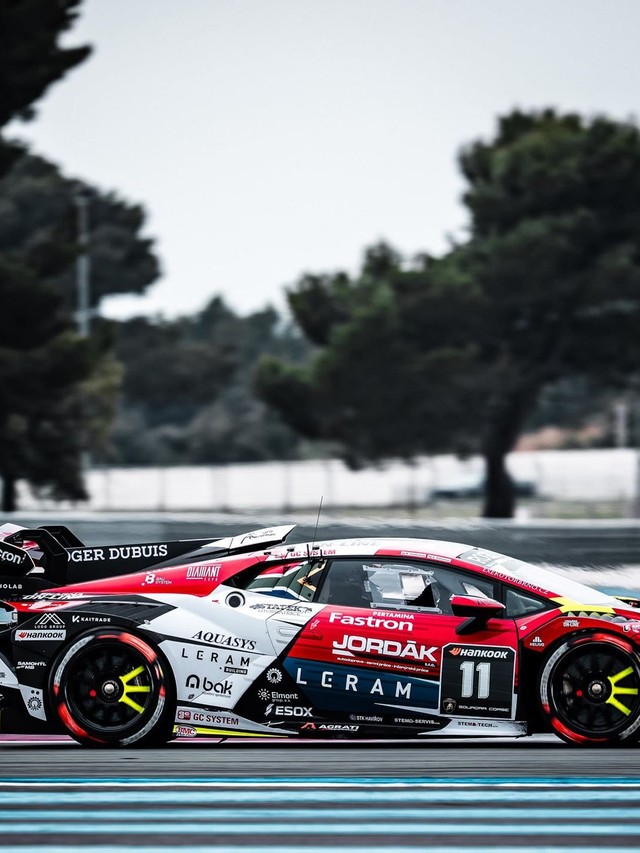
Silverstone Hosts the Super Trofeo for the Ninth Time in Ten Years
When a racing series returns to the same circuit nine times out of ten editions, the relationship between track and car has clearly earned its keep. The Lamborghini Super Trofeo Europe arrives at Silverstone’s 5.9-kilometer layout on May 18 to 20 for the second round of what happens to be the championship’s tenth anniversary season, and the grid looks dense: nearly 50 Huracán Super Trofeo EVO cars from 22 teams will fill the Northamptonshire circuit.
The more interesting number, though, is seven. That is how many different crews took victories across just two races at the opening round in Monza. In a field of purpose-built, nominally identical race cars, that kind of result spread does not happen by accident. It points to something deliberate in the way Lamborghini Squadra Corse structures this championship, a philosophy of competitive balance that turns every class into a genuine contest and makes the series function as a credible development pathway for aspiring professionals and gentleman racers alike.
Every car on the grid runs the same Huracán Super Trofeo EVO specification: same engine, same aero package, same Hankook tires. Squadra Corse provides full technical support to teams throughout race weekends, controlling the variables that could otherwise let budget alone decide the outcome. Driver skill, team strategy, and pit-stop execution become the primary separators. For a brand that wants to develop racing talent rather than just sell race cars, that distinction matters enormously.
The Huracán Super Trofeo EVO: Built to Equalize, Not to Dominate
The Huracán Super Trofeo EVO occupies a specific and deliberate rung on Lamborghini’s motorsport ladder. Rear-wheel drive, stripped of road-car comforts, and optimized for circuit racing with aggressive carbon fiber aerodynamic elements, a large rear wing, and a prominent diffuser, the car puts its 5.2-liter naturally aspirated V10 behind the driver in a package significantly lighter than the road car. Yet the engineering philosophy here is not about extracting maximum lap time from a single chassis. It is about extracting maximum competition from a full grid.
That is the fundamental tension in any one-make series. Build the car too fast and the racing becomes processional, decided by whoever found the best setup or the freshest engine. Build it with the right constraints and the racing becomes about racecraft. Lamborghini’s approach leans hard toward the latter. Specific technical and sporting regulations limit what teams can change, and Squadra Corse’s trackside presence ensures mechanical parity stays tight.
Seven different winning crews from two Monza races is the proof. No single team or driver combination found a dominant advantage, and that kind of parity is fiendishly difficult to engineer. It is also exactly what makes the series attractive to both aspiring professionals who need competitive laps on their resume and gentleman drivers who want a real fight rather than a parade. The barrier to entry is lower than in open GT3 competition, where car development budgets and tire wars can price out smaller operations, and the controlled format means results reflect talent more than spending.
Championship Battles: Tight Points and a 17-Year-Old Leading the PRO Class
The standings heading into Silverstone read like a thriller with too many suspects. In the PRO category, Giacomo Altoè and Job Van Uitert of Antonelli Motorsport sit at the top, but their lead over Bonaldi Motorsport’s James Pull and Kelvin Snoeks amounts to a single point. Altoè is seventeen years old: a teenager leading the professional class of a continental racing championship in a car that produces well north of 600 horsepower on slick tires at circuits like Silverstone.
At Silverstone, Altoè gets a new co-driver. Daniel Zampieri steps in, and his credentials illustrate how the Super Trofeo functions as a development pathway rather than a dead end. Lamborghini describes Zampieri as a GT3 Junior driver within Squadra Corse, already competing in the Italian GT Championship. The fact that a GT3-level driver rotates into a Super Trofeo seat tells you these series are not siloed. They feed each other.
Behind the PRO leaders, Imperiale Racing’s Vito Postiglione and rookie Karol Basz won Race 2 at Monza and sit just three points off the lead. The PRO-AM class is even tighter: Target Racing’s Dennis Lind (the 2016 champion) and twenty-year-old Simon Larsson share the lead on equal points with VS Racing’s Takashi Kasai and Philipp Wlazik. In the AM category, Raffaele Giannoni of Automobile Tricolore swept both Monza races and carries momentum from a victory at Imola in 2017, while defending champion Andrej Lewandowski trails by 14 points with ten races still to run. The Lamborghini Cup sees Supachai Weeraborwornpong of Team Lazarus leading two-time champion Gerard Van der Horst by four points. Every class is genuinely contested, which is precisely the point of the format Squadra Corse has spent a decade refining.
Names to Watch: Vettel, Schreiner, and the Grid’s Breadth
One name on the Silverstone entry list will catch casual motorsport fans off guard. Fabian Vettel, brother of four-time Formula 1 world champion Sebastian, will co-drive for Konrad Motorsport alongside Carrie Schreiner. Schreiner, 19, already won the PRO-AM title in the 2018 Middle East series and brings genuine competitive credentials rather than just a famous co-driver.
The grid also includes Francesca Linossi with Iron Lynx Motorsport Lab and Caitlin Wood with Mtech. Three female drivers on a grid of nearly 50 cars is not a statistical revolution, but it reflects the kind of accessibility that a well-structured one-make series can provide. A controlled technical environment, factory-backed parity, and a season spanning Europe’s best circuits create conditions where the range of participants is broader than top-tier GT3 competition typically allows. That breadth, from a 17-year-old PRO leader to gentleman racers to GT3 juniors rotating through for development laps, is what gives the Super Trofeo its texture and its purpose.
Squadra Corse’s Bigger Picture: From One-Make Grid to GT3 and Beyond
Zoom out from Silverstone and the Super Trofeo reveals its strategic purpose within Lamborghini’s motorsport architecture. Squadra Corse does not run this championship purely for the spectacle or the car sales, though both matter. The series functions as a talent incubator. Drivers who prove themselves here graduate to GT3 machinery, and the operational knowledge teams accumulate feeds directly into higher categories.
The Temerario GT3, which Autoblog reported as Lamborghini’s first competition car fully designed, developed, and built in-house, represents where this pipeline leads. When that car enters GT3 competition, the drivers and teams who learned their craft in Super Trofeo will form the backbone of Lamborghini’s customer racing effort. The SC63 LMDh prototype sits at the top of the pyramid, but the base is here, on grids like Silverstone’s, where a 17-year-old Italian and a 19-year-old German are learning how to race at the highest level they can currently reach.
This is the part of Lamborghini’s motorsport story that rarely gets the attention it deserves. The headline-grabbing prototypes and GT3 cars are built on a foundation of hundreds of customer racing weekends, thousands of laps turned by developing drivers, and a deliberate engineering philosophy that prizes competitive equality over outright speed. The Super Trofeo’s tenth anniversary season is a good moment to recognize that the series is not a sideshow. It is the infrastructure.
Race 1 at Silverstone takes place Saturday, May 19 at 2:40 p.m. local time, with Race 2 following Sunday at 11:30 a.m. Both feature 50-minute formats with rolling starts and mandatory pit stops between minutes 20 and 30. Saturday also hosts two 20-minute qualifying sessions, while Friday is reserved for free practice. Live streaming is available through the Lamborghini Squadra Corse website and Facebook page.
Gallery


