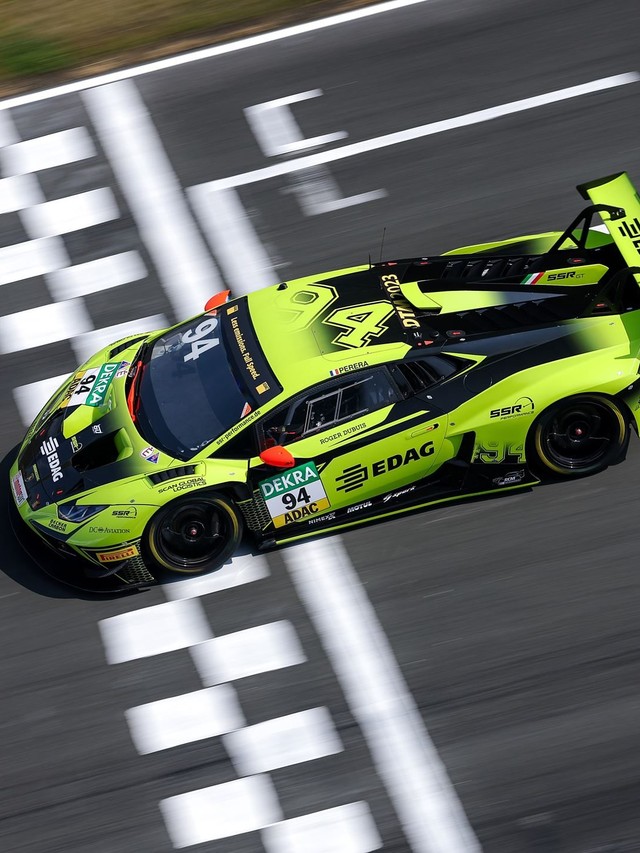
Pole by Eighteen Thousandths, Victory by Four Seconds
Franck Perera put the #94 SSR Performance Lamborghini Huracán GT3 EVO2 on pole at Oschersleben by 0.018 seconds over Jack Aitken’s Ferrari, then drove away from the entire DTM field in Saturday’s season opener to finish 3.987 seconds clear of the second-place Porsche. In a qualifying session where the top 26 cars were separated by less than one second, Perera’s race pace was from a different postcode entirely.
Lamborghini says this was the first race victory anywhere in the world for the Huracán GT3 EVO2, and also the brand’s maiden DTM win since entering the series in 2022. For SSR Performance, the result arrived on their very first race weekend running Lamborghini machinery. Teammate Mirko Bortolotti qualified third and initially slotted into second at the start before losing ground during the mandatory pit stop cycle, eventually finishing further down the order. Perera, by contrast, maintained his lead through his own stop and pulled away in the second half of the race, collecting a maximum 28-point haul: three for pole, 25 for the win. The gap at the flag told the real story. In a series built on parity, nearly four seconds is not a marginal advantage. It is a statement about the car underneath the driver.

Franck Perera celebrates on the podium, acknowledging his achievement in the DTM race.
Why Immediate Pace Matters More Than a Single Trophy
A debut win makes for good television. What matters more for Lamborghini’s customer racing business is the way it happened. Perera did not inherit the lead through attrition or a lucky safety car. He was genuinely the fastest car on circuit from Friday practice, where Bortolotti topped the timesheets, through qualifying and across the full race distance. In a series that pits current-generation GT3 machinery from Porsche, Ferrari, Audi, BMW, and Mercedes-AMG against each other on identical tire compounds and under strict Balance of Performance rules, that kind of outright speed is difficult to engineer through loopholes. It suggests the EVO2’s aerodynamic package and naturally aspirated V10 are working well within the current BoP window.
Giorgio Sanna, Lamborghini’s Head of Motorsport, acknowledged the competition level while framing the result as validation. Lamborghini says Sanna expressed delight at the victory but also noted that “the level of competition is very high,” adding that this gives the team “extra motivation to continue to give our best.” Measured language from a motorsport boss after a dominant debut is worth noting. It signals confidence in the car’s underlying pace rather than a belief that one weekend settles anything. The Oschersleben round also marked DTM’s return to the circuit after an eight-year absence and the series’ first event under new ADAC stewardship. A strong opening statement at a venue where the entire paddock was recalibrating adds further context to the result.
The V10’s Philosophical Advantage in a Turbo Era
The Huracán GT3 EVO2 is the third generation of Lamborghini’s GT3 platform, built on the bones of the road-going Huracán STO. One source describes the car as featuring a naturally aspirated 5.2-liter V10 with direct IDS gasoline injection, dry sump lubrication, and 10 electronically actuated throttle bodies. That last detail is the interesting one. Individual throttle bodies give each cylinder its own air supply, translating to sharper throttle response than a single-throttle-body setup. In a racing context where drivers modulate power through slow corners dozens of times per lap, that precision matters enormously.
Most of the EVO2’s direct competitors in DTM now run turbocharged engines. Turbo lag is managed well in modern GT3 cars, but it still exists as a variable, particularly on corner exit at low RPM. The V10’s linear power delivery and instant response to throttle inputs represent a philosophical advantage Lamborghini can exploit at circuits like Oschersleben, where tight, technical sections reward driver confidence on the pedal. For customer teams, that predictability also lowers the barrier to extracting performance, which is exactly what a factory motorsport program selling cars to independent outfits needs to deliver. Perera’s four-second margin was not just a driver performance; it was a demonstration that the naturally aspirated architecture still has teeth against the turbo establishment.

The Lamborghini Huracán GT3 EVO2, number 92, awaits its next session in the SSR Performance pit garage.
Customer Teams as the Proving Ground
Lamborghini’s DTM effort runs entirely through customer teams, not a factory-entered squad. SSR Performance and Grasser Racing Team (GRT) operate independently, purchasing or leasing the EVO2 from Squadra Corse and receiving technical support. This model keeps Lamborghini’s direct costs lower while spreading the brand across multiple garages, pit crews, and sponsor networks. When SSR wins on their debut weekend with Lamborghini hardware, it validates the car and the support package simultaneously.
GRT’s contribution was quieter but still solid. Mick Wishofer placed as the highest Lamborghini in fourth during second practice, and Clemens Schmid qualified third for race two before finishing fifth. Bortolotti came home sixth in that second race, while Perera, after his Saturday heroics, could only manage 18th on the grid and 12th at the flag. That inconsistency across the two races is a useful reminder: BoP-regulated GT3 racing is won on margins so thin that a few tenths in qualifying can mean the difference between pole and the midfield. One dominant Saturday does not guarantee a dominant Sunday.
For enthusiasts watching Lamborghini’s motorsport trajectory, the customer team model is the foundation for everything that comes next, including the Temerario GT3 program. According to Car and Driver, the Temerario GT3 will replace the Huracán GT3 EVO2 as Lamborghini’s factory-backed GT3 effort and represents the first race car entirely designed and developed at Sant’Agata Bolognese. Road & Track notes that the Huracán platform served Lamborghini for a full decade in GT3 competition, during which time rivals like Porsche cycled through three entirely new cars. The EVO2’s continued competitiveness in its final seasons strengthens the foundation those customer teams will carry into the turbocharged Temerario era.
Beyond DTM: British GT Poles and Spa Endurance
The EVO2’s competitive weekend extended well beyond Germany. At Donington Park, Barwell Motorsport’s Sandy Mitchell and Shaun Balfe took pole by four tenths of a second in British GT qualifying, a commanding margin in any GT3 series. A 15-second success penalty from their previous Silverstone podium limited their race result to seventh, but the raw qualifying pace confirmed the car’s single-lap speed on a very different circuit. Barwell teammates Will Tregurtha and Mark Sansom also claimed pole in the Am-Silver category and recovered from an early puncture to finish ninth overall.
At Spa-Francorchamps, two EVO2s contested the International GT Open’s 140-minute endurance race. Oregon Team’s Pierre Louis Chovet and Maximilian Paul qualified fourth, while the Bonaldi Motorsport Pro-Am pairing of Sandro Mur and Martin Kodrić finished as the best Lamborghini in fourth overall. Spa rewards aerodynamic efficiency through its long, fast sweeps, so a top-five result on that circuit adds a different data point to the EVO2’s versatility. Taken together with Oschersleben and Donington, the picture is consistent: across tight technical layouts, classic fast circuits, and endurance formats, the EVO2 is extracting competitive pace from its naturally aspirated architecture wherever it appears.

The Lamborghini Huracán GT3 EVO2, number 19, takes a corner with precision on the DTM circuit.
The Huracán’s Final Chapter Begins at the Front
The Huracán GT3 platform is now in its twilight, with the Temerario GT3 set to take over from 2026. Winning on debut in a new series, with a new customer team, in the EVO2’s first competitive outing anywhere, is the kind of send-off that cements a racing legacy. For teams currently running the EVO2 or considering purchasing one for the remaining homologation window, Oschersleben confirms the car can still fight at the front of the most competitive GT3 grids in the world.
The DTM season continues at Zandvoort on June 24-25, a faster, flowing circuit that will test the EVO2’s aerodynamic balance in a completely different way than Oschersleben’s tight layout. Whether Perera and SSR Performance can sustain this form, or whether the BoP pendulum swings back toward Porsche and Ferrari, will shape the narrative for the rest of the year. For now, Lamborghini’s naturally aspirated V10 just announced itself in the loudest way possible: from the front of the grid to the top step of the podium, without anyone getting close enough to argue.
Gallery


