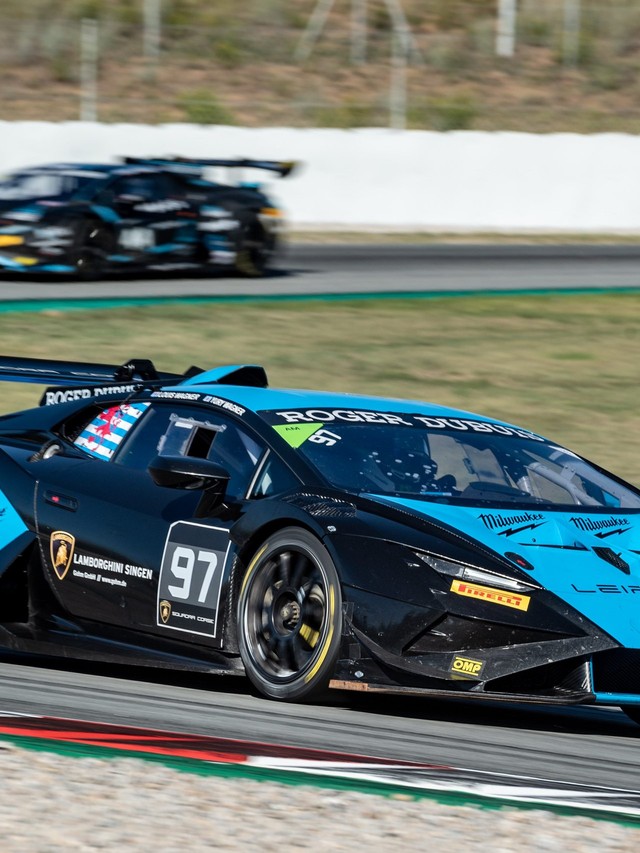
Sebring’s Grueling Test: Four Huracán GT3s Against the Storm
Twelve hours at Sebring Raceway is punishing under clear skies. When thunderstorms turn the concrete-patched surface into a river, the race becomes a survival exercise that exposes every weakness in a car’s chassis, aero balance, and mechanical durability. That was the stage for Lamborghini Squadra Corse‘s customer teams, and the Huracán GT3 responded with the kind of performance that makes a sixth-place finish more instructive than most victories.
Paul Miller Racing‘s #48 Huracán GT3, driven by Bryce Miller, Bryan Sellers, and Madison Snow, led the GTD class for several hours in the opening stages. The car posted some of the fastest lap times in its category precisely when conditions were at their worst, a detail that matters far more than final classification. After 229 laps covering roughly 850 miles of Sebring’s notoriously abrasive surface, the #48 crossed the line just eight seconds behind the GTD winner.
Eight seconds over twelve hours. That margin is roughly one poorly timed yellow flag, one extra splash of fuel, one moment of caution in standing water. The Huracán GT3 was fast enough to win. The gap was circumstantial, not fundamental. And that distinction frames everything worth understanding about where Lamborghini’s GT3 program stands as the Huracán approaches its final bow.
Beyond the Podium: Why This Result Still Matters
Race results in GT3 endurance events rarely tell the full engineering story. A car that leads for hours, sets competitive wet-weather pace, and completes a full 12-hour distance without mechanical failure demonstrates exactly the qualities customer teams pay for: predictability, durability, and a wide operating window.
Giorgio Sanna, Head of Lamborghini Motorsport, framed it plainly. The Huracán GT3, he said, “demonstrated reliability, high performance and drivability in every track conditions” despite what he called a particularly hard race. That language is measured, but the underlying message to prospective customer teams is unmistakable: this platform finishes races.
For Lamborghini’s broader narrative, consistent competitiveness in GT3 feeds directly into the perception of its road cars. The Huracán GT3 EVO2 draws its foundation from the Huracán STO, sharing essential design elements, rear-wheel drive, and the naturally aspirated V10. When a customer team runs that car hard for 850 miles in monsoon conditions and it holds together, the engineering credibility extends well beyond the pit lane.

A teal Lamborghini Huracán GT3 race car powers through a turn on a damp track.
The Rest of the Field: Penalties, Incidents, and Sebring’s Unforgiving Surface
Change Racing’s two-car effort illustrated how quickly Sebring can punish even competitive machinery. The #16 entry, piloted by Lamborghini GT3 Junior Driver Corey Lewis alongside Spencer Pumpelly and Al Carter, ran near the front throughout practice and fought for the lead during the race. A stop-and-go penalty plus a separate four-minute time penalty dropped the car to 11th, a result that obscures genuinely strong pace.
The team’s second car, the #11 of Townsend Bell, Bill Sweedler, and Blancpain Super Trofeo North American champion Richard Antinucci, retired early after an off-track excursion caused by deteriorating surface conditions. When Sebring’s concrete seams fill with water, the track becomes a different circuit entirely, and the #11 paid the price.
Konrad Motorsport brought its #28 home in 14th, completing the full distance. Dream Racing’s #27 suffered a technical problem that compromised its race. Four cars entered, three finished, and the one that retired was a victim of conditions rather than catastrophic engineering failure. For a customer racing program, that completion rate in a storm-battered endurance race reinforces the same point the #48’s near-miss made at the front: the Huracán GT3 is a platform teams can trust to bring them home.
Engineering That Earns Its Keep in the Rain
The Huracán GT3 EVO2 carries a 5204 cc naturally aspirated V10 paired with a six-speed sequential gearbox from Xtrac, all packaged at a dry weight of 1230 kg. Fully compliant with the FIA’s 2022 technical regulations, the EVO2 introduced original aerodynamic innovations and an entirely new intake system compared to its predecessor.
What made the Sebring result particularly telling is how the car performed when grip disappeared. A naturally aspirated V10 delivers its power in a linear, progressive curve, giving the driver more intuitive throttle response in low-grip situations compared to turbocharged alternatives where boost can arrive abruptly. In heavy rain on Sebring’s notoriously bumpy surface, that throttle predictability becomes a genuine competitive advantage, not a philosophical talking point.
The Huracán GT3 was the first GT3 car entirely engineered, developed, and assembled in-house by Automobili Lamborghini. That distinction matters because it means Squadra Corse controls the full development loop: aero, chassis, powertrain calibration, and the customer support infrastructure that keeps these cars competitive weekend after weekend. The platform debuted in North American GT3 racing in 2016, and nearly a decade later it was still fast enough to lead at one of the most demanding circuits on the calendar. That longevity is not accidental; it is the product of a design philosophy that prioritized a wide operating window over peak-condition heroics, exactly the quality Sebring’s storms rewarded.
From Huracán to Temerario: The Baton Pass Begins
The Temerario GT3 is confirmed as the Huracán GT3 EVO2’s successor, and it represents a fundamental shift in Lamborghini’s customer racing philosophy. Where the Huracán GT3 relied on a naturally aspirated V10, the Temerario GT3 will use a modified version of the road car’s twin-turbocharged engine, stripped of its hybrid system to comply with GT3 regulations. It also marks the first race car fully designed and developed at Lamborghini’s Sant’Agata Bolognese facility, a distinction that separates it from the original Huracán GT3’s collaboration with Dallara.
Road & Track noted that Lamborghini stuck with updated versions of the same basic Huracán platform for a full decade while competitors like Porsche cycled through multiple entirely new GT3 designs. That patience now looks like a deliberate strategy: extract maximum value from a proven platform while developing a clean-sheet successor in-house.
For customer teams currently running the Huracán GT3, the transition means adapting to an entirely different powerband, revised weight distribution, and the complexities of turbo management in wheel-to-wheel racing. The Huracán’s linear V10 delivery rewarded smooth inputs. The Temerario’s turbo V8 will demand a different driving technique, and the teams that adapt fastest will define the early competitive pecking order. Results like Sebring set the benchmark the Temerario must clear. A car that can lead in the rain, survive 850 miles on one of the roughest circuits in professional racing, and finish within eight seconds of a win is not a platform that will be easy to replace.
What This Means for Lamborghini’s Competitive Position
GT3 racing is the most commercially important category in global sportscar competition because it directly connects factory engineering to customer teams who buy and race the cars. Ferrari, Porsche, and Mercedes-AMG all invest heavily in their GT3 platforms, and the results feed directly into marketing, brand perception, and the willingness of wealthy enthusiasts to write very large checks.
Reports indicate the SC63 LMDh program was discontinued for the 2026 season after two seasons of challenging performance, which means the GT3 program now carries even more weight as Lamborghini’s primary motorsport proving ground. The Huracán GT3’s Sebring performance, arriving in what amounts to the platform’s twilight, reinforces the narrative that Squadra Corse builds durable, competitive customer cars even when the flagship prototype effort stumbles.
For prospective buyers considering a Temerario GT3 program, the practical takeaway from Sebring is reassuring. Lamborghini’s customer racing infrastructure, the engineering support, the parts supply chain, the driver development pipeline that produced talents like Corey Lewis, delivered competitive results with a car approaching the end of its competitive life. If Squadra Corse can do that with a decade-old platform in a thunderstorm, the standard for a clean-sheet design with modern aerodynamics and a more powerful engine has been set. Eight seconds is the number the Temerario will be measured against.
Gallery


