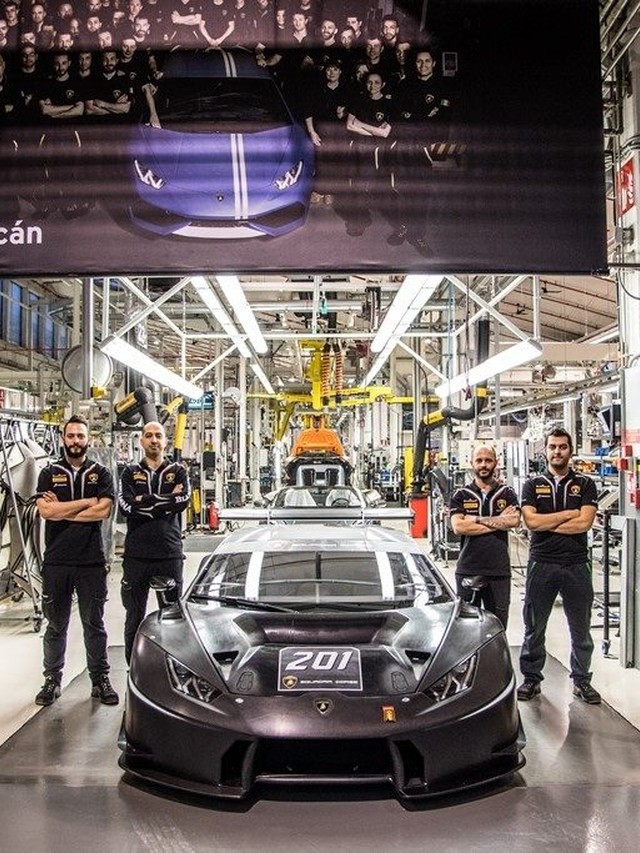
201 Race Cars, One Assembly Line
On January 18, 2017, a Huracán GT3 rolled off the assembly line at Sant’Agata Bolognese as the 201st racing car produced by Lamborghini Squadra Corse. The number itself is impressive for any motorsport department. What makes it genuinely unusual is where that car was built: the exact same production line that assembles the road-going Huracán you can order from a dealer.
Lamborghini says both the Huracán Super Trofeo and the Huracán GT3 share the standard Huracán’s assembly stations, with dedicated Squadra Corse technicians following each racing chassis through the process. That detail, easy to skim past in official material, is the real story here. Most manufacturers’ motorsport divisions operate in separate facilities, sometimes in entirely different countries, with bespoke tooling and workflows that bear little resemblance to series production. Lamborghini chose the opposite approach, and the results over a 24-month production window suggest the strategy works.
The milestone of 201 units encompasses both models: more than 140 Super Trofeos and nearly 60 GT3s, all built between 2015 and January 2017. For context, the preceding Gallardo Super Trofeo totaled 106 units across a six-year production run from 2009 to 2014. The Huracán surpassed its predecessor’s entire career output in roughly a third of the time. That acceleration was not the product of a bigger workforce or a new factory wing. It was the product of embedding race car production inside an existing, proven system.
How Road Cars and Race Cars Share a Birth
The concept sounds counterintuitive. A race car stripped to its essential structure, fitted with a roll cage, running on slicks, and governed by FIA homologation rules seems like a fundamentally different product from a leather-lined road car with air conditioning and an infotainment screen. Yet the Huracán‘s aluminum and carbon fiber architecture provides a common starting point that Lamborghini exploits deliberately.
According to Lamborghini, skilled Squadra Corse technicians oversee the assembly of each racing car at every station on the shared line. The road car’s chassis moves through the same sequence of body assembly, powertrain marriage, and systems integration. When a Super Trofeo or GT3 enters that sequence, the Squadra Corse crew steps in to manage the divergences: the stripped interior, the racing wiring harness, the competition-spec suspension pickup points, the aerodynamic bodywork. The core structure benefits from the same tooling precision, the same quality checkpoints, and the same institutional discipline that governs every road Huracán.
Lamborghini claims this integrated model reduces manufacturing times and ensures the highest quality control standards, which translate into greater reliability on track. For a customer racing team spending hundreds of thousands on a GT3 car, mechanical reliability is the difference between a podium finish and a flatbed ride back to the paddock. Building the race car within a proven, high-volume production system, rather than in a low-volume skunkworks, means each chassis benefits from processes refined over thousands of road car builds. When line workers identify a tolerance issue or a supplier defect on a road car, the fix propagates immediately to the racing chassis rolling through the same stations. A separate facility would need its own parallel quality loop, with its own lag time and its own potential for divergence.
The Strategic Logic Behind Integration
Beyond a factory-tour talking point, the shared-line approach addresses the single biggest barrier to entry in customer GT racing: confidence in the product.
Customer racing programs live or die on trust. A gentleman driver or a privateer team choosing between a Huracán GT3, a Ferrari 488 GT3, or a Porsche 911 GT3 R evaluates lap times, certainly, but also parts availability, factory support responsiveness, and the car’s reputation for not stranding them with unexplained failures. Lamborghini’s integrated production model functions as a structural guarantee. The car was built by the same people, with the same tools, under the same roof as the road car that already passed every Volkswagen Group quality gate.
Few competitors replicate this exact approach. Ferrari’s Corse Clienti and Porsche’s customer motorsport operations are formidable, but they tend to operate with greater separation between road car and race car assembly. Porsche, for example, builds its 911 GT3 R through Manthey and its own motorsport division, drawing on the Zuffenhausen parts stream but not literally sharing the 911 Carrera’s assembly line station by station. Ferrari’s GT racing cars go through Maranello’s Reparto Corse with dedicated processes. Neither method is inherently inferior, but Lamborghini’s version offers a specific advantage: production velocity without sacrificing build consistency.
The numbers reinforce the point. Producing over 200 racing Huracáns in 24 months, while simultaneously meeting road car demand, is a logistical achievement that a standalone motorsport workshop would struggle to match without significant capital investment in parallel infrastructure. By anchoring its racing production inside the road car factory, Squadra Corse could offer competitive lead times and a parts supply chain that piggybacks on the Huracán’s road car logistics. When a customer team needs a replacement gearbox casing or a new set of uprights, the supply chain serving thousands of road cars is already in motion. A manufacturer whose GT3 cars are built in a dedicated motorsport facility with its own, smaller-scale supplier relationships can face parts bottlenecks, especially mid-season when every team on the grid is ordering spares simultaneously. Lamborghini’s approach does not eliminate that problem entirely, but it mitigates it structurally.
From Gallardo to Huracán: Acceleration in Every Sense
The generational leap from Gallardo to Huracán in customer racing illustrates how Lamborghini’s motorsport ambitions scaled alongside its manufacturing confidence.
The Gallardo Super Trofeo launched the brand’s one-make series in 2009, a meaningful step for a company that, for most of its history, treated factory-backed racing as someone else’s job. Over five years, 106 Gallardo race cars left Sant’Agata. Respectable, but modest by the standards of Porsche’s Carrera Cup ecosystem, which was already producing hundreds of spec racers per generation.
The Huracán Super Trofeo debuted publicly at Pebble Beach in August 2014 and began racing in the 2015 season. Within two years of full production, more than 140 Super Trofeo units were delivered. The GT3 variant, developed in collaboration with Dallara for more sophisticated aerodynamics and suspension kinematics, debuted the same year and accounted for nearly 60 additional units by early 2017.
That pace of production only makes sense if the manufacturing backbone can absorb the volume without disrupting road car output. The shared-line strategy is what made the math work. Lamborghini did not need to build a new facility or hire a parallel workforce. It needed Squadra Corse technicians embedded in an existing, proven system. For the customer teams that bought those cars, the practical benefit was shorter lead times. A racing program that orders a GT3 chassis in January needs it ready for pre-season testing, not arriving six months late because a boutique workshop hit a bottleneck. The shared line’s production cadence, tuned to road car volumes, gave Squadra Corse a throughput advantage that smaller operations simply cannot replicate.
On-Track Proof: The Huracán GT3’s Racing Record
Production efficiency means nothing if the cars are slow. The Huracán GT3’s competition record suggests the quality control Lamborghini touts is more than marketing language.
Lamborghini says approximately 40 Huracán GT3s competed in 2016 GT championships, collecting 2 titles, 52 podiums, 18 overall wins, and 22 pole positions. The car’s racing debut came in 2015, where it won the Endurance race of the Blancpain GT Series at Monza, a statement result for a brand still building its GT3 credibility.
The platform’s competitive arc only steepened from there. The Huracán GT3 EVO, introduced in 2019 with improved Dallara-developed aerodynamics and revised suspension geometry, became a genuine championship contender across multiple series. In 2020, Paul Miller Racing secured IMSA WeatherTech SportsCar Championship driver and team titles in both full-season and endurance standings. Barwell Motorsport delivered Lamborghini’s first British GT title. The same year brought a class victory at the 24 Hours of Spa and multiple GT World Challenge wins.
By 2021, one report indicated the Huracán Super Trofeo program, including later EVO2 models, had seen over 400 cars built and nearly 1,000 drivers participate. Those figures reflect a racing ecosystem, not just a car. Lamborghini’s one-make series spans Europe, Asia, North America, and the Middle East, creating a global support network that a customer team can plug into with relative confidence. None of that infrastructure would exist at this scale without the production throughput the shared assembly line made possible.
As Road & Track noted in a 2025 deep dive on the successor Temerario GT3, the Huracán GT3 served as Lamborghini’s racing platform for a full decade, during which eleven other brands introduced entirely new GT3 cars and Porsche alone released three different generations. The Huracán’s longevity in competition speaks to the robustness of its original design and, arguably, to the manufacturing discipline that kept build quality consistent across hundreds of units over many years.
What the 201st Huracán Signals for Squadra Corse’s Future
The 201st Huracán GT3 was a milestone, but it was also a proof of concept for everything Squadra Corse would do next. The integrated production philosophy validated by the Huracán program laid the groundwork for the eventual transition to the Temerario GT3, which will carry Lamborghini’s customer racing ambitions into a new era defined by a twin-turbo V8 rather than the naturally aspirated V10.
For buyers and teams evaluating their next GT3 commitment, the question is whether Lamborghini will maintain the same shared-line approach with the Temerario. The company’s public statements about the Temerario GT3 suggest continued collaboration between Squadra Corse and the road car production infrastructure, though the specifics of how a hybrid-capable road car platform translates to a pure racing chassis remain to be fully detailed.
What the Huracán program proved, conclusively, is that Lamborghini’s approach to building race cars is not a marketing gimmick. Over 200 cars in 24 months, competitive across multiple international championships, supported by a global one-make series infrastructure. The shared assembly line at Sant’Agata Bolognese turned out to be the foundation for all of it. For anyone who still thinks of Lamborghini purely as the brand that makes posters for teenagers’ bedroom walls, the Squadra Corse production story is a useful corrective. The company builds race cars the way it builds road cars, and that is precisely the point.
Gallery


