A Second Sprint Cup Win at Imola, and a Pro-Am Title Sealed Early
Stuart Middleton and Alberto di Folco drove Imperiale Racing’s #6 Lamborghini Huracán GT3 Evo to victory in Race 1 of the Italian GT Championship Sprint Cup at Imola, beating a Ferrari 488 GT3 by 0.871 seconds and a BMW M4 GT3 by 1.380 seconds. The margin was slim, the circuit unforgiving, and the result telling: Lamborghini’s second Sprint Cup win of the 2022 season came at a track where tight corners, heavy braking zones, and scarce overtaking opportunities reward qualifying position and pit strategy over raw straight-line speed. In other words, the kind of track that exposes a car’s weaknesses rather than flattering its strengths.
The weekend produced a second headline. LP Racing’s Jonathan Cecotto and Mattia di Giusto clinched the Pro-Am class title with a full round still remaining, combining a class victory and a runner-up finish to put the championship beyond reach. Two Lamborghini stories from one weekend, each illustrating a different quality: outright pace in the overall classification, and relentless consistency in the amateur ranks.
Taken together, the results say something measurable about the Huracán GT3 Evo’s competitiveness in its final seasons before the platform transition. The Italian GT Championship is one of the most manufacturer-diverse national GT series in Europe, regularly fielding factory-supported entries from Ferrari, BMW, Mercedes-AMG, Audi, and Porsche alongside Lamborghini’s Squadra Corse-backed teams. Winning here, against that depth, is not ceremonial. It is evidence that a naturally aspirated V10 platform still has teeth even as newer machinery crowds the grid.
How Middleton and Di Folco Turned Third on the Grid into First at the Flag
The victory was engineered across both stints, not gifted by circumstance. Middleton qualified the #6 car third with a 1:47.578 lap, exactly three-tenths off pole, a gap consistent with the promising pace the pair showed in both practice sessions. From the rolling start he jumped the #55 Honda into Tamburello to claim second, then spent the opening stint defending that position against both the Honda and a pursuing Ferrari while keeping the leading BMW within striking distance.
A safety car period compressed the field, erasing whatever gap the leaders had built. After the restart Middleton shadowed the BMW closely enough that when the pit window opened, the team’s strategy could play out on its terms. The key detail: Imperiale Racing executed a faster pit stop than the Ferrari crew behind them. Di Folco rejoined the track with clean air ahead and the Ferrari in his mirrors rather than on his bumper.
The decisive moment came when the BMW served its mandatory pit stop plus a 15-second success handicap, a penalty imposed on previous race winners to keep the championship competitive. Di Folco inherited the lead and defended it through the closing laps, including a second safety car restart, to cross the line eight-tenths of a second clear of the Ferrari.
Race 2 on Sunday proved more difficult. Di Folco qualified second but was demoted to third before the start. The #6 car then absorbed its own 15-second success handicap during the mandatory pit stop, dropping Middleton to fourth, where the pair held to the flag. The success handicap system, which few outlets bother to explain, penalizes winning cars with additional stationary time during their mandatory pit stop in subsequent races, scaling the penalty based on recent results. It forces teams to think about championship points across a full season rather than maximizing every individual race. Imperiale Racing’s willingness to absorb that penalty on Sunday, after converting Saturday’s opportunity, reflects a team calculating its championship math carefully. The pair had come into the weekend looking to make amends for a challenging Sprint Cup round at Misano, where mechanical issues prevented them from starting the second race. Imola delivered the redemption they needed.

The Lamborghini Huracan GT3 Evo, number 6, powers through a turn on the race track under clear skies.
The Huracán GT3 Evo: Why the V10 Platform Keeps Winning Late in Its Life Cycle
Consider the machinery the Huracán GT3 Evo lined up against at Imola. The BMW M4 GT3, in its debut 2022 season, runs a twin-turbo inline-six. The Ferrari 488 GT3, itself a mature platform, benefits from Maranello’s deep GT racing investment. The Mercedes-AMG GT3, visible in on-track images trailing the #6 Lamborghini, represents yet another engineering philosophy. On paper, the Huracán is the elder statesman.
What keeps it sharp is how naturally aspirated V10 power translates to GT3 racing. The engine delivers linear throttle response, which matters enormously in a category where Balance of Performance regulations equalize peak power across manufacturers. When everyone produces roughly similar horsepower, the car that lets its driver modulate power most precisely through corner exits gains a compounding advantage over a 50-minute sprint. That throttle linearity is one reason the Huracán platform continued winning GT3 races years after its road-car sibling stopped being the newest thing in Lamborghini’s showroom.
The car’s aluminum and carbon fiber structure, developed by Squadra Corse, also aged well because GT3 regulations constrain weight and aerodynamic development tightly enough that a well-sorted older platform can remain competitive against newer entrants still working through their development cycles. Maturity counts. A customer team like Imperiale Racing could extract performance through preparation and driver coaching rather than chasing setup unknowns, which is exactly how smaller operations compete against factory-backed entries. The Imola result was not a fluke; it was the product of a platform whose behavior teams understood down to its tire wear patterns, brake characteristics, and fuel consumption windows.
Cecotto and Di Giusto Wrap the Pro-Am Title with a Round to Spare
LP Racing’s championship victory deserves its own attention because it illustrates a different dimension of the same story. Pro-Am pairings combine a professional driver with an amateur or gentleman driver, and the class exists specifically to make GT3 racing accessible to enthusiasts who want competitive wheel-to-wheel action without needing to match outright pace with full professional lineups.
Cecotto and Di Giusto secured the title with a class win and a runner-up finish across the Imola weekend, building enough of a points margin that the final round at Mugello became a formality. Wrapping up a championship early signals dominance across a full season, not just a single strong weekend.
This is where Lamborghini’s Squadra Corse operation earns its reputation among the people who actually write the checks. Customer racing programs live or die on the support infrastructure: spare parts availability, trackside engineering assistance, driver coaching programs, and the responsiveness of the factory when something breaks at 10 PM on a Friday before qualifying. LP Racing’s ability to sustain a title-winning campaign through a full season suggests that infrastructure was working as intended. If the Huracán GT3 Evo’s outright pace at Imola proved the car still bites, the Pro-Am title proved the ecosystem around it still delivers.

Celebrate the human element of motorsport with the victorious drivers.
Beyond the Podium: What National GT Success Means for Lamborghini’s Racing Future
National GT championships lack the global visibility of the FIA World Endurance Championship or the prestige of the 24 Hours of Le Mans. What they offer instead is volume: more teams, more customer cars sold, more weekends of competitive data feeding back to the factory. The Italian GT Championship is particularly valuable for Lamborghini because it runs on the brand’s home circuits, in front of Italian media and the enthusiast community closest to Sant’Agata Bolognese.
A strong showing here directly reinforces the perception among potential customer racing buyers that the Huracán GT3 Evo is a competitive, reliable, and well-supported platform. That perception translates into car sales. Squadra Corse does not publicly disclose how many GT3 customer cars it delivers annually, but the number of Huracán GT3 entries across Italian GT, British GT, ADAC GT Masters, and various other national and international series suggests healthy demand throughout the car’s competitive life.
The timing of this Imola victory also matters in a broader context. Car and Driver reports that the Temerario GT3, designed to replace the Huracán GT3 Evo 2 as Lamborghini’s factory-backed GT3 effort, represents the first race car entirely designed and developed at Lamborghini’s Sant’Agata facility. That platform transition, from naturally aspirated V10 to twin-turbo V8, will reshape Lamborghini’s entire customer racing proposition. Every late-career Huracán GT3 Evo victory adds to the legacy the Temerario GT3 will need to match or exceed.
One more thread from the same Imola weekend reinforces the point. Rodrigo Testa, a 16-year-old Portuguese driver making his maiden Italian championship appearance for FFF Racing Team, took the GT Cup victory in a Lamborghini Huracán ST. A teenager winning on debut in a Lamborghini one-make car is exactly the kind of pipeline moment that keeps the brand’s racing ecosystem feeding talent upward into GT3 and beyond.

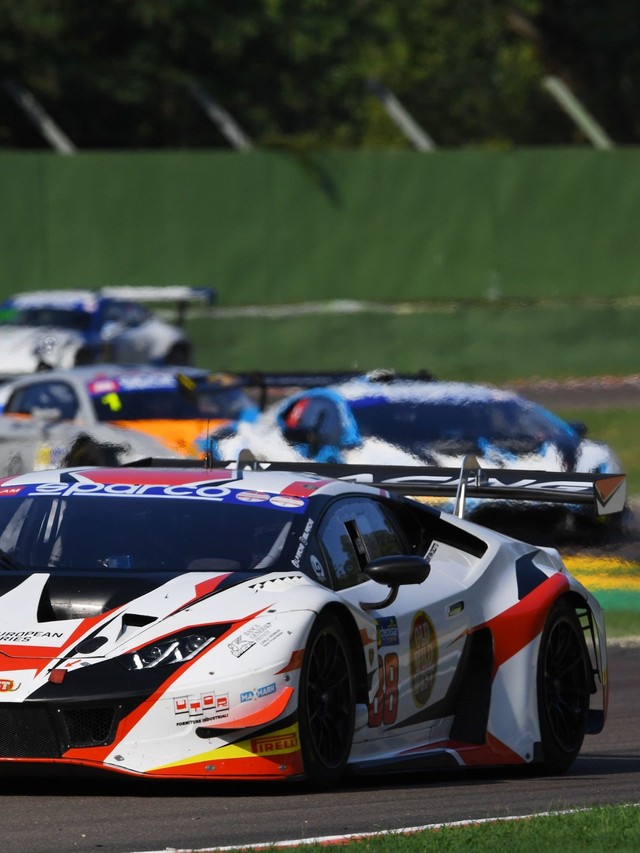
The Lamborghini Huracan GT3 Evo, number 19, leads the pack through a turn on the race circuit.
Looking Ahead to Mugello and the Platform Handover
The Italian GT Sprint Cup’s final round was scheduled for Mugello on October 22-23, giving Imperiale Racing one more opportunity to add to its 2022 tally and LP Racing a chance to celebrate its Pro-Am title on another storied Italian circuit.
For Lamborghini enthusiasts following the racing side of the brand, the real question extending beyond this season is how smoothly the transition from Huracán to Temerario GT3 will proceed. Customer teams that invested in the Huracán platform, learned its characteristics over hundreds of racing hours, and built their engineering processes around its V10 powertrain will eventually face a complete reset. The Imola results serve as a reminder of what the outgoing platform could still deliver when preparation, strategy, and driver talent aligned. Whether the Temerario GT3 can replicate that combination of accessibility, reliability, and raw competitiveness will determine the next chapter of Lamborghini’s customer racing story.
Gallery


