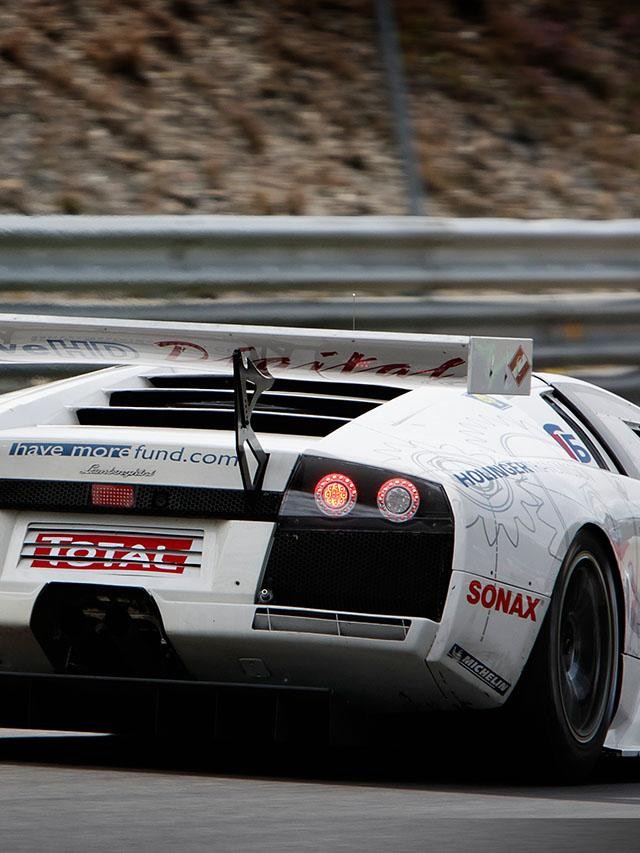
Daytona’s Near-Triumph: How the Huracán GTD Led the Class and Lost It
Five Lamborghini Huracán GTDs started the Daytona 24 Hours. Four completed every lap without a single technical failure. Each of those surviving entries led the GTD class at some point, and Lamborghini says its cars remained in contention for the class victory until the final laps. The fifth retired after on-track contact, a racing incident rather than an engineering one.
So why no trophy? Lamborghini attributes the outcome to severe penalties and aggressive race strategies that compromised the final result, particularly in the closing stages. The company’s account does not specify the nature of those penalties or which strategic calls backfired, leaving a frustrating gap in the narrative. What it does confirm is that the race “seemed to be completely in favor of Lamborghini Squadra Corse” before those late interventions changed the order.
The subtext is loud for anyone following GT racing closely. Pace and mechanical endurance are the two hardest things to get right over 24 hours, and Lamborghini demonstrated both. The elements that cost them the result, penalties and strategy, are correctable. The engineering, the part that takes years to develop and millions to validate, held up under the most demanding conditions in North American GT racing. That distinction matters enormously as Lamborghini prepares to transition its entire GT3 program to a new powertrain architecture with the Temerario, because Daytona proved the current platform’s reliability is the benchmark the successor must meet.
Endurance Proven: What 24 Faultless Hours Tells You About the V10
A 24-hour race is the cruelest reliability test in motorsport. Engines cycle through tens of thousands of thermal events. Gearboxes absorb hundreds of thousands of shift loads. Brakes get cooked, cooled, and cooked again through long night stints and dawn restarts. Four cars finishing clean is a statement about the maturity of the Huracán GT3 EVO2 platform, and it reinforces why this car’s engineering record will serve as the yardstick for everything Squadra Corse builds next.
The car’s 5,204 cm³ naturally aspirated V10 sits in a field increasingly populated by turbocharged competitors. Naturally aspirated engines carry inherent endurance advantages in this context: fewer failure-prone components such as turbocharger bearings, wastegates, or intercooler plumbing, more linear heat management, and a power delivery curve that is gentler on drivetrains. The V10 uses gasoline direct injection and dry sump lubrication, both essential for sustained high-load operation where oil starvation during hard cornering would kill a conventional wet sump in minutes.
The chassis combines aluminum and carbon fiber in a hybrid construction, with carbon composite body panels attached via a quick-fixing Dzust system. That last detail matters more than it sounds: in endurance racing, the ability to swap damaged panels quickly during pit stops can save laps. A 6-speed sequential Xtrac gearbox handles power delivery through pneumatically controlled paddle shifters, and the rear-wheel-drive layout uses a mechanical differential lock paired with a 10-position adjustable Bosch Motorsport traction control system. Every one of these components survived 24 hours at racing intensity across four separate cars.
Developed by Squadra Corse based on the road-going Huracán STO, the GT3 EVO2 shares core design elements with its street sibling, including the rear-wheel-drive configuration and that naturally aspirated V10. It complies with FIA 2022 technical regulations and incorporates aerodynamic innovations and a redesigned intake system compared to its predecessor. At a dry weight of 1,230 kg, it carries just enough mass to be stable through Daytona’s banking while remaining light enough to be competitive on the infield’s tighter sections.
The Penalties and Strategy Question Nobody Has Answered
Lamborghini’s account of the race outcome raises more questions than it resolves. “Severe penalties” is a loaded phrase without specifics. In GTD racing, penalties can range from drive-through penalties for pit lane infractions to time additions for contact or exceeding track limits. The difference between a 30-second stop-and-go and a minor time penalty is enormous in a race where class leaders are often separated by seconds after 24 hours.
The mention of “aggressive race strategies” is equally vague. In endurance racing, strategy encompasses fuel stint length, tire compound choices, driver rotation timing, and the critical decision of when to pit under caution periods. An aggressive strategy might mean short-fueling to gain track position, gambling on caution periods to leapfrog competitors, or pushing tire stints beyond the optimal window. Any of these can work brilliantly or backfire catastrophically, and the margin between the two outcomes is often a single yellow flag.
Lamborghini’s decision to highlight these factors without elaboration is deliberate. The company wants the takeaway to be about engineering competence rather than operational mistakes. The honest reading is that the car proved itself and the team learned expensive lessons. Both things can be true simultaneously, and both feed the same larger story: the Huracán GT3‘s engineering is mature enough that the remaining performance gaps are human, not mechanical.
That maturity has deep roots. The Huracán GT3 competes in 12 different racing series worldwide, including the IMSA WeatherTech SportsCar Championship where this Daytona race took place. Across that breadth of competition, the platform’s track record speaks for itself. Lamborghini secured double victories at the Daytona 24 Hours and Sebring 12 Hours in both 2018 and 2019, earned IMSA GTD Manufacturers Championships those same years, and celebrated a one-two finish at Daytona in 2020. It won the Blancpain GT Series in Europe in 2017 and swept the Team, Drivers, and Endurance titles in 2019. This Daytona result, while disappointing in the final classification, fits a pattern of a car that consistently runs at the front.
The V10’s Last Stand in a Turbo World
One detail deserves more attention than it typically receives: the Huracán GT3 EVO2‘s naturally aspirated V10 is the only engine of its kind in the current GT3 contingent. Every major competitor, from Ferrari’s 296 GT3 to Porsche’s 911 GT3 R and the various AMG, Aston Martin, and BMW entries, runs a turbocharged powertrain. The V10 is an anachronism in the best possible sense, and its faultless Daytona run underscores why its departure will leave a gap no Balance of Performance table can quantify.
BoP regulations exist to equalize different engine configurations, so raw power output is theoretically neutralized across the field. But BoP cannot fully account for the character differences between engine types. A naturally aspirated V10 delivers its power with an immediacy and throttle response that turbocharged engines, even the best ones, struggle to replicate. For drivers, that translates to more predictable behavior on corner exit, where the relationship between throttle position and rear tire load is most critical. It also means the engine’s behavior remains consistent whether the ambient temperature is 45°F during a 3 AM stint or 85°F under the afternoon Florida sun. Turbocharged engines are more sensitive to intake air temperature, and while intercoolers mitigate this, they add weight and complexity.
The practical buyer takeaway for anyone considering a Huracán GT3 EVO2 as a customer racing platform: this car represents the final chapter of a proven, naturally aspirated racing architecture. Teams running the Huracán benefit from a decade of accumulated setup data, parts availability, and engineering support. The car’s base price for the Super Trofeo variant sits at $360,000 according to Car and Driver, and the GT3 specification commands a premium above that. For customer teams evaluating their next racing investment, the Huracán’s reliability record at Daytona provides concrete evidence that this platform can still deliver results even as its replacement approaches.

The teal and black Lamborghini Huracán GT3 race car with number 28 speeds around the track during a race.
From Huracán to Temerario: What Daytona Means for Lamborghini’s Next GT3 Chapter
Everything the Huracán proved at Daytona sharpens the stakes for its successor. The Temerario GT3 is set to replace the Huracán GT3 EVO2 as Lamborghini’s official GT3 racing platform, and its development carries a significance that extends beyond a simple model swap. According to Car and Driver, the Temerario GT3 is the first race car entirely designed and developed by Lamborghini at its Sant’Agata Bolognese facility. Previous Huracán GT3 generations were built in collaboration with Dallara. Bringing the entire process in-house marks a philosophical shift for Squadra Corse, established in 2013, from a motorsport division that outsourced chassis construction to one that controls every element of the car’s design.
The powertrain transition is equally significant. GT3 regulations require the Temerario GT3 to use a modified version of the road car’s twin-turbocharged engine, meaning Lamborghini’s GT3 program will move from naturally aspirated to forced induction for the first time. That transition carries risk. Turbo engines introduce new failure modes, bearing wear, boost control issues, intercooler leaks, that Squadra Corse’s engineering team will need to master in competition. The Huracán’s Daytona performance, proving the current car’s reliability in the most demanding conditions, provides a benchmark against which the Temerario GT3’s early race results will inevitably be measured.
For Lamborghini’s competitive position against Ferrari and Porsche in GT3 racing, the timing matters. Both rivals field mature turbocharged GT3 platforms with years of race data. Lamborghini will be the newcomer to turbo GT3 racing, and the learning curve is real. Road & Track’s analysis of the Temerario GT3 noted that Porsche alone released three entirely new GT3 cars during the decade Lamborghini stuck with updated versions of the same basic Huracán platform. The Temerario represents Lamborghini’s answer to that criticism: a ground-up design rather than another evolution.
What the Daytona result demonstrates is that Squadra Corse understands endurance racing at a fundamental level. The operational mistakes are fixable. The engineering foundation, four cars running 24 hours without mechanical failure, is the harder problem to solve, and Lamborghini solved it years ago with the Huracán. The question now is whether they can replicate that reliability with an entirely new powertrain architecture.
Customer teams watching this transition face a familiar dilemma. The Huracán GT3 EVO2 is a known quantity with a proven record, available setup data, and established parts supply chains. The Temerario GT3 promises a newer, potentially faster platform but carries the uncertainty of any first-generation race car. For teams planning their 2026 and 2027 programs, Daytona’s result reinforces the case for extracting maximum value from the Huracán platform while the Temerario matures through its early competitive seasons. Lamborghini’s own motorsport history suggests patience: the original Huracán GT3 debuted in the WeatherTech Championship GTD class in 2016 and earned its first victory at Virginia International Raceway that same year, but the dominant championship campaigns came in 2018 and 2019, after two full seasons of development and data accumulation.


