The Huracán That Refuses to Choose Between Road and Track
Every Huracán lineup eventually produces a model that makes the others look like compromises. The Tecnica is Lamborghini’s bid for exactly that position: a rear-wheel-drive V10 that borrows the STO’s full 640 CV engine but wraps it in bodywork and calibration tuned for the buyer who actually drives home from the circuit instead of trailering the car both ways.
Lamborghini slots the Tecnica between the EVO RWD and the stripped-out STO, and the intent is unmistakable. The EVO RWD is the approachable entry to rear-drive Huracán ownership. The STO is a barely disguised race car with fixed bucket seats and visibility that requires faith. The Tecnica occupies the gap where most real-world enthusiast driving actually happens: spirited road work punctuated by occasional track days, all without needing a chiropractor afterward. MotorWeek describes it as a “tweener model” between the EVO and STO, a framing that captures the engineering brief precisely.
What makes the Tecnica compelling from a design and engineering standpoint is how Lamborghini chose to split the difference. Rather than simply detuning the STO and bolting on prettier bumpers, the company recalibrated the entire dynamic envelope, from aerodynamics to brake cooling to drive-mode software, creating a car that Lamborghini says delivers the STO’s powertrain character with meaningfully better livability.
STO Power, Recalibrated Manners: Why the Engineering Brief Matters
At the Tecnica’s core sits the 5.2-liter naturally aspirated V10 producing 640 CV (631 horsepower) and 565 Nm of torque at 6,500 rpm, an increase of 30 CV over the Huracán EVO RWD and identical to the unit in the STO. Paired with a 7-speed dual-clutch transmission sending power exclusively to the rear axle, the Tecnica accelerates from 0 to 100 km/h in 3.2 seconds according to Lamborghini’s figures.
Raw output alone does not explain why this car exists, though. The real story sits in how the LDVI (Lamborghini Dinamica Veicolo Integrata) system orchestrates everything around that engine. LDVI is a feed-forward control architecture: rather than simply reacting to slip or yaw after it occurs, the system anticipates dynamic changes in virtual real-time and pre-adjusts the car’s responses. On the Tecnica, LDVI coordinates rear-wheel steering, torque vectoring, and a modified Performance Traction Control System (P-TCS) across three distinct driving modes, each calibrated to deliver a genuinely different character.
In STRADA, rear-wheel steering prioritizes stability and low-speed maneuverability, with the engine and gearbox softened for comfortable daily use. SPORT shifts the rear-wheel steering to enhance oversteer, raises the P-TCS slip threshold to let the tail move, and sharpens throttle response. CORSA goes further still: track-optimized throttle mapping, the fastest gearshift times, and maximum grip extraction from the torque vectoring and traction control working in concert.
The calibration philosophy here deserves attention, because few competitors explain it clearly. Most mid-engine supercars offer drive modes that feel like volume knobs, turning everything up or down together. Lamborghini claims each Tecnica mode reconfigures the relationship between systems, not just their intensity. One review notes that the rear-wheel-drive configuration makes the front end feel lighter and more willing to turn in compared to AWD Huracán variants, the kind of tactile feedback that rewards a driver who pays attention to steering weight and turn-in response rather than just straight-line speed.

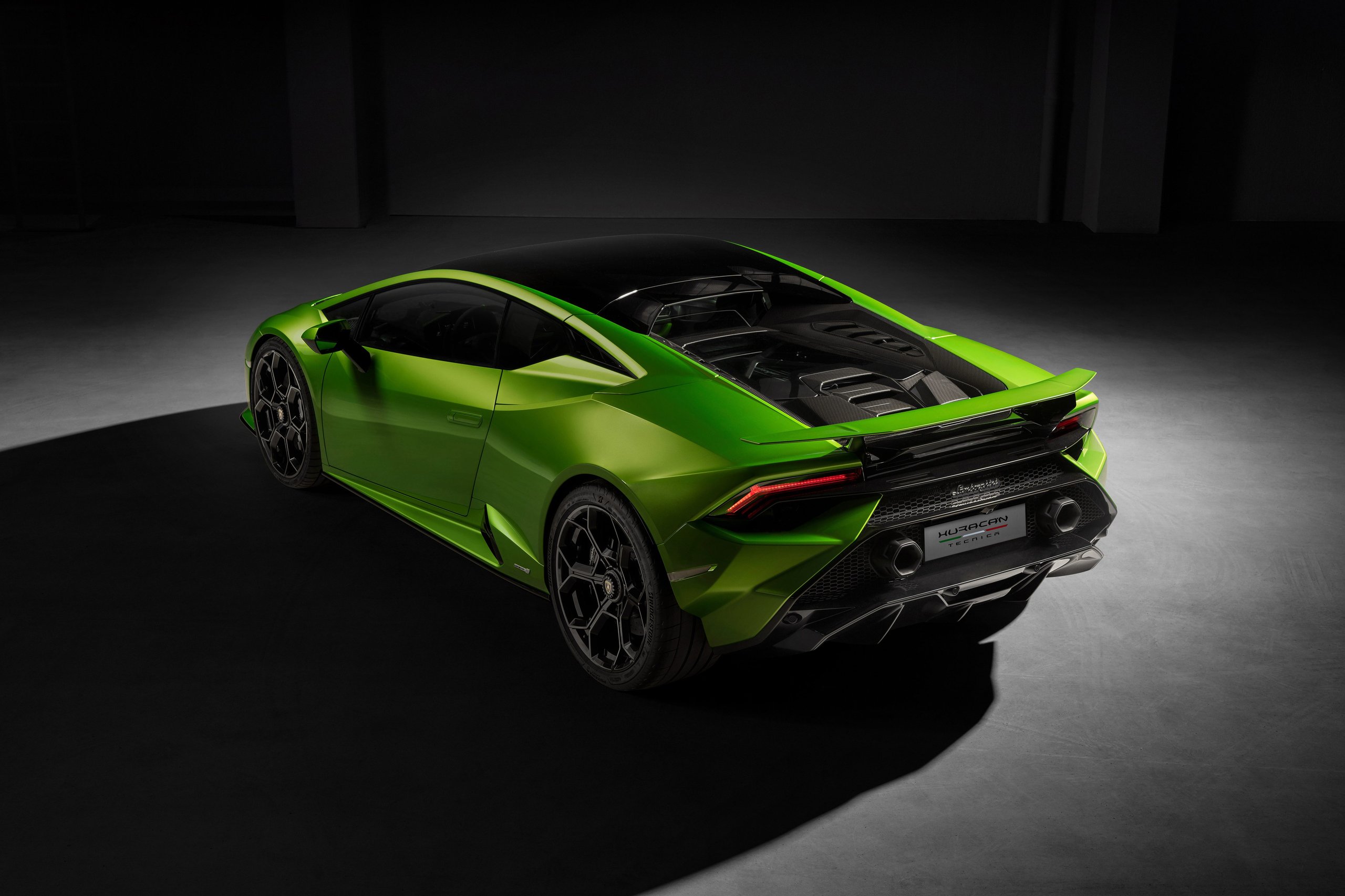
The exposed V10 engine of the Huracán Tecnica reveals its powerful heart and meticulous carbon fiber detailing. Image: Automobili Lamborghini.
Aerodynamic Design That Earns Its Fixed Wing
Lamborghini says the Tecnica achieves a 35% improvement in rear downforce over the Huracán EVO RWD while simultaneously reducing drag by 20%. Those two numbers moving in opposite directions is the aerodynamicist’s holy grail, and the Tecnica accomplishes it through a comprehensive rework of the car’s surfaces rather than simply bolting on a bigger wing.
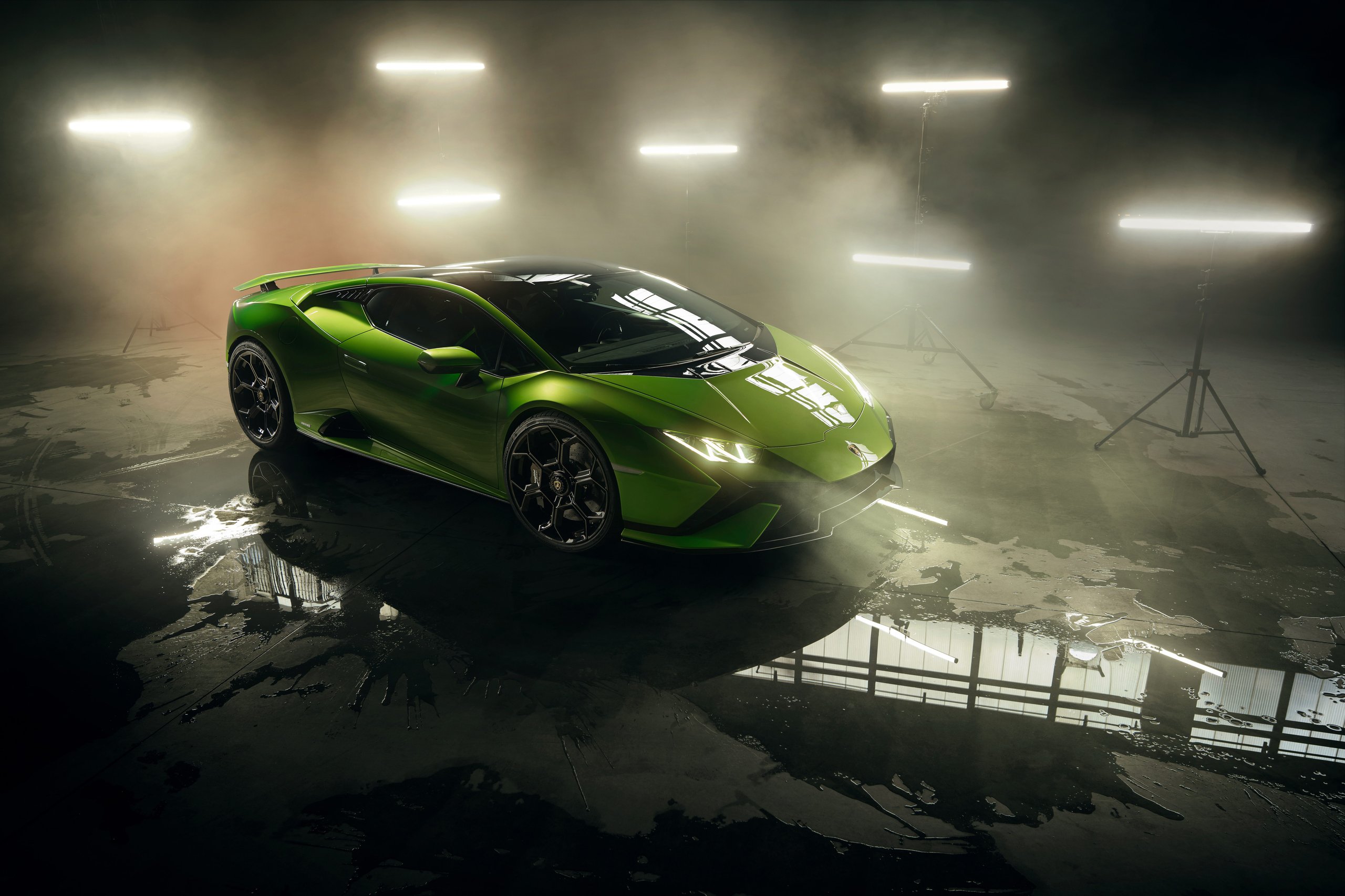
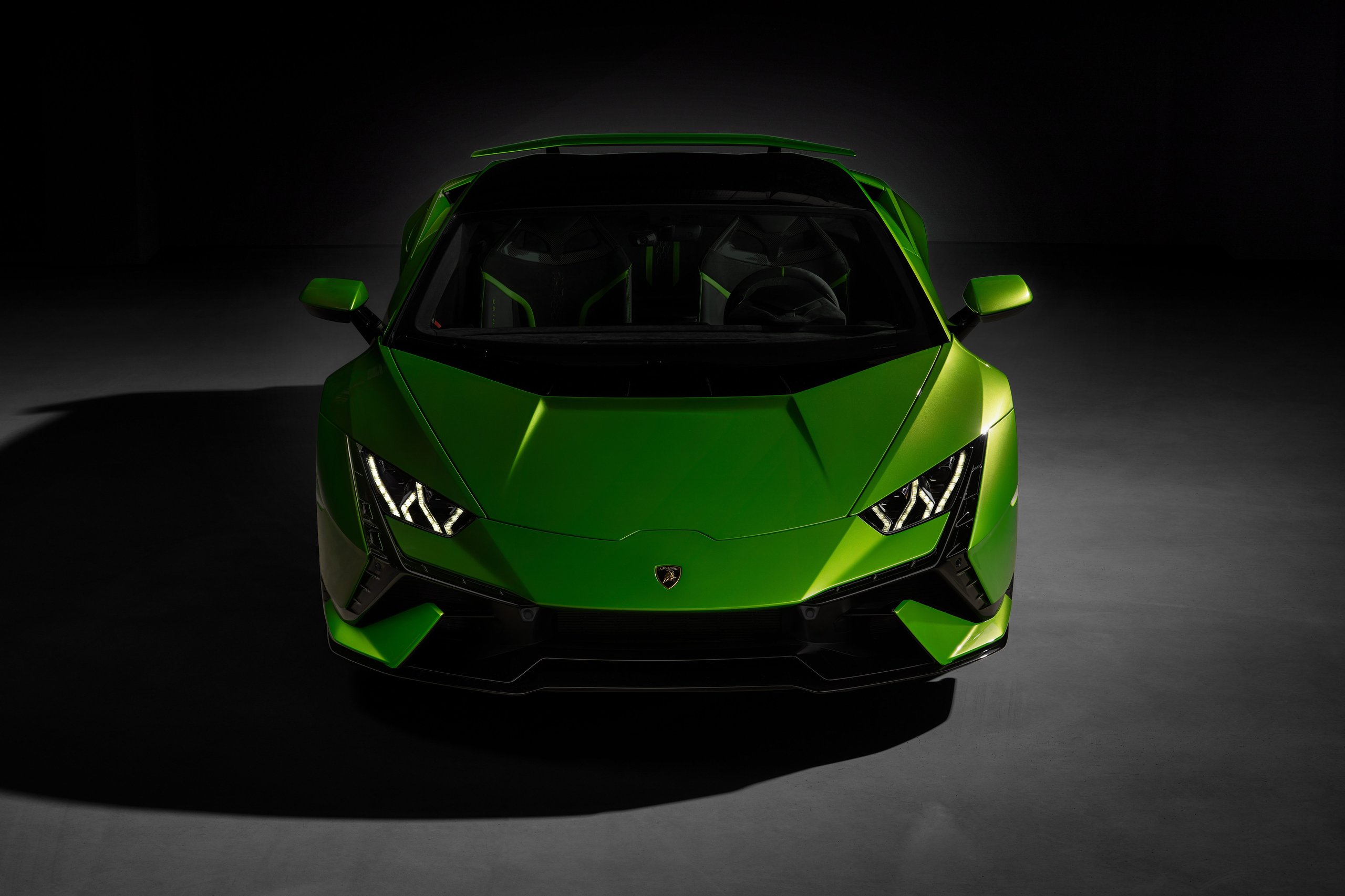
The fixed rear spoiler is the most visible change, but the front end does equally important work. A new front bumper incorporates the Terzo Millennio’s black Ypsilon design motif and, for the first time on any Huracán, an air curtain. Below it, a redesigned front splitter uses open slats to direct airflow through the wheel wells, improving both downforce and brake cooling. New underbody aero deflectors clean up airflow beneath the car, and the overall result is a machine that generates meaningful downforce without the STO’s aggressive visual hardware. Compared to the STO, the Tecnica features a smaller wing and fewer air intakes, yet the car’s shape still generates significant downforce according to early assessments.
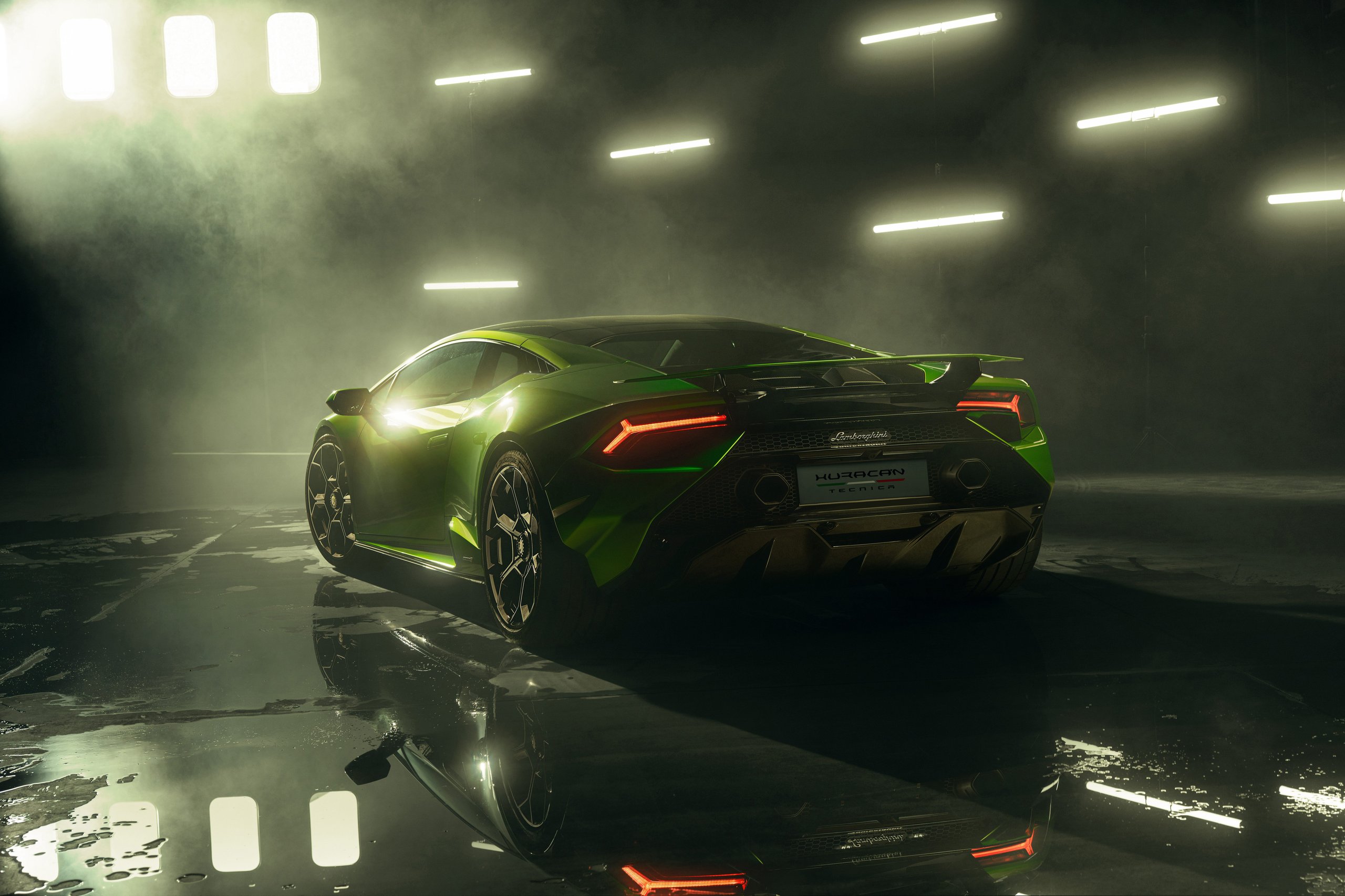
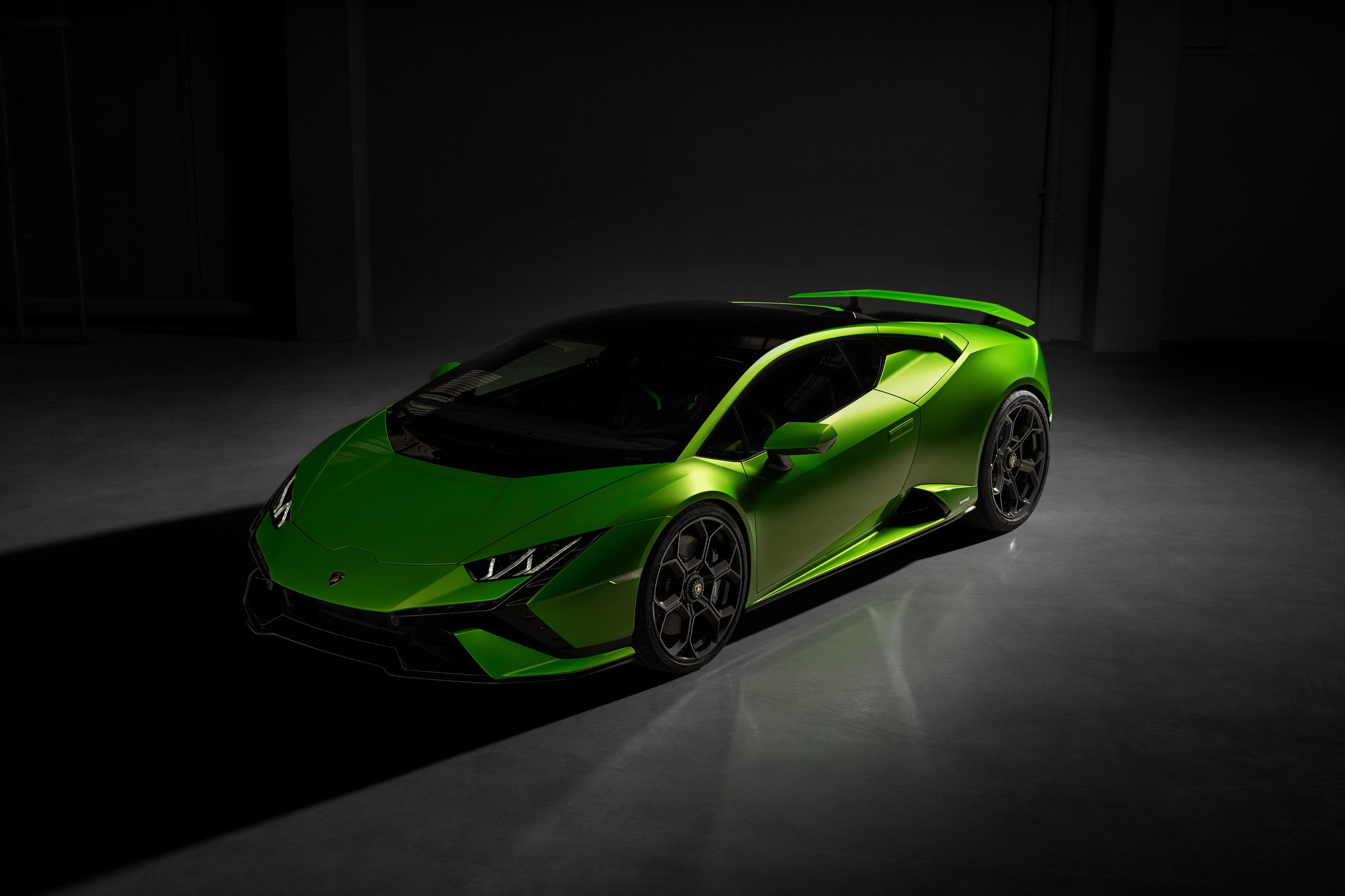
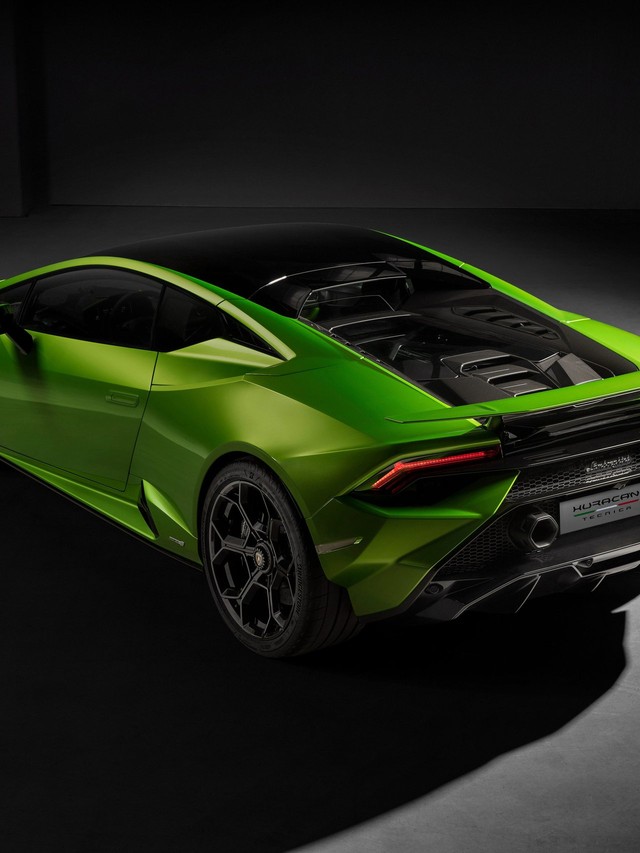
Visually, the Tecnica stretches 6.1 cm longer than the Huracán EVO while maintaining identical height and width, creating a lower, broader stance. Lamborghini draws the roofline inspiration from the Essenza SCV12’s daylight opening line, and the black Ypsilon graphic running from the front bumper along the flanks to the side intakes gives the profile a visual tension that the standard EVO lacks. At the rear, a new vertical glass window improves rearward visibility (a genuine weak point on the STO), while the redesigned carbon fiber engine cover and hexagonal exhaust pipes complete the Tecnica’s identity.
A track-inspired brake cooling system rounds out the functional upgrades. Lamborghini designed specific cooling deflectors and caliper ducts for the carbon ceramic brakes, aimed at reducing disc temperatures, brake fluid temperatures, and pedal elongation during sustained hard use. For the buyer who drives to a track morning and does ten laps before heading home, this kind of thermal management separates a car you can actually use from one that fades after three hot laps.

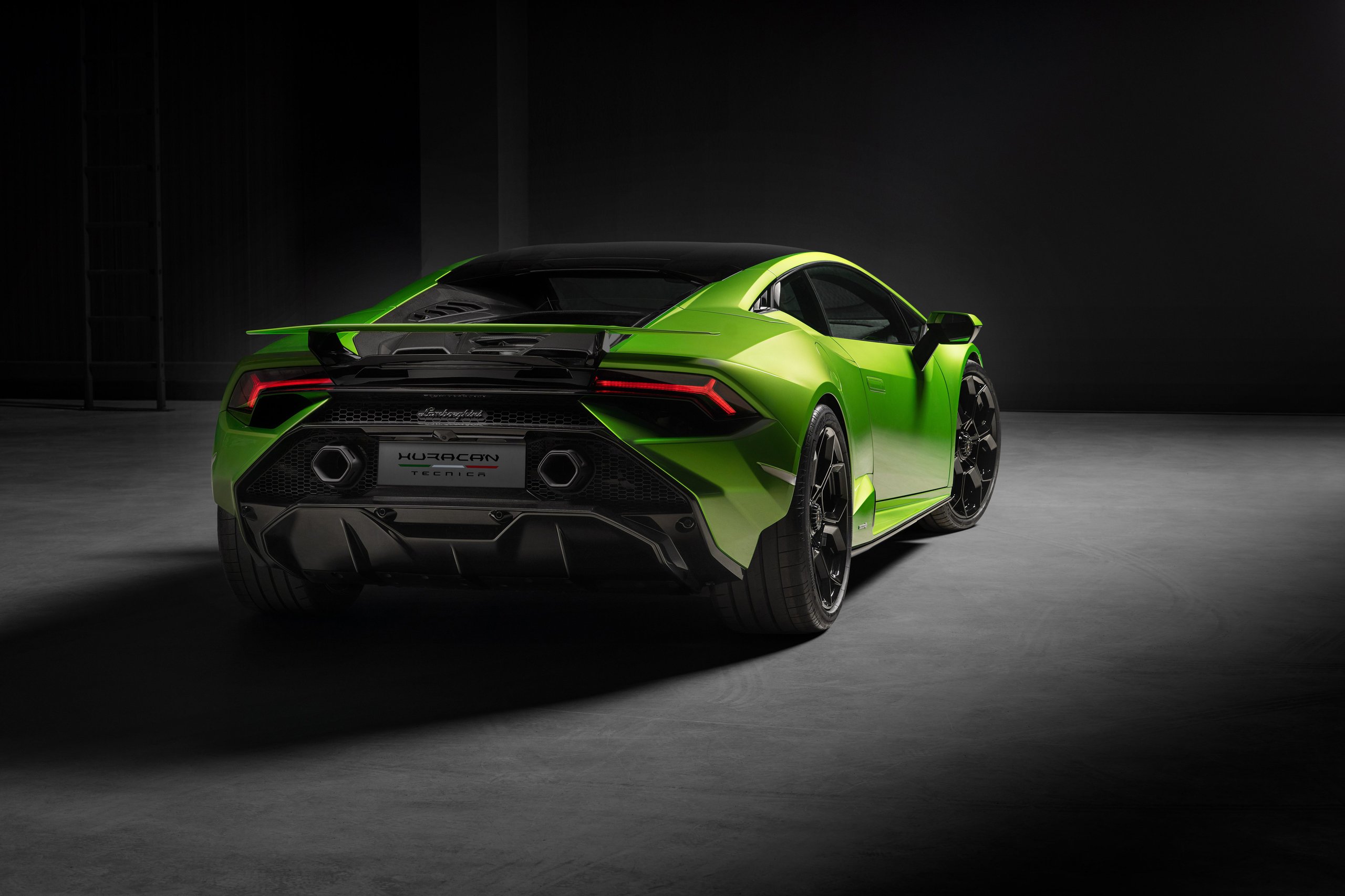
The Huracán Tecnica's aggressive rear features prominent hexagonal exhaust tips and a sculpted diffuser. Image: Automobili Lamborghini.
Inside the Cockpit: Livability the STO Cannot Match
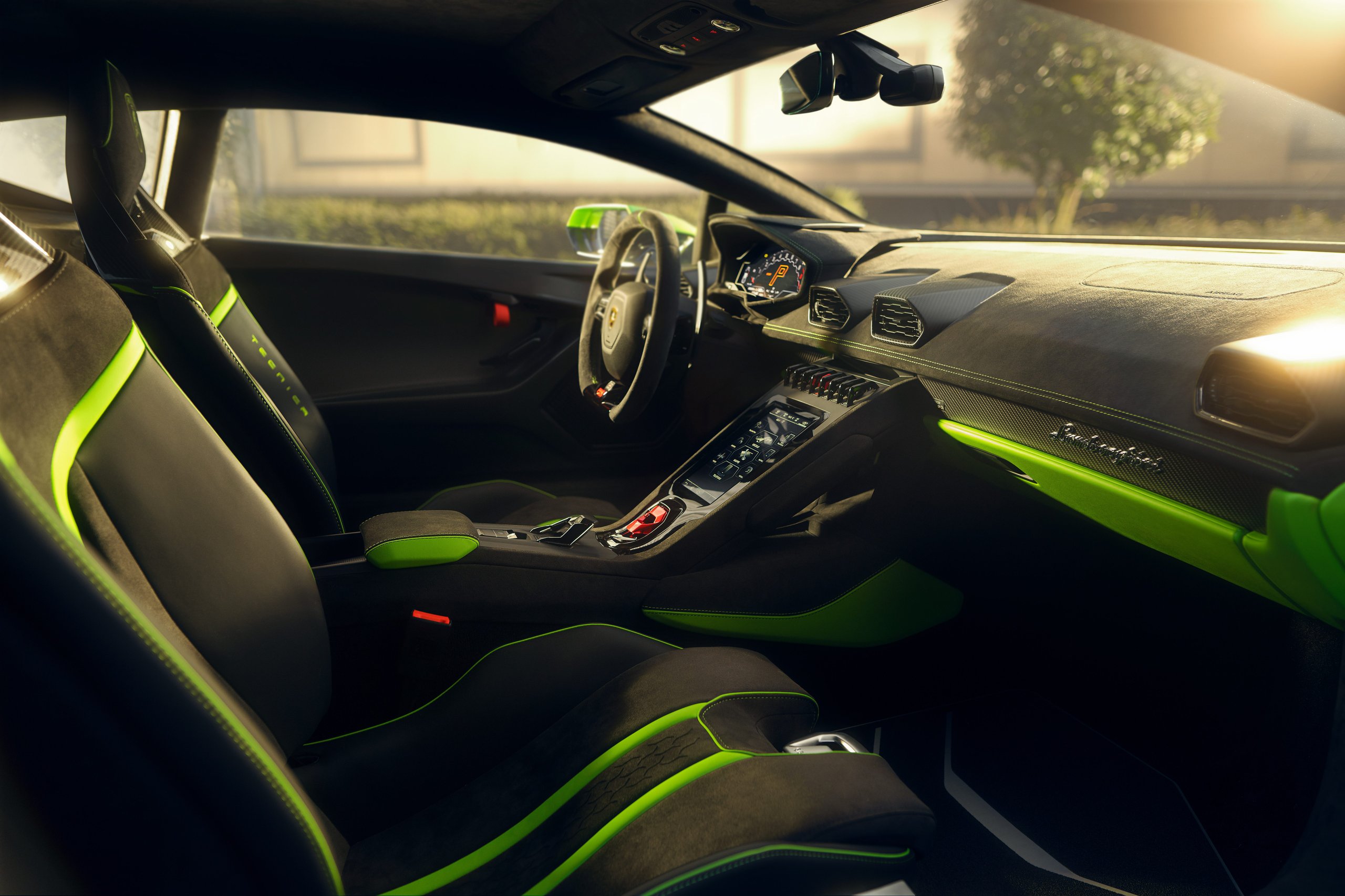
The Tecnica’s interior reflects its dual-purpose brief from the moment you drop into the height-adjustable sports seats. These replace the STO’s fixed racing buckets, a change that sounds minor until you consider that the STO’s seats are widely described as uncomfortable for anything beyond a track session. Optional lightweight door panels, titanium rear arch and wheel bolts, and harness seat belts let track-focused buyers strip weight, but the standard configuration prioritizes comfort.
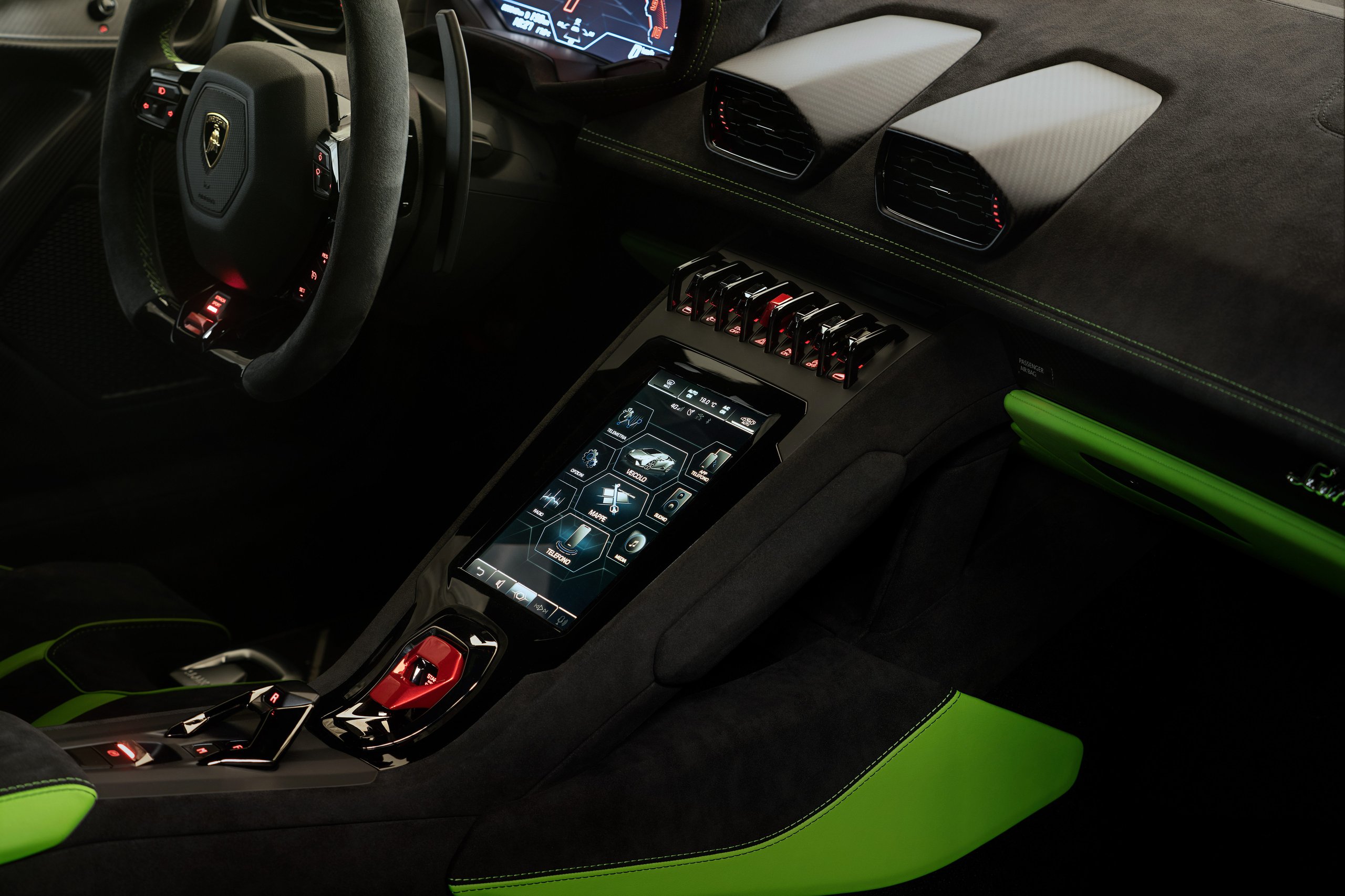
A redesigned HMI interface exclusive to the Tecnica features a driver’s instrument panel with a new “arc” layout that reduces visual clutter and emphasizes readability. The central console screen displays real-time LDVI functions alongside Apple CarPlay, Android Auto, and Amazon Alexa integration. Borrowed from the STO is connected telemetry with on-board diaries for tracking destinations and lap times, all linked to Lamborghini’s UNICA app, so you can log your track times and review telemetry data without bolting in an aftermarket data logger.
Customization runs deep. Beyond eight standard exterior colors, over 200 additional paint options are available through the Ad Personam program. A new Alcantara interior trim is specific to the Tecnica, with exclusive stitching patterns and the “Tecnica” motif embroidered into the seat bolsters. Experienced Lamborghini buyers tend to spec these cars aggressively through Ad Personam, and the Tecnica’s option sheet gives them plenty to work with.

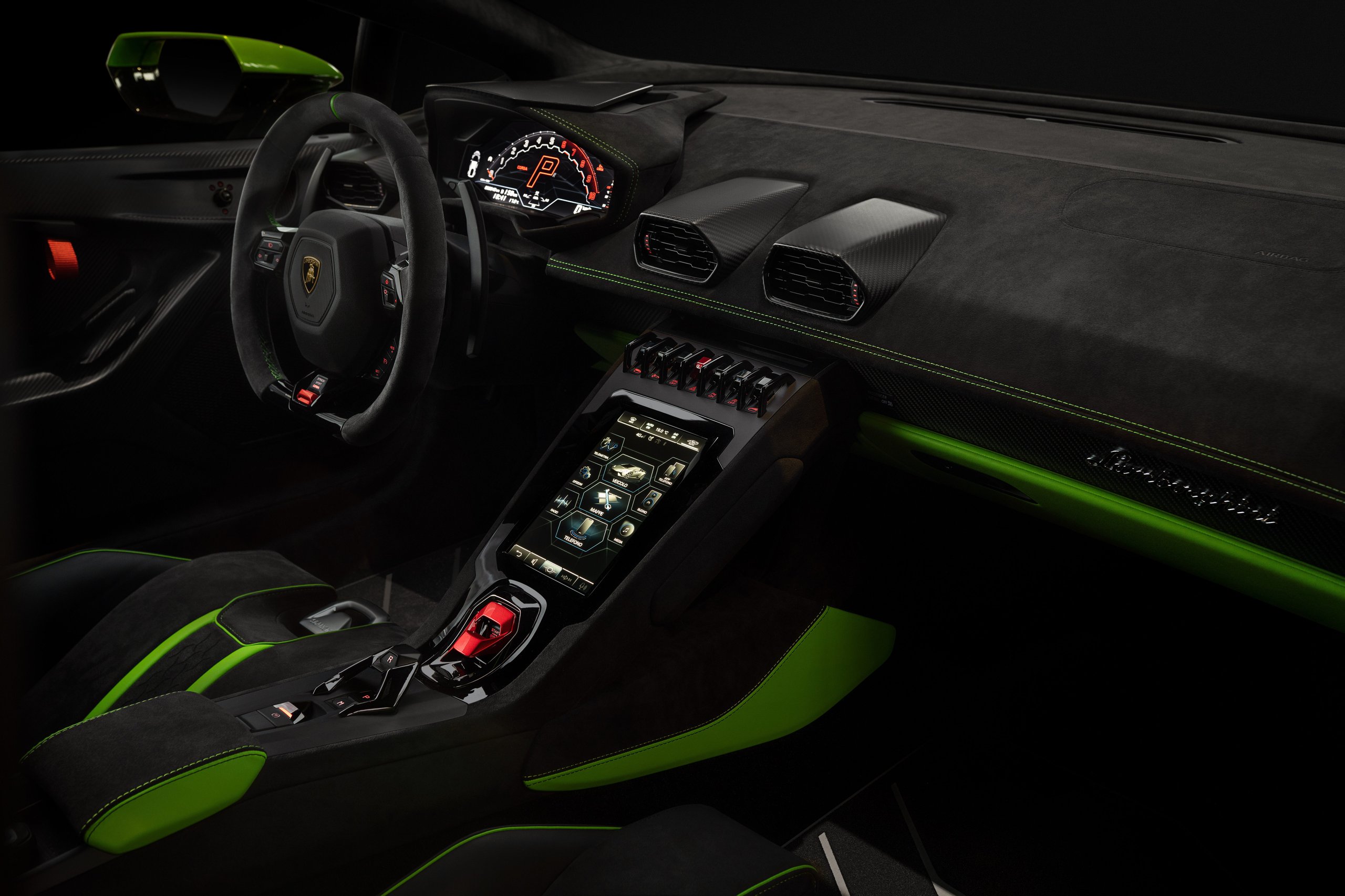
The Huracán Tecnica's interior combines luxurious black Alcantara with striking Verde Mantis accents for a sporty feel. Image: Automobili Lamborghini.
A Naturally Aspirated V10 in a Turbocharged World
The Tecnica arrived at a moment when the naturally aspirated mid-engine supercar was already becoming an endangered species. Ferrari’s 296 GTB pairs a twin-turbo V6 with a hybrid system. McLaren’s Artura does the same. Porsche’s 911 GT3 keeps its atmospheric flat-six, but that is a front-engine car with a fundamentally different character. The Tecnica’s 5.2-liter V10, breathing without forced induction, occupies a shrinking category.
Lamborghini’s own trajectory confirms the shift. The Temerario, the Huracán’s successor, moves to a twin-turbo V8 with hybrid assistance and 907 horsepower. Road & Track reports the Temerario revs to 10,000 rpm and loves to slide, which suggests Lamborghini found ways to preserve driver engagement in the new architecture. But the character of a naturally aspirated V10 at full cry is a different animal entirely. The free-flowing exhaust delivers what one assessment describes as a “wailing” sound on track, an auditory experience that no amount of hybrid torque-fill can replicate.
For collectors and enthusiasts watching the market, the Tecnica occupies an interesting position. It carries the STO’s full engine specification in a body that works as a genuine road car. The Huracán STJ, a 10-unit final edition, later served as the model’s ultimate farewell, but the Tecnica represents the last broadly available, naturally aspirated V10 Huracán built for both environments. Lamborghini did not confirm pricing in its official material, though one source indicates a starting figure around $249,865 before options and dealer adjustments.

The Huracán Tecnica in Verde Mantis stands alongside another Huracán variant, highlighting their unique design philosophies. Image: Automobili Lamborghini.
The Smartest Huracán in the Lineup?
The Tecnica’s value proposition comes down to a simple question: do you want STO performance with livable packaging, or do you need the STO’s last tenth of a second on circuit badly enough to accept its compromises? For most buyers, the honest answer favors the Tecnica. The STO demands commitment with its fixed seats, limited visibility, and aggressive aero. The EVO RWD gives up 30 CV and the rear-wheel steering system, leaving it as the more relaxed but less capable option.
Between them, the Tecnica threads the needle with a dry weight of 1,379 kg and a weight-to-power ratio of 2.15 kg/CV, numbers that place it firmly in serious performance territory. Bridgestone Potenza Sport tires on 20-inch Damiso wheels (245/30 front, 305/30 rear) provide the contact patch, and the comprehensive brake cooling system means the carbon ceramics should remain consistent through a full track session rather than fading after a few hard laps.
Road & Track called the Tecnica “silly fun on the track, but a handful on the road,” a fair assessment of any 631-horsepower rear-drive mid-engine car on public roads. The rear-wheel-drive layout rewards smooth inputs and punishes ham-fisted throttle applications, particularly in Sport mode where the traction control deliberately allows more slip. That demands a certain level of driver skill, but it also delivers the kind of mechanical honesty that makes a car memorable rather than merely fast.
For LamboCars readers weighing the Tecnica against its siblings or cross-shopping with a 911 GT3 or 296 GTB, the calculus is straightforward. The Porsche offers a more refined daily-driver experience with a different engine character. The Ferrari brings hybrid efficiency and a turbocharged punch. The Tecnica offers something neither can: a naturally aspirated V10 sending power to the rear wheels through a chassis calibrated to let you feel every input. In a market moving rapidly toward electrification and forced induction, that combination grows rarer by the model year.

The Lamborghini Huracán Tecnica showcases its aggressive rear design and powerful stance in motion. Image: Automobili Lamborghini.
Gallery