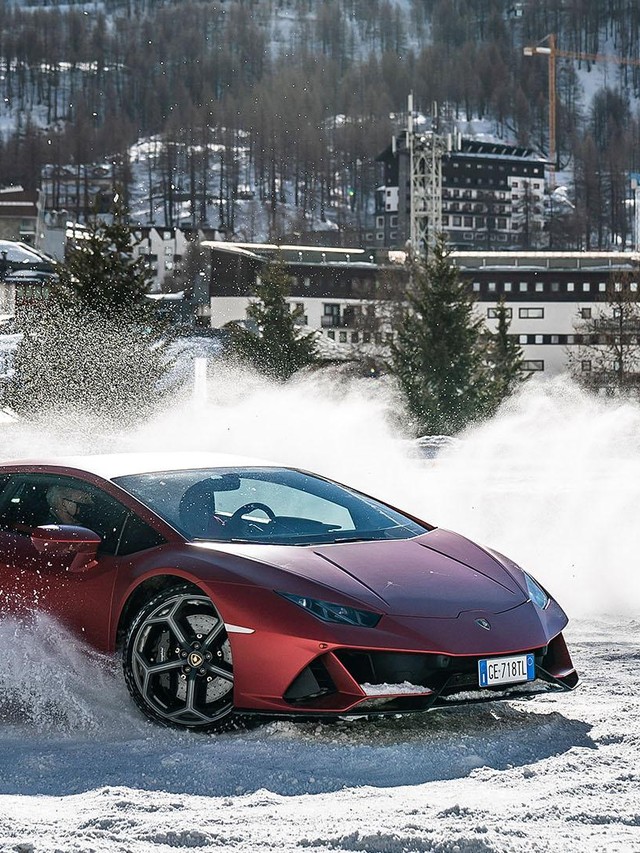
Lamborghini Builds the Huracán That Demands More From Its Driver
When Lamborghini pulled the covers off the Huracán LP 580-2 at the 2015 Los Angeles Auto Show, the company made a choice that ran against the grain of its own recent history. Instead of adding grip, adding power, adding systems, it subtracted. The front driveshafts disappeared. Thirty horsepower went with them. What remained was a 580 hp, naturally aspirated 5.2-liter V10 sending every last newton-meter exclusively to the rear tires.
Then-CEO Stephan Winkelmann described the result as “the purest expression of a Lamborghini to date,” aimed at two distinct audiences: drivers who wanted the Huracán’s mid-engine architecture and screaming V10 soundtrack but preferred to manage traction with their right foot rather than delegate it to electronics, and owners of other rear-wheel-drive marques who aspired to step into a Lamborghini for the first time. That second audience mattered. For years, the conventional wisdom held that if you wanted a playful, tail-happy Italian supercar, you bought a Ferrari. The LP 580-2 was Lamborghini’s direct answer to that assumption.
Calling this the “entry-level” Huracán misses the point entirely. Stripping out the front drive hardware and retuning every dynamic system around a rear-drive layout created a fundamentally different car, one that prioritized the quality of communication between machine and driver over the sheer quantity of mechanical grip. Every engineering decision Lamborghini made on the LP 580-2 served a single purpose: to tighten the feedback loop between throttle input and chassis response, producing what Winkelmann called “maximum driving fun.” The sections that follow trace how that philosophy shaped the hardware, the driving experience, and ultimately the car’s place in the supercar landscape.
What Lamborghini Actually Changed (and Why It Matters)
Removing the front driveshafts and associated hardware from the LP 610-4 saved 33 kg, bringing the LP 580-2’s dry weight down to 1,389 kg. That number alone tells only half the story. The more consequential change is where the remaining mass sits: a 40% front, 60% rear weight distribution that fundamentally alters the car’s rotational behavior. With less inertia loading the front axle, the nose becomes eager to change direction, while the rear carries enough mass to give the tires meaningful work to do under power.
Lamborghini developed an entirely new power management setup for the car, encompassing modified suspension, a revised steering calibration, and recalibrated stability and traction controls. R&D boss Maurizio Reggiani reportedly emphasized “power oversteer” throughout the car’s technical briefing, and the engineering reflects that obsession. The three selectable driving modes, STRADA, SPORT, and CORSA, were each specifically tuned to encourage oversteering behavior rather than suppress it.
Consider what that means in practice. In most modern supercars, the electronics exist to keep the rear end in line. The LP 580-2’s electronics were recalibrated to let the rear end rotate, progressively loosening the leash as the driver selects more aggressive modes. STRADA keeps things civil for public roads but still permits a degree of slip that the AWD car would simply absorb through its front axle. SPORT opens the door wider. CORSA, the track-focused setting, allows the kind of sustained oversteer angles that reward precise throttle modulation and punish ham-fisted inputs.
The suspension changes reinforce the same philosophy. Reports indicate a 10 percent reduction in spring rate compared to the AWD car, along with adjusted roll stiffness and specially developed Pirelli P Zero tires engineered to improve turn-in response and steering feel. Softer springs might sound counterintuitive for a performance car, but the logic is sound: with no front driveshafts loading the front axle, the car needs less mechanical resistance to maintain composure, and the softer setup allows the chassis to communicate road surface changes more clearly through the steering column. Multiple reviews described a Huracán that feels more “centered” on the driver, free of the chassis-induced understeer that occasionally characterized the AWD model. Every calibration choice circles back to the same goal: making the driver’s right foot the primary traction management tool.
Why Less Grip Creates a Better Driving Experience
The philosophical argument for rear-wheel drive in a supercar explains why a car with 30 fewer horsepower and objectively less traction can feel more rewarding than its more capable sibling.
All-wheel drive distributes torque across four contact patches. The benefit is enormous mechanical grip, faster launch times, and a safety net in poor conditions. The cost is communication. When the front axle absorbs a portion of the engine’s output, the driver loses a direct feedback loop. Understeer becomes the car’s default response to excessive speed in a corner, because the front tires are simultaneously steering and driving. The throttle becomes a blunter instrument.
Rear-wheel drive reverses that equation. The front tires do one job: steer. The rear tires do one job: drive. The separation creates clarity. When the rear begins to slide under power, the driver feels it through the seat, the steering lightens fractionally, and the correction is intuitive: modulate the throttle. The car becomes an extension of the driver’s intentions rather than a system that interprets and filters them.
Crucially, the LP 580-2 was reportedly designed to be approachable, flattering the skills of even moderately talented drivers. The car encourages oversteer progressively, with enough electronic backstop to prevent a momentary lapse from becoming a catastrophic spin. The goal is confidence-building, not punishment. A driver who learns to manage the LP 580-2’s balance at seven-tenths will find the car teaching them to drive at eight-tenths, then nine. The AWD Huracán, by contrast, masks the limit so effectively that the transition from grip to slip can arrive with less warning.
For enthusiasts who grew up admiring the Gallardo LP 550-2 Valentino Balboni, the LP 580-2 represented a continuation of that lineage: a Lamborghini that trusted the driver enough to let the rear end talk. That trust is the thread connecting every engineering decision on the car, from the softer springs to the loosened stability maps, and it is what separates the LP 580-2 from a mere cost-reduced variant.
Design Tweaks That Serve the Engineering
The LP 580-2’s exterior changes are subtle but purposeful. A larger front spoiler generates additional front downforce to compensate for the lighter nose, while a more steeply raked rear diffuser reduces lift at the back. The active rear spoiler of the LP 610-4 gave way to a fixed lip spoiler, a decision that trades a small amount of high-speed downforce for reduced weight and mechanical simplicity. New staggered 19-inch wheels complete the visual differentiation, though the overall silhouette remains unmistakably Huracán.
Inside, the notable option was a set of lightweight carbon fiber seats with manual adjustment. Removing the electric motors from the seat rails saved additional weight and, for track-focused owners, provided a more secure seating position. The standard sports seats remained comfortable and supportive for daily use, which matters for a car that Lamborghini clearly intended to be driven regularly rather than stored.
The studio images show the car in a vivid red finish that highlights the sharp crease lines running from the front fenders through the doors, the aggressive LED daytime running lights, and the prominent side air intakes feeding the mid-mounted V10. The overall visual impression is leaner and more focused than the AWD car. Even the aesthetics reinforce the LP 580-2’s central promise: everything that does not sharpen the connection between driver and machine has been pared away.

The red Lamborghini Huracán LP 580-2 stands out with its striking design in a controlled studio environment.
Challenging Ferrari’s Claim on the Rear-Drive Supercar
For decades, Ferrari owned the narrative around rear-wheel-drive supercars. The mid-engine, rear-drive layout was Maranello’s signature, and buyers who prioritized driving purity over all-weather capability gravitated toward the prancing horse almost by default. Lamborghini, with its emphasis on all-wheel drive from the Diablo VT onward, ceded that territory willingly in exchange for the traction advantage.
The LP 580-2 reclaimed it. By offering a rear-drive Huracán with a naturally aspirated V10, Lamborghini presented a direct alternative to Ferrari’s contemporary mid-engine offerings, and did so with a powertrain philosophy that Ferrari itself was abandoning in favor of forced induction. The irony was rich: Lamborghini, the brand historically associated with brute force and all-wheel-drive security, was now offering a purer analog driving experience than its Maranello rival.
McLaren occupied similar territory with its rear-drive, twin-turbo lineup, but the McLaren approach leaned heavily on electronic chassis management and turbocharged response. The LP 580-2’s naturally aspirated V10, with its linear power delivery and mechanical throttle response, offered a distinctly different flavor. Where McLaren prioritized efficiency and precision, Lamborghini prioritized sensation and drama.
For buyers cross-shopping in this segment, the LP 580-2 represented something genuinely unusual: a Lamborghini that could match or exceed its rivals on driver engagement while retaining the brand’s visual drama and emotional intensity. The car made a compelling case that Sant’Agata understood the rear-drive formula just as well as anyone, precisely because every competitive advantage it claimed grew from the same driver-first engineering philosophy that defined the car from the start.
What the LP 580-2 Means for Buyers Today
Production of the LP 580-2 ceased in 2019 when it was succeeded by the Huracán Evo RWD, a car that carried the rear-drive philosophy forward with updated electronics and revised aerodynamics. The LP 580-2’s relatively short production run and its status as the first rear-drive Huracán give it a distinct identity in the used market.
According to CLASSIC.COM, the market benchmark value for the LP 580-2 sits at approximately $189,718. One market tracker reported a high sale of $234,000 for a 2016 Coupe in January 2022, while the lowest recorded transaction was $122,222 for a 2018 model. That spread tells a story about specification and condition mattering enormously, as it does with any Lamborghini. Well-optioned, low-mileage examples in desirable colors command premiums, while higher-mileage cars without notable options can represent genuine value in the V10 Lamborghini market.
The practical question for prospective buyers is whether the LP 580-2 offers enough differentiation from the later Evo RWD to justify seeking one out specifically. The answer depends on priorities. The Evo RWD received Lamborghini’s LDVI (Lamborghini Dinamica Veicolo Integrata) system, which uses predictive logic to manage torque delivery and stability interventions more seamlessly. The LP 580-2, by contrast, relies on a simpler, more transparent set of electronic calibrations. Enthusiasts who value directness and mechanical honesty over electronic sophistication will find the earlier car more appealing, and that preference maps directly onto the car’s original design intent.
Ownership reports from enthusiast forums describe the naturally aspirated V10 as remarkably robust, though maintenance costs for any mid-engine Italian supercar remain substantial. The dual-clutch transmission, shared across the Huracán family, draws generally positive feedback for its shift speed and refinement.
The LP 580-2 also proved pivotal for Lamborghini’s broader strategy. Its commercial success demonstrated that a meaningful segment of buyers wanted less electronic intervention, not more. That lesson carried forward into the Evo RWD and, arguably, into the company’s thinking about how to preserve driver engagement as its lineup transitions to hybrid powertrains with the Temerario generation. It was the proof of concept: a Lamborghini that trusted its driver, and found an audience that trusted it right back.


