Lamborghini’s First Hybrid, Sold Out Before Anyone Saw It
When Lamborghini pulled the cover off the Sián FKP 37 at the Frankfurt Motor Show on September 3, 2019, the car was already a collector’s item. All 63 units, a number chosen to honor the company’s 1963 founding year, were spoken for. Lamborghini stated that every example sold before the public debut. That fact alone reveals the car’s intended role: the Sián was never a volume product. It was Lamborghini’s opening argument for how a company built on naturally aspirated V12s could enter the hybrid era without losing its soul.
The “FKP 37” suffix pays tribute to Ferdinand Karl Piëch, the late Volkswagen Group chairman, with his initials and the number 37 referencing his birth year. The name Sián itself translates to “flash” or “lightning” in Bolognese dialect, a nod to the car’s electric component and a deliberate connection to the company’s home territory.
Neither the exclusivity nor the naming convention, though, is what made this car genuinely interesting. It was the engineering decision at the heart of the hybrid system: Lamborghini rejected lithium-ion batteries entirely and built the Sián around a supercapacitor. That single choice shaped everything about the car’s character and foreshadowed how Sant’Agata Bolognese would approach electrification for years to come.
The Supercapacitor: Solving Problems Batteries Create
A lithium-ion battery stores energy chemically, giving it excellent energy density but relatively slow charge and discharge rates. A supercapacitor stores energy electrostatically, in an electric field. It holds less total energy, but it can absorb and release that energy almost instantaneously. For a hypercar application where the goal is instant torque response rather than electric-only range, that trade-off is enormously favorable.
Lamborghini says the Sián’s supercapacitor is three times more powerful than a battery of the same weight and three times lighter than a battery producing the same power. The entire electric system, supercapacitor and 48-volt e-motor combined, weighs just 34 kg. For context, the battery pack in a typical plug-in hybrid supercar can weigh several hundred kilograms.
Equally critical is what Lamborghini calls “symmetric power flow.” The energy storage system fully recharges every time the vehicle brakes. No waiting, no charge management, no range anxiety. Every braking event returns the system to full capacity, ready to deploy its boost on the next acceleration. This is fundamentally different from a lithium-ion battery, which degrades slightly with each charge cycle and cannot accept energy as quickly as it delivers it.
Lamborghini had already experimented with supercapacitor technology in the Aventador, where it powered the start-stop system. The Sián’s application stores ten times the power of that earlier system, representing a genuine leap in capability rather than an incremental improvement. The supercapacitor was not a curiosity bolted onto a familiar platform; it was the organizing principle around which the entire hybrid architecture was designed.
Feeding the V12, Not Replacing It
The 34 hp from the Sián’s e-motor will not win any electric-power bragging contests. Ferrari’s SF90 Stradale, which debuted the same year, produces 217 hp from its electric motors alone and can drive on pure electric power for short distances. Some commentators describe the Sián’s system as a “mild hybrid” due to its low-voltage nature and lack of plug-in capability, and that label is technically fair. But it misses the point of what Lamborghini was trying to accomplish.
The e-motor is not there to provide electric range or to improve efficiency in any meaningful regulatory sense (the combined fuel consumption figure of 19.2 l/100km confirms that much). It exists to make the V12 feel better.
The V12 itself is uprated to 785 hp at 8,500 rpm, the highest output from any Lamborghini engine at the time of the car’s debut. Combined with the e-motor’s 34 hp, total system output reaches 819 hp, making the Sián the most powerful Lamborghini ever produced at launch. Integrated directly into the gearbox, the e-motor fills the torque gap during gear changes, eliminating the momentary hesitation that the Aventador’s ISR automated manual gearbox was occasionally criticized for. Lamborghini claims this marks the first time a direct connection between an electric motor and the wheels occurred in a low-voltage hybrid system. The result is that the driver feels only continuous forward pull during upshifts.
Below 130 km/h, the e-motor adds torque on top of the V12’s output. Lamborghini says traction force improves by up to 20% in higher gears at lower speeds, and the 70 to 120 km/h acceleration time drops by 1.2 seconds compared to the Aventador SVJ. Above 130 km/h, the e-motor disconnects entirely, leaving the V12 to do what a V12 does. The car also uses electric power for low-speed maneuvers like reversing and parking. With the lowest weight-to-power ratio of the Lamborghini V12 family ever, the Sián accelerates from 0 to 100 km/h in under 2.8 seconds and reaches a top speed of over 350 km/h.
Lamborghini’s Approach vs. Ferrari’s: Different Problems, Different Answers
The contrast with Ferrari’s SF90 Stradale is instructive because both cars debuted in 2019 and both represent their manufacturer’s first hybrid production supercar. Ferrari went with a high-voltage plug-in hybrid system producing substantial electric power and offering a short all-electric driving mode. The SF90’s approach prioritizes total system output and the ability to claim electric-only capability, even if most owners rarely use it.
Lamborghini took the opposite path. By choosing the supercapacitor, Sant’Agata accepted minimal electric range in exchange for near-zero weight penalty, instant energy recovery, and a system that enhances the combustion engine’s delivery rather than occasionally substituting for it. One competitor analysis suggests that the Sián’s gains in normalized fuel consumption are significantly lower compared to a plug-in hybrid like the SF90, which is true but also somewhat beside the point. Lamborghini was not trying to build the most efficient hybrid. It was trying to build a hybrid that made the V12 experience more intense.
For the type of buyer who purchases a 63-unit limited-edition Lamborghini, that distinction matters. These owners care about throttle response, about the sound, about the feeling of a naturally aspirated twelve-cylinder engine pulling to 8,500 rpm. The supercapacitor lets Lamborghini offer those buyers an electrified car that does not compromise on any of those sensations.
Design as a Statement of Direction
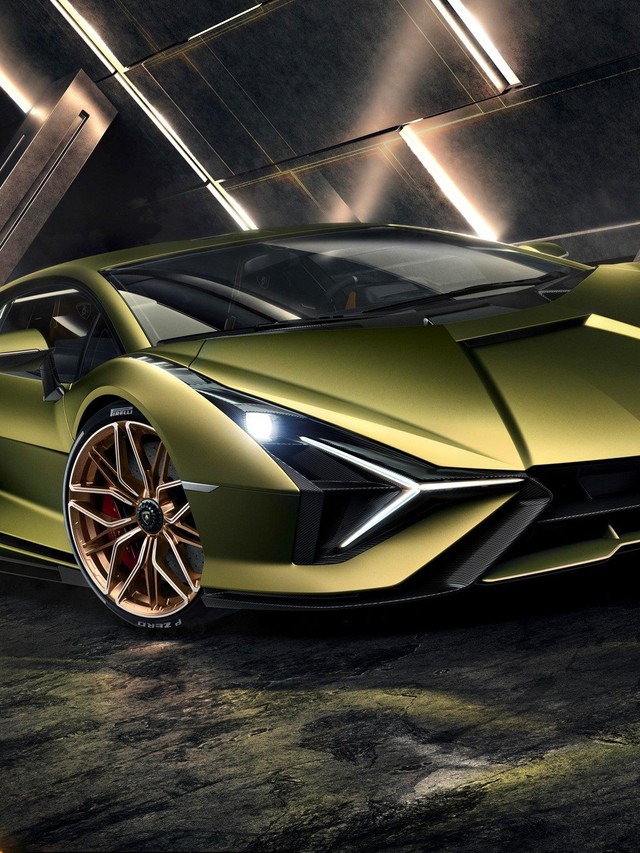
If the supercapacitor defined the Sián’s engineering philosophy, the bodywork broadcast it visually. The profile carries what Lamborghini calls the “Gandini line,” a reference to the Countach’s designer Marcello Gandini, visible in the car’s long, clean flanks and the diagonal crease on the front hood. The Y-shaped headlights, used here for the first time, originated in the Terzo Millennio concept car, Lamborghini’s fully electric study from 2017. Pulling design cues from both a 1970s icon and an electric concept car in a single vehicle is a deliberate statement: the Sián sits precisely at the intersection of Lamborghini’s past and its future.
At the rear, active cooling vanes use Lamborghini’s patented smart-material technology. These vanes respond to exhaust heat by physically rotating, providing cooling without electronics, actuators, or additional weight. It is a clever piece of materials science that feels very much in character for a company that tends to solve engineering problems through unconventional means.
Each of the 63 owners worked directly with Lamborghini’s Centro Stile and Ad Personam program to create a unique specification. The show car’s Verde Gea paint with Oro Electrum (electric gold) details was designed to visualize the electrified concept, and the interior introduced 3D-printed components in a Lamborghini production car for the first time.

The Lamborghini Sián FKP 37, a limited-edition hybrid supersports car, is presented in a stunning matte green finish.
The Sián’s Real Legacy: A Blueprint for the Revuelto and Beyond
Lamborghini always described the Sián as a “first step” in its electrification strategy, and that language proved accurate. The Revuelto, which succeeded the Aventador as Lamborghini’s flagship V12, adopted a substantially more powerful plug-in hybrid system with three electric motors and a high-voltage battery. The Revuelto’s approach is closer to Ferrari’s philosophy than to the Sián’s supercapacitor minimalism, which raises an interesting question: did Lamborghini ultimately abandon the supercapacitor path?
The answer is more nuanced than a simple yes. The Sián proved that Lamborghini could electrify a V12 without destroying the driving character that defines the brand. It demonstrated a willingness to pursue unconventional technology rather than defaulting to industry-standard solutions. And it established, in a tangible product rather than a concept car, that Lamborghini’s electrification would prioritize performance sensation over efficiency metrics. The Revuelto carries a bigger battery and more electric power, but the underlying philosophy, that hybrid components should enhance the combustion engine rather than apologize for it, traces directly back to the Sián.
A Roadster version followed the coupe, limited to 19 units, all of which also sold immediately. Lamborghini did not publicly confirm pricing for either variant, and the secondary market for these cars remains predictably stratospheric. For the 63 coupe owners and 19 roadster owners, the Sián represents something few modern supercars can claim: a genuine technological turning point, wrapped in a body that looks like nothing else on the road, powered by a system that no other manufacturer has replicated in production.


