A Clean Sweep From Pole to Flag
Vito Postiglione and Kikko Galbiati left the Nürburgring with two trophies, a four-win season tally, and a championship deficit that shrank from comfortable to alarming for the leaders. Their Race 2 victory on September 1, 2019, mirrored the pattern of Race 1: Postiglione converted pole position into an immediate gap, built a four-second cushion before the mandatory pit window opened, then handed the #44 Imperiale Racing Huracán to Galbiati, who brought it home 5.707 seconds clear of Jack Bartholomew in the Bonaldi Motorsport #32 car.
The margin tells you everything about the weekend’s character. This was controlled dominance, not a last-lap dice. Postiglione pulled away from the rolling start while Bonaldi Motorsport teammates Stuart Middleton and Sergei Afanasiev fought each other for second under braking into Turn 1, a scenario that played directly into Imperiale Racing’s hands. By the time the pit window arrived, Postiglione’s lead was already decisive.
Galbiati’s second stint was equally composed. He managed the gap without drama, crossing the line well ahead of Bartholomew and ensuring Imperiale Racing rebounded emphatically from what Lamborghini described as a difficult weekend at Spa-Francorchamps. Four wins from the season confirmed this pairing as the form crew in the second half of the 2019 Lamborghini Super Trofeo campaign, and the question now was whether that form had arrived in time to overhaul the championship leaders.
The Championship Battle Heading to Jerez
The real consequence of the Nürburgring double sits in the points table. Danny Kroes and Afanasiev maintain their Pro standings lead on 121 points, but Postiglione and Galbiati now trail by just five, sitting on 116. Middleton and Bartholomew remain within striking distance at 100. With two rounds left at the World Finals in Jerez de la Frontera, the title fight involves three crews from two teams, all racing identical machinery.
That last detail is the crux of the matter. The Lamborghini Super Trofeo is a one-make series, which means the Huracán Super Trofeo Evo under every driver is mechanically the same car. No power advantage, no aero loophole, no engine mapping trick separates the front-runners. Championship battles in this format come down to driver skill, pit-stop execution, qualifying pace, and team strategy. A five-point gap with two races remaining is essentially a coin toss, and the momentum clearly belongs to Imperiale Racing.
One report indicates that Galbiati and Postiglione previously secured a victory at Misano, their second consecutive win following a Race 2 triumph at Silverstone. That run of form suggests the pairing found a setup rhythm and driving partnership that peaked at precisely the right moment in the calendar. For Kroes and Afanasiev, defending a five-point lead at a World Finals event, where pressure and track unfamiliarity can amplify small mistakes, will require the kind of composure they showed earlier in the season when they built that cushion. The Nürburgring double did not just close the gap; it shifted the psychological burden from the chasers to the chased.
Race 2 Midfield: Where the Real Action Unfolded
Behind the dominant #44, the race produced genuine wheel-to-wheel combat that underscored how tightly matched the field was on identical hardware. Kroes, who replaced Afanasiev during the pit stops, initially dropped to fourth after losing ground to the Bonaldi sister car of Bartholomew. The Target Racing #9 entry of Davide Venditti, whose teammate Alberto di Folco completed a strong opening stint, then passed Kroes for third.
Kroes responded with the kind of measured aggression a championship leader needs. He stalked Venditti through the second stint, biding his time before diving down the inside of Turn 10 to reclaim the position. He then set about chasing Bartholomew for second, closing the gap but running out of laps. Bartholomew held on to secure another podium for the #32 car, while Venditti and Di Folco finished fourth, unable to repeat their Race 1 podium.
The Leipert Motorsport pairing of Anthony Lambert and Niels Lagrange rounded out the top five, finishing just over five seconds behind Venditti. In the Pro-Am class, Shota Abkhazava and Harald Schlegelmilch from ArtLine Team Georgia claimed honors once again. The Am class saw AGS Events’ Nicolas Gomar and Gilles Vannelet emerge on top after an early battle with Robert Zwinger of GT3 Poland, who won Race 1 but lost critical time around the pit-stop window in Race 2 and finished a distant second. Antonios Wossos took third. Reigning Lamborghini Cup champion Gerhard van der Horst secured class victory, beating Jose Collado of AGS Events by just over 2.6 seconds.
The depth of competition across every class illustrates why the one-make format works so well as a championship proving ground. Pit-stop strategy becomes a genuine variable rather than an afterthought, and driver changes can make or break a result. Kroes’s recovery drive and Zwinger’s pit-window misfortune are textbook examples of how seconds lost in the pits translate directly into positions lost on track, a dynamic that will only intensify at the World Finals.
The Huracán Super Trofeo Evo on the Nürburgring GP Circuit
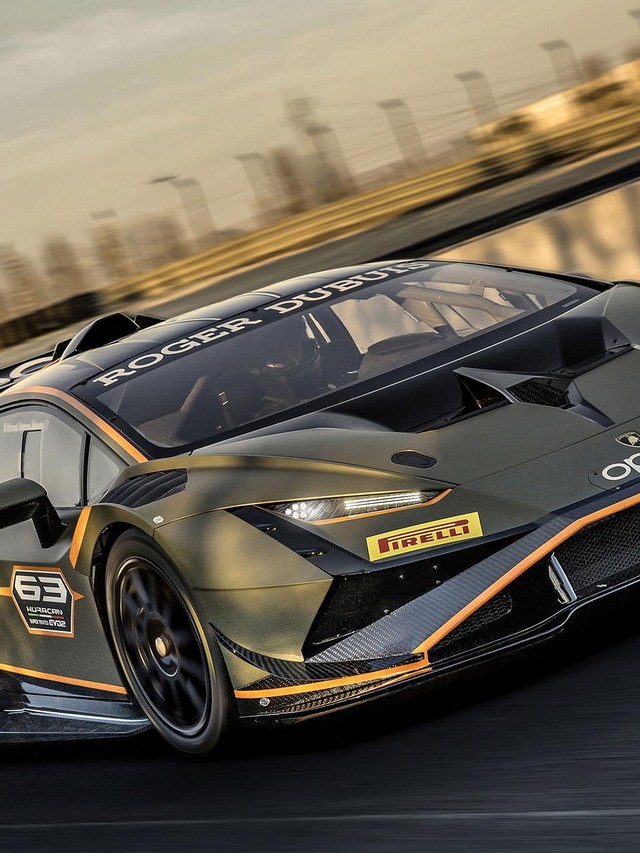
The Nürburgring GP circuit is a different animal from the full Nordschleife, but it still rewards a car with precise front-end response and stable braking zones. The Huracán Super Trofeo Evo, a track-focused iteration of the road-going Huracán, is built around Lamborghini’s naturally aspirated 5.2-liter V10. In race trim, the car features aggressive aerodynamic elements, with a prominent front splitter and large rear wing clearly visible in official imagery, along with lightweight carbon fiber construction, competition suspension, and slick racing tires. A roll cage visible through the windshield confirms what the stripped-out interior implies: this is a purpose-built race car, not a road car with a helmet net.
Because the one-make format means the Evo’s engineering characteristics define the entire grid’s performance envelope, every driver works within the same V10 powerband, the same braking capability, the same aero balance. That uniformity is the series’ greatest asset and its most demanding constraint. Teams differentiate themselves through damper setup, tire management, and the precision of their pit-stop choreography. Postiglione’s ability to build a four-second lead in the opening stint, on identical hardware, speaks to the fine margins that separate the best crews from the rest.
The Huracán Super Trofeo Evo succeeded the earlier LP 620-2 Super Trofeo and became the defining car of Lamborghini’s customer racing program through the late 2010s. Its naturally aspirated V10 soundtrack became synonymous with the Super Trofeo brand identity, and the linear power delivery that comes with it rewarded smooth, committed driving rather than the boost-management techniques required by turbocharged competitors in other series. At the Nürburgring, that character was on full display: Postiglione and Galbiati’s dominance was built not on mechanical advantage but on extracting every fraction of performance from a car their rivals also possessed.
Why the Super Trofeo Series Matters to Lamborghini
Lamborghini Squadra Corse, the brand’s motorsport division, operates the Super Trofeo as a three-continent championship spanning Europe, Asia, and North America, with all three series converging at the annual World Finals. The format serves multiple purposes simultaneously. It gives wealthy enthusiasts and aspiring professionals a structured, well-organized racing environment. It keeps Lamborghini visible on circuits around the world without the staggering budgets required for factory prototype or GT programs. And it functions as a driver development pipeline, identifying talent that can graduate to GT3 and beyond.
For Lamborghini’s brand, the Super Trofeo occupies a space that Ferrari’s Challenge series and Porsche’s various one-make cups also target: the intersection of customer engagement and competitive credibility. The difference is philosophical. Built around the mid-engined Huracán platform, the series emphasizes the raw, naturally aspirated character that defined the brand’s identity for decades. The cars sound extraordinary on track, and that visceral quality converts spectators into enthusiasts and enthusiasts into customers in a way that data sheets alone cannot.
Anyone curious about the cost and logistics of entering the Super Trofeo will find that Lamborghini does not publicly detail a simple entry price. The investment involves purchasing or leasing the race car, covering team operational costs, travel, tires, and series registration fees. Multiple enthusiast forum discussions describe the financial commitment as substantial, comparable to other manufacturer one-make series at this level. The barrier to entry is real, but the structured support from Squadra Corse, including technical assistance and parts supply, reduces some of the uncertainty that plagues independent racing efforts. The result is a grid deep enough to produce the kind of multi-class, multi-team championship battles that played out at the Nürburgring.
From the Huracán to the Temerario GT3: What Comes Next
The 2019 Nürburgring round captured the Huracán Super Trofeo Evo at the peak of its competitive life. The road-going Huracán, which debuted at the 2014 Geneva Motor Show, was eventually succeeded by the plug-in hybrid Temerario in 2024. That transition carries significant implications for Lamborghini’s customer racing future.
The Temerario GT3, widely reported as Lamborghini’s first competition car to be fully designed, developed, and built in-house, represents a fundamental shift. According to Autoblog, the car debuted at the 2025 Goodwood Festival of Speed. Previous Lamborghini GT3 cars were developed in partnership with external racing specialists. Bringing that capability entirely within Sant’Agata Bolognese signals that Squadra Corse’s ambitions extend well beyond managing a one-make series. The in-house approach mirrors what other manufacturers, including Mercedes-AMG, pursue with their own GT3 homologation programs.
For current Super Trofeo participants and followers, the practical question is how the series will evolve once the Temerario platform replaces the Huracán in competition. Lamborghini has not detailed a timeline for a Temerario-based Super Trofeo car. What the Huracán’s decade-long racing career demonstrates is that Lamborghini builds its customer racing programs around platforms with long competitive lives, extracting maximum value from each generation before transitioning. The shift from a naturally aspirated V10 to a twin-turbocharged V8 hybrid architecture will change the character of the racing. Whether that new character can generate the same emotional connection among drivers and spectators remains an open question, and one that matters enormously for a series whose appeal rests as much on spectacle as on competition.
For now, the 2019 season’s final act belongs to the Huracán. Postiglione and Galbiati head to Jerez five points behind Kroes and Afanasiev, carrying four victories and the kind of late-season momentum that makes championship leaders nervous. The World Finals will determine whether the Nürburgring double was the turning point of the season or simply a brilliant weekend that fell one race short. Either way, the Huracán Super Trofeo Evo proved, once again, that identical cars and talented drivers produce the kind of racing that justifies the entire program’s existence.
Gallery


