A Red Flag, a Last-Place Start, and a Nine-Second Win
Corey Lewis opened the 2016 Lamborghini Blancpain Super Trofeo North America season at Mazda Raceway Laguna Seca the way most drivers dread: dead last on the grid. A red flag during qualifying left him without a timed lap, which meant the No. 16 Change Racing Huracán LP 620-2 Super Trofeo, representing Lamborghini Carolinas, would need to pass every single car on track to contend for the win.
Lewis did exactly that, crossing the line with a 9.288-second margin of victory over second-place Shinya Michimi in the No. 1 Prestige Performance entry representing Lamborghini Paramus. James Sofronas completed the podium in third overall and claimed the Pro-Am class win in the No. 14 GMG machine representing Lamborghini Newport Beach. The result continued a pattern for Lewis, who ended the 2015 season on the top step and picked up right where he left off.
“We had a lot of work cut out for us in Race 1,” Lewis said after the race. “We just tried to be as consistent as we could and manage the traffic as best we could.”
A nine-second gap in a one-make series is remarkable precisely because the machinery is equalized. Every car on that grid ran the same Huracán LP 620-2 Super Trofeo, the same 5.2-liter naturally aspirated V10, the same carbon-fiber aero package. When the hardware is identical, a margin that large tells you something about the driver, the team’s setup, and the car’s ability to reward precision rather than punish aggression. That combination is exactly what Lamborghini’s Squadra Corse division designed the series to showcase, and Lewis’s drive through the entire field at a circuit as demanding as Laguna Seca laid the principle bare.
The Huracán LP 620-2 Super Trofeo: What Makes It Different from the Road Car
The “LP 620-2” designation tells you the two most important engineering decisions Squadra Corse made when converting a road-going Huracán into a dedicated race car: 620 horsepower and rear-wheel drive. The road car, the Huracán LP 610-4, sends its 610 hp through an electronically controlled all-wheel-drive system and a 7-speed dual-clutch transmission. The Super Trofeo strips away the front driveshafts, replaces the dual-clutch unit with a 6-speed sequential X-Trac gearbox, and pairs the rear axle with a mechanical limited-slip differential.
That switch to rear-wheel drive fundamentally changes how the car rotates under braking and how a driver manages throttle application on corner exit. In a one-make series where everyone runs the same power, the car that rewards precise rear-axle management gives the more skilled driver a wider performance window. Lewis’s ability to carve through the entire field at Laguna Seca, a circuit defined by elevation changes, off-camber corners, and the famous Corkscrew, illustrates that principle vividly. The car does not flatter sloppy inputs; it amplifies good ones.
Weight savings compound the advantage. The Super Trofeo’s dry weight sits at approximately 1,270 kg (2,800 lbs), compared to the road car’s 1,422 kg. That 152 kg reduction, achieved through carbon-fiber bodywork, a stripped interior with roll cage, and the deletion of road-car comfort equipment, yields a power-to-weight ratio of roughly 2.05 kg per horsepower. The aerodynamic package, developed in collaboration with Dallara Engineering, adds a large fixed rear wing, front splitter, and rear diffuser to generate downforce levels the road car simply cannot approach.
A Motec engine management unit replaces the road car’s electronics, extracting an additional 10 hp from the same 5.2-liter V10 while optimizing fueling and ignition maps for track conditions. The engine still revs to 8,250 rpm for peak power, and the naturally aspirated throttle response remains instantaneous. No turbo lag, no hybrid complexity. Just displacement and airflow. When Lewis talks about consistency and managing traffic, this is the mechanical context: a car whose feedback loop between driver and rear axle is direct enough to let a talented pilot make up an entire grid’s worth of positions in a single race.
Why the One-Make Series Matters More Than Its Results Suggest
A single-make championship where every entrant runs the same car might sound like a minor-league exercise. For Lamborghini, the Blancpain Super Trofeo series, which runs regional championships in North America, Europe, and Asia before a World Final, serves strategic purposes that directly affect the cars sitting in showrooms.
The series functions as a proving ground for the road car’s core architecture. The Huracán Super Trofeo shares its aluminum and carbon-fiber hybrid chassis, its V10 block, and its fundamental suspension geometry with the production car. When that platform survives a full season of wheel-to-wheel racing across multiple continents, the durability data flows back to Sant’Agata Bolognese. Engineering lessons from racing brake wear, gearbox reliability under sequential-shift loads, and chassis flex under sustained downforce inform the development of road-car variants like the Performante and STO.
The championship also builds a pipeline of drivers who know Lamborghini machinery intimately. Michimi, who finished second in Round 1, came into the North American season as a championship contender from Super Trofeo Europe. Sofronas, the Pro-Am winner, ran with GMG, one of the most established customer racing operations in North America. These are the drivers and teams who graduate into GT3 and GT4 competition carrying Lamborghini livery, and their familiarity with the brand’s engineering philosophy matters when they move into multi-manufacturer grids.
Perhaps most commercially significant, the series ties dealerships directly into motorsport. Lewis represented Lamborghini Carolinas. Michimi represented Lamborghini Paramus. Sofronas represented Lamborghini Newport Beach. Every podium finish puts a specific dealer’s name on a trophy, on a broadcast, and on social media. For a brand that sells roughly 10,000 cars globally per year, that kind of localized racing identity creates a connection between the showroom and the circuit that a national advertising campaign cannot replicate. Ferrari operates a similar model with its Challenge series, and Porsche runs the Carrera Cup. Lamborghini’s version is smaller in grid size, but the tight connection between dealer identity and racing result gives it a boutique intensity that suits the brand’s positioning. When a Lamborghini dealer can point to a race car carrying its name and say “that car won last weekend,” the conversation with a prospective Huracán buyer changes.
The Blancpain Partnership and What It Signals
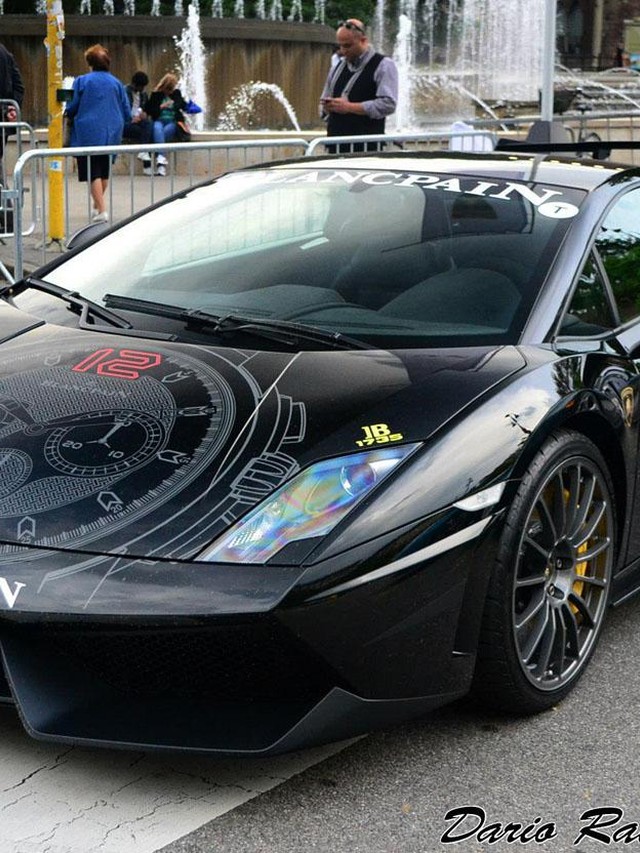
Blancpain, the Swiss watchmaker, serves as title sponsor for the Super Trofeo series, and the partnership reflects more than logo placement. It represents a deliberate alignment between two brands that trade on craftsmanship, mechanical heritage, and exclusivity. Lamborghini even produced a limited-edition Gallardo LP570-4 Blancpain Edition road car during the Gallardo era, borrowing visual cues and engineering highlights from the Super Trofeo race car and packaging them for street use.
That kind of cross-pollination between racing and road car, facilitated by a luxury partner, is a pattern Lamborghini continues to exploit. The STO (Super Trofeo Omologata) road car that arrived years later carried the same philosophy forward: take what works on the one-make grid, homologate it for the street, and sell it as a driver’s car with genuine racing provenance. Lewis’s dominant weekend at Laguna Seca is one of the data points that eventually validates that approach, connecting a Saturday afternoon at a California racetrack to the engineering decisions that shape a future production car.
From Super Trofeo to Temerario GT3: The Racing Lineage Continues
The 2016 season represented the Huracán Super Trofeo near the beginning of what became a decade-long competitive life for the platform. The Huracán succeeded the Gallardo Super Trofeo in the one-make series, and its various evolutions, including the later EVO and EVO2 specifications, kept the car competitive and relevant through continuous aerodynamic and suspension development.
Lamborghini says the upcoming Temerario GT3 will be the brand’s first competition car fully designed, developed, and built in-house. Previous GT3 efforts involved external partners for chassis development. That shift to internal capability represents a significant investment in Squadra Corse’s engineering independence, and it builds directly on the institutional knowledge accumulated through years of running the Super Trofeo series. The drivers, teams, and data infrastructure that support the one-make championship form the foundation on which Lamborghini’s multi-manufacturer GT3 ambitions rest.
For buyers and enthusiasts watching the Temerario program take shape, the lineage matters. The Huracán Super Trofeo proved that Lamborghini could sustain a global customer racing series, attract serious driving talent, and feed engineering insights back into road cars. The Temerario GT3 is the next chapter, but it reads differently when you understand the chapter that came before it.
One detail worth noting for collectors: the Huracán Super Trofeo EVO is generally not street-legal, which makes these cars track-only propositions for most buyers. Autoblog reported one unusual exception, a Michigan dealer listing a Super Trofeo titled for road use, but that remains an outlier rather than a pattern. For most enthusiasts, experiencing the Super Trofeo means either entering the series or finding one of the rare low-mileage collector examples that occasionally surface at auction.
Round 1 Results and the Season Ahead
| Position | Driver | Car No. | Team | Dealer | Class |
|---|---|---|---|---|---|
| 1st | Corey Lewis | 16 | Change Racing | Lamborghini Carolinas | Overall |
| 2nd | Shinya Michimi | 1 | Prestige Performance | Lamborghini Paramus | Overall |
| 3rd | James Sofronas | 14 | GMG | Lamborghini Newport Beach | Pro-Am |
The full Round 1 podium at Laguna Seca: Lewis’s Monster Energy-sponsored car carried momentum from a strong 2015 campaign into the new season, and the margin of his Round 1 victory set an early benchmark for the rest of the field. Prestige Performance, which placed Michimi on the second step here, went on to dominate the broader 2016 season, eventually clinching all four possible North American championships.
Lewis’s weekend distills the entire appeal of the Super Trofeo format. The equalized machinery means talent and team preparation determine results, not budget advantages in car development. A red-flag qualifying session can drop you to last. A well-prepared car and a disciplined race strategy can bring you back to first. That is the point of a one-make series, and it is why Lamborghini keeps investing in this format as the foundation of its motorsport pyramid.
Gallery


