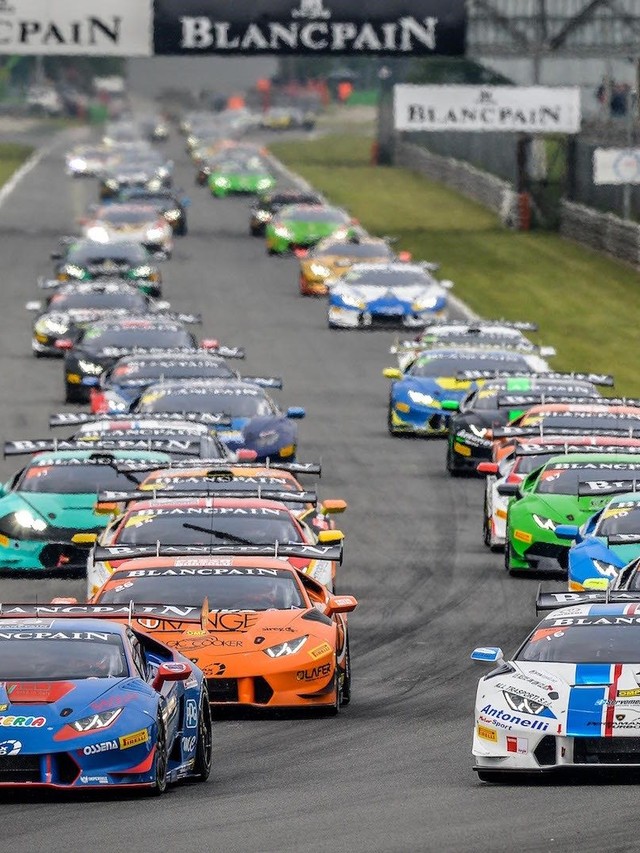
Monza’s Wild Welcome: 47 Cars, Shifting Skies, and an Upset Winner
Forty-seven Lamborghini Huracán Super Trofeo cars lined up on the Monza grid for the opening round of the 2016 Blancpain Super Trofeo Europe season, and the weather seemed determined to test every single one of them. Conditions cycled from dry to rain and back to sunshine during the race, the kind of atmospheric roulette that punishes hesitation and rewards drivers who can recalibrate on the fly. Into that chaos stepped Dennis Lind, a 23-year-old Dane driving for Raton Racing, making his very first start in the one-make series. He won.
Lind qualified fourth, a solid but unremarkable position on a grid that deep. By the time the checkered flag fell on Race 1, he had worked his way past every car ahead of him. The crew of Orange 1 Team Lazarus, Nicola De Marco and Fabrizio Del Monte, led before their mandatory driver swap. De Marco, returning to racing after a two-year absence, handled the first stint and put the car in a strong position, but the team could not hold off Lind’s charge once the second half of the race unfolded. Latvian Harald Schlegelmilch, representing Artline Team Georgia, completed the podium. Lamborghini says Schlegelmilch recorded the fastest times in the second qualifying session, confirming he was quick all weekend, not just in the race itself.
The Rookie Factor: Why Lind’s Debut Matters Beyond the Trophy
Winning on debut in any professional racing series is unusual. Doing it in a field of 47 identical cars, where machinery advantages are largely neutralized, makes the achievement nearly impossible to dismiss as circumstance. The Huracán Super Trofeo is a purpose-built race car with a naturally aspirated V10, stripped interior, aggressive aerodynamics, and a lightweight chassis. In a one-make format, the car is a constant. What separates the field is the driver.
Lind was 23 at the time, with enough raw speed to extract performance from a car he barely knew in conditions that kept changing. For Lamborghini’s Squadra Corse motorsport division, results like this validate the series as a genuine talent filter rather than a customer hospitality exercise. The Super Trofeo grid attracts a mix of gentleman drivers, aspiring professionals, and young racers looking for a stepping stone. When someone from that last category wins on their first attempt, it signals that the competition level is real enough to surface genuine ability.
Lind was not the only newcomer to make an impression. One report indicates that 17-year-old Rik Breukers, described as the youngest Super Trofeo driver in Europe, won the AM class in his debut at the same event. Another class victory went to Patrick Kujala and Adrian Amstutz of Bonaldi Motorsport in PRO-Am, reportedly finishing an impressive fifth overall. The pattern across all three classes at Monza that weekend was the same: fresh faces delivering results against established competitors. The series, in other words, was doing exactly what a talent pipeline is supposed to do.
The Huracán Super Trofeo in Mixed Conditions: What the Weather Revealed
Monza is a power circuit. Long straights, heavy braking zones, and a few chicanes that demand precision rather than downforce. In dry conditions, the Huracán Super Trofeo’s V10 engine and lightweight construction reward bravery on the brakes and commitment through the Parabolica. Add rain, and the equation changes entirely. Traction becomes the limiting factor, and a rear-wheel-drive race car on slick or intermediate tires in standing water becomes a very honest machine. It will tell you exactly how good you are.
The weather shifted from dry to rain and back to sun during Race 1. That kind of variability forces teams into real-time strategy decisions about tire choice, driving style, and pit timing. For the engineers at Squadra Corse, mixed-condition races generate invaluable data about how the platform behaves at its limits across different grip levels. For spectators and fans, they produce the kind of unpredictable racing that makes one-make series worth watching in the first place.
That a debutant won under those conditions, rather than a seasoned campaigner who understood the car’s wet-weather quirks from years of experience, is itself a data point. It suggests the Huracán Super Trofeo was accessible enough in its handling characteristics for a talented newcomer to exploit quickly, even when the track surface was at its most treacherous. The car rewarded skill, not just familiarity, and that quality is what makes a one-make platform credible as a proving ground.
Super Trofeo as a Strategic Pipeline: From Customer Racing to GT3
Lamborghini’s one-make series, established in 2009 with the Gallardo, was never purely about selling race cars to wealthy enthusiasts, though it certainly does that. The deeper strategic function is building a motorsport ecosystem that feeds upward. Drivers who prove themselves in Super Trofeo earn visibility with factory-affiliated GT3 teams. Engineers who develop the one-make car contribute knowledge that flows into the GT3 and, eventually, prototype programs.
By 2016, the Huracán had replaced the Gallardo as the series platform, and Squadra Corse was refining the pipeline that would eventually produce the Huracán GT3 EVO, one of the most successful customer GT3 cars of its generation. The trajectory from one-make racing to international GT competition is deliberate. Ferrari runs a similar escalator through its Challenge series, and Porsche does the same with its Carrera Cup. What distinguishes the Super Trofeo is the scale of its single-weekend grids. A 47-car field at Monza is enormous for a one-make championship. That density of competition means drivers who rise to the top face genuine pressure, not a half-empty grid where a podium finish is almost guaranteed.
The lessons Lamborghini learned running the Huracán through years of Super Trofeo and GT3 competition informed the development of the Temerario GT3, which Autoblog reports is Lamborghini’s first competition car to be fully designed, developed, and built entirely in-house. That shift, from outsourcing GT3 development to bringing it inside Squadra Corse’s own walls, represents a confidence that was built race by race, season by season, starting with events exactly like the 2016 Monza opener.
Where Lamborghini’s Customer Racing Stands Now
For anyone considering Lamborghini’s customer racing programs today, the 2016 Monza story is useful context. The Super Trofeo series remains the entry point, the place where owners and aspiring professionals learn to race Lamborghinis in a controlled, competitive environment. The cost of entry is not publicly disclosed by Lamborghini, and the company does not publish a standard price list for participation. What the series does offer is a clear ladder: perform well in Super Trofeo, and doors open to GT3 seats, factory support, and the kind of career trajectory that Dennis Lind’s Monza debut exemplified.
The Huracán Super Trofeo cars themselves are becoming collectible artifacts. Autoblog recently featured a 2020 Huracán Super Trofeo EVO Collector with just 84 miles on the odometer listed on Bring a Trailer, and a separate Michigan dealer reportedly titled a Super Trofeo for road use, the kind of creative registration work that makes you appreciate American DMV flexibility.
The transition from the Huracán to the Temerario as Lamborghini’s core racing platform will reshape the series in the coming years. For teams and drivers who built their programs around the Huracán’s naturally aspirated V10 characteristics, adapting to the Temerario’s twin-turbo V8 hybrid architecture means learning an entirely new powerband, different weight distribution, and the complexities of energy management in wheel-to-wheel racing. That transition will produce its own crop of unexpected winners, its own Monza moments. The 2016 opener, with its soaked track and unknown Dane crossing the line first, is a reminder that the series works precisely because it creates conditions where talent can announce itself without warning.
Gallery


