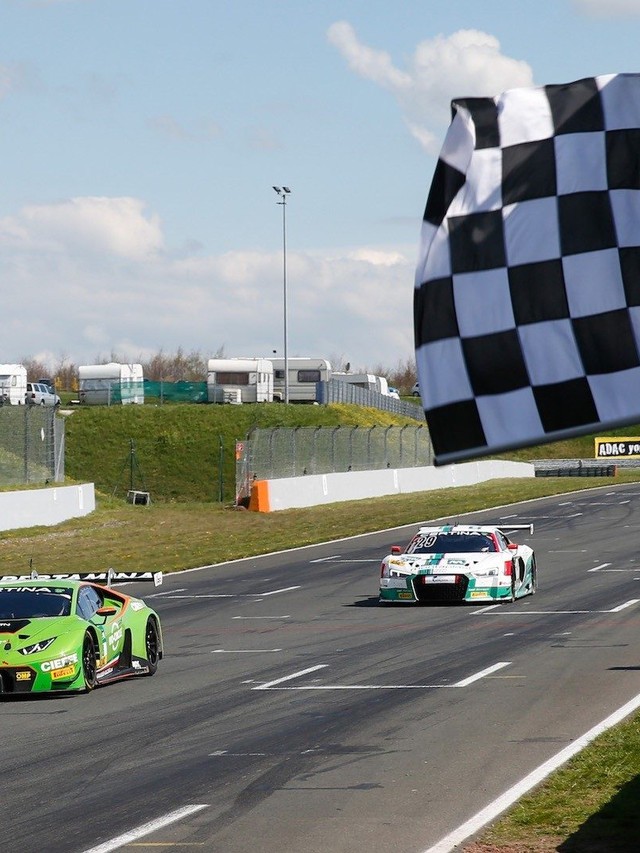
A Fifth-Place Qualifier Steals the Win at Oschersleben
When the Austrian Grasser Racing Team rolled their Lamborghini Huracán GT3 onto the grid at Oschersleben’s Motorsport Arena in April 2016, they sat fifth. By the time the checkered flag fell on the first round of the ADAC GT Masters season, drivers Christian Engelhart and Rolf Ineichen stood on the top step of the podium, having beaten 32 rival cars through disciplined racecraft, a brilliantly timed pit stop, and the kind of last-lap chaos that makes GT3 racing irresistible. The win was not a fluke. It was the product of positioning, and positioning is the thread that runs through every layer of this result, from the pit wall to the broader arc of Lamborghini’s GT3 program.
Engelhart gained a position immediately off the line, settling into fourth and shadowing the leading trio through the first half of the race. The real move came in the pits. A well-executed strategy during the mandatory driver change sent Ineichen back onto the circuit in second place, directly behind the Zakspeed Mercedes-AMG GT. Four minutes from the finish, a safety car deployment compressed the entire field for one final restart lap.
The Huracán GT3 crossed the line second on the road. The Zakspeed Mercedes-AMG, which had led from the front, was subsequently handed a 30-second time penalty for failing to respect the restart procedure, a punishment severe enough to drop the car to 22nd. Victory fell to Grasser Racing. Some will call that lucky. But you do not inherit a win unless you are already close enough to take it, and the pit strategy that vaulted Ineichen from fourth to second is what made that proximity possible.
The V10’s Quiet Advantage in a Turbo-Heavy Field
Part of what kept the Huracán GT3 in contention through that compressed final lap was the character of its engine. While competitors increasingly relied on turbocharged powertrains, the Huracán GT3 drew on Lamborghini’s 5.2-liter naturally aspirated V10, the same fundamental architecture found in the road car, stripped and retuned for endurance racing.
The practical difference on track is subtle but significant. A naturally aspirated engine delivers power in a linear, predictable curve. When a driver exits a corner and rolls onto the throttle, the response is immediate and proportional. Turbocharged GT3 cars, by contrast, must manage boost thresholds, and the lag between throttle input and peak torque can complicate mid-corner adjustments. For Ineichen, defending second place through a safety car restart and into a frantic final lap, that predictability becomes a genuine asset. Multiple sources in the GT3 community describe the Huracán’s V10 as rewarding driver skill over boost management, a quality that matters most when the field is bunched and every exit speed counts.
The Huracán GT3 EVO2, a later evolution of this platform, retained the 5.2-liter V10 and paired it with an aluminum chassis and a 6-speed sequential gearbox with paddle shifters. One report lists the EVO2 at 640 PS and 1,230 kg, numbers that illustrate how Lamborghini refined the car over successive generations without abandoning the core formula that made it competitive in the first place.

A yellow Lamborghini Huracán GT3 navigates a turn on the racetrack, displaying its striking livery and aerodynamic features.
Squadra Corse and the Business of Customer Racing
The Oschersleben result also validated a business model. Lamborghini Squadra Corse does not field a factory team in the traditional sense for series like ADAC GT Masters. Instead, it builds and supports the cars, then equips privateer outfits like Grasser Racing with the engineering backup, spare parts logistics, and technical guidance needed to compete at the sharp end.
This model matters because it scales. A single factory team can win one championship. A well-supported customer program can win across multiple continents simultaneously. In 2016, the Huracán GT3 also secured the GT Asia Series Championship, spreading Lamborghini’s racing footprint far beyond European circuits. Giorgio Sanna, Lamborghini’s Head of Motorsport, framed the Oschersleben result as validation for both the factory and its customer teams, noting that the win motivated Squadra Corse and the privateers who operate with what he described as professionalism and passion.
For prospective customer racing teams evaluating which manufacturer to partner with, results like Oschersleben serve as proof of concept. The car can win. The support structure works. The Gallardo LP600+ GT3 had laid the groundwork for Lamborghini’s GT3 ambitions, but the Huracán GT3 transformed that ambition into a genuinely competitive global program. Positioning, again: Squadra Corse put its customers in a place where victories could happen, and Grasser Racing proved the system delivered.
From Oschersleben to a GT3 Dynasty
Context makes this 2016 result more interesting in hindsight. The Huracán GT3 had already won on its ADAC GT Masters debut the previous year, with Mirko Bortolotti and Adrian Zaugg behind the wheel. Two consecutive season-opening victories in a series packed with Audi, Mercedes-AMG, Porsche, and Corvette entries established a pattern: the Huracán GT3 was not a novelty entrant. It belonged at the front.
That early competitiveness fed directly into the platform’s evolution. The original car became the GT3 EVO, then the EVO2, each iteration refining aerodynamics, chassis stiffness, and engine calibration while preserving the naturally aspirated V10 identity. The lineage now extends further still, with Lamborghini developing the Temerario GT3 as the next chapter in its customer racing story. Enthusiasts watching that transition will recognize the template: build a competitive base car, prove it in global GT3 competition, iterate relentlessly.
What the Oschersleben weekend demonstrated, beyond the raw result, was that Lamborghini’s approach to customer racing could generate victories even when the car did not start from pole and did not lead the race outright. Engelhart’s patience in the first stint, the pit crew’s strategic execution, and Ineichen’s composure under safety car pressure all reflected a mature racing operation. The penalty that sealed the win was a consequence of a competitor’s error, not a gift. Grasser Racing put their Huracán GT3 in position to capitalize, and that positioning is ultimately what separates a competitive car from a winning one.
Gallery


