Spring Mountain: Where Factory White Became Race Ready
On April 20, at a desert circuit roughly 50 minutes from Las Vegas, Lamborghini Squadra Corse handed the keys to a new era. Teams and drivers in the Lamborghini Blancpain Super Trofeo North America series gathered at Spring Mountain to collect their Huracán LP 620-2 Super Trofeo race cars, attend technical training sessions run by Squadra Corse engineers, and log their first meaningful laps before the season opener at Mazda Raceway Laguna Seca on May 1 through 3.
The cars arrived from Italy in factory white, blank canvases waiting for individual team liveries. 2014 race winner Corey Lewis described watching the transformation from unpainted shells to fully liveried machines as compelling in its own right. That visual metamorphosis captures something about the event’s real purpose: this was not a simple car delivery. Lamborghini staged a technical immersion, a structured handover designed to compress weeks of learning into days, because the Huracán LP 620-2 is a fundamentally different animal from the Gallardo it replaces. Reigning champion Kevin Conway put it plainly, noting that being able to shake down the cars at Spring Mountain should be a big help heading into the season opener at Laguna Seca. He had good reason to want every available minute of preparation. The car he would be driving demands an entirely different skill set.
Rear-Wheel Drive Changes Everything
The single most consequential engineering decision in the Huracán LP 620-2 Super Trofeo is the switch from the Gallardo LP 570-4’s all-wheel-drive system to rear-wheel drive. On paper, deleting the front driveshafts saves weight and simplifies the drivetrain. On track, it rewrites the entire vocabulary of car control.
An all-wheel-drive race car forgives sloppy throttle application at corner exit. The front axle pulls the car straight when the rears start to slide. Remove that safety net and suddenly every input through the throttle pedal determines whether the car rotates predictably or snaps into oversteer. For gentleman drivers moving up from track days, and even for seasoned competitors like Conway, this demands recalibration. He acknowledged as much, noting that the Huracán’s cockpit-adjustable systems for ABS, traction control, and brake bias add a deeper level of technicality for both engineers and teams.
The practical implication for anyone watching this season: expect a wider spread between the fastest and slowest drivers in the Huracán class. Rear-wheel drive rewards skill and punishes overconfidence, which makes for better racing to watch and a steeper learning curve to live through. Spring Mountain existed precisely to soften that curve before the green flag dropped at Laguna Seca.
Gallardo to Huracán: What 50 Extra Horsepower and a Carbon-Hybrid Frame Actually Buy
The outgoing Gallardo LP 570-4 Super Trofeo produced 570 horsepower from its 5.2-liter naturally aspirated V10 and came equipped with paddle-shift E-gear transmission, Öhlins race shocks, Brembo brakes, and a carbon fiber aero package with a 10-position adjustable rear wing. A capable race car by any measure.
The Huracán LP 620-2 keeps the 5.2-liter V10 architecture but extracts 620 horsepower, managed through a MoTeC control unit rather than the Gallardo’s factory ECU. Its hybrid carbon/aluminum frame offers significantly greater torsional rigidity, with modified geometries designed to house an improved front radiator and a purpose-built racing gearbox at the rear. Those structural changes also contribute to improved aerodynamics.
| Specification | Gallardo LP 570-4 Super Trofeo | Huracán LP 620-2 Super Trofeo |
|---|---|---|
| Engine | 5.2L V10 | 5.2L V10 (direct injection) |
| Power | 570 hp | 620 hp |
| Drivetrain | AWD | RWD |
| Frame | Aluminum | Hybrid carbon/aluminum |
| ECU | Factory | MoTeC |
| Cockpit-adjustable ABS/TC/brake bias | No | Yes |
The MoTeC unit deserves a moment of appreciation. In customer racing, where teams operate on tight budgets with limited engineering staff, having a widely understood, well-documented engine management system lowers the barrier to effective setup work. Teams familiar with MoTeC from other racing categories can transfer that knowledge directly, rather than learning a proprietary Lamborghini system from scratch. That accessibility matters because the Huracán already asks so much more of its drivers through the steering wheel.

A black Lamborghini Huracan GT3 race car with blue accents and sponsor decals is ready on the track.
Cockpit Electronics as a Strategic Weapon
In the Gallardo, most electronic settings required pit-lane intervention or pre-session decisions. The Huracán puts ABS, traction control, and brake bias adjustments on the steering wheel, and that distinction matters far more than it might sound.
Consider a typical race scenario: the track surface evolves as rubber builds up across a stint, or a light rain begins to fall on one section of the circuit. A driver who can dial back traction control by two clicks mid-corner, or shift brake bias forward entering a newly damp braking zone, gains time without pitting. The Gallardo simply could not offer that kind of real-time adaptability. Series rookie Angel Benitez Jr. described the car as fitting well with his driving style and noted that his team expected to be competitive immediately, suggesting the electronics flatten the learning curve for drivers willing to engage with them.
The flip side: more adjustability means more ways to get things wrong. A driver who chases the perfect traction control setting lap after lap can lose focus on the fundamentals. The teams that will thrive are the ones that established baseline electronic settings during the Spring Mountain sessions, then empowered their drivers to make small, confident adjustments during the race. In a rear-wheel-drive car with 620 horsepower, the line between a well-timed traction control tweak and a costly mistake is razor thin.
Two Classes, One Grid, and the Largest Field Yet
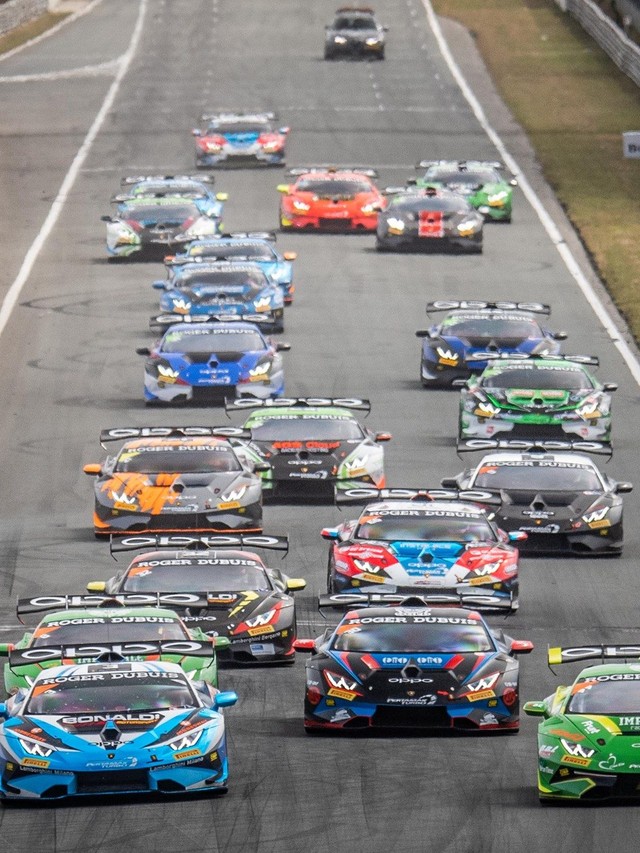
Lamborghini says this season will feature the largest grids in the North American series’ history. Competition splits into two classes: one for the new Huracán, another for the 2013 Gallardo LP 570-4 Super Trofeo. The season opener at Laguna Seca will mark the first time both models share a North American racetrack in competition.
Running two distinct cars on the same grid creates a fascinating dynamic. The Huracán class will likely set faster outright pace, but Gallardo drivers benefit from a car they already understand deeply. Conway, who carries the titles of reigning North American champion and World Final Pro-Am champion, noted that the overall level of competition from both team and driver lineups ranks among the best in sports car racing.
For anyone considering the Super Trofeo as a driver development pathway, this moment is worth watching closely. The skills cultivated in the series, particularly rear-wheel-drive car control and electronic management, map directly onto the demands of GT3 competition. Lamborghini’s recently debuted Temerario GT3 represents the brand’s first fully in-house developed competition car, and the Super Trofeo functions as the proving ground for the drivers and engineering philosophies that will define its next generation of motorsport programs. When the green flag falls at Laguna Seca, it will reveal how quickly teams and drivers absorbed what Spring Mountain was designed to teach them, and whether a few days in the Nevada desert were enough to tame a car that refuses to be driven casually.


