A Carbon Fiber Lab 5,000 Miles from Sant’Agata
On June 20, 2016, Lamborghini officially opened its Advanced Composite Structures Laboratory (ACSL) in Seattle, Washington, a facility dedicated to a single material obsession: carbon fiber reinforced polymer. The grand opening also marked the 30th anniversary of Lamborghini’s adoption of carbon fiber in its vehicles, a timeline stretching back to the Countach Quattrovalvole in the mid-1980s.
Planting a research lab on the opposite side of the planet from your factory floor sounds eccentric until you consider what surrounds it. Seattle is Boeing country. The ACSL exists because of Lamborghini’s collaboration with Boeing on carbon fiber innovations that cross between automotive and aerospace applications. CEO Stefano Domenicali called carbon fiber “one of the most important keys to the success of our cars in the past, present and future.” The ACSL is where that future gets prototyped.
Equipped for testing, characterization, manufacturing, and machining of carbon fiber materials, the lab operates as an entity outside Lamborghini’s Sant’Agata Bolognese headquarters. Lamborghini says it provided significant financial contributions to the facility, with the broader goal of advancing the University of Washington’s long-running aerospace composites research. The company’s collaboration with ACSL head Professor Paolo Feraboli dates back to 2001, meaning this formal opening represents the culmination of over 15 years of joint work rather than a cold start.
Why Boeing, and Why It Matters More Than the Address
Choosing to co-locate with Boeing is the most revealing decision Lamborghini made here, and the one that sharpens the lab’s strategic purpose. Carbon fiber knowledge flows in two directions in this partnership: aerospace engineers bring expertise in fatigue life, structural certification, and large-scale composite manufacturing, while Lamborghini contributes its understanding of complex, low-volume geometries and rapid forming techniques. The intersection produces materials and processes neither side would likely develop alone.
A supercar manufacturer building a few thousand cars per year cannot justify the capital expenditure of a full aerospace composites division. By embedding its researchers inside an ecosystem where Boeing and the University of Washington are already pushing composite science forward, Lamborghini gains access to testing infrastructure and intellectual capital that would be prohibitively expensive to replicate in Emilia-Romagna. Washington State Governor Jay Inslee called the collaboration “a benefit and a point of pride for the city and the state,” but the real beneficiary is Lamborghini’s engineering pipeline.
For buyers, the practical implication is straightforward: the carbon fiber components in future Lamborghinis will be informed by aerospace-grade research, not just automotive convention. That distinction shows up in structural rigidity, weight savings, and the kind of complex shapes that define Lamborghini’s aggressive design language.
From Countach to Centenario: 30 Years of Carbon Fiber in Production
Lamborghini’s carbon fiber timeline reads like a condensed history of the material’s migration from race cars and fighter jets into road-legal exotics. The Countach Quattrovalvole marked the starting point. By the time the Aventador arrived, Lamborghini was building an entire monocoque from the stuff, using a proprietary process the company called RTM-Lambo. According to CarBuzz, the Aventador successor (codenamed LB744) pushed this further with what Lamborghini described as a “monofuselage” inspired by aeronautical construction, fashioned entirely from multiple carbon fiber technologies.
The Centenario, debuted at the 2016 Geneva Motor Show, served as the ACSL’s showcase at the time of the lab’s opening. Built to commemorate what would have been founder Ferruccio Lamborghini’s 100th birthday, it wore a body of fully exposed carbon fiber across its limited production run of 20 coupes and 20 Roadsters. Exposed carbon fiber on a car like this is more than cosmetic vanity. It eliminates the weight of paint, demonstrates manufacturing precision (every weave pattern and surface imperfection is visible to the naked eye), and signals that the material is the design, not a substrate hiding underneath a finish coat.
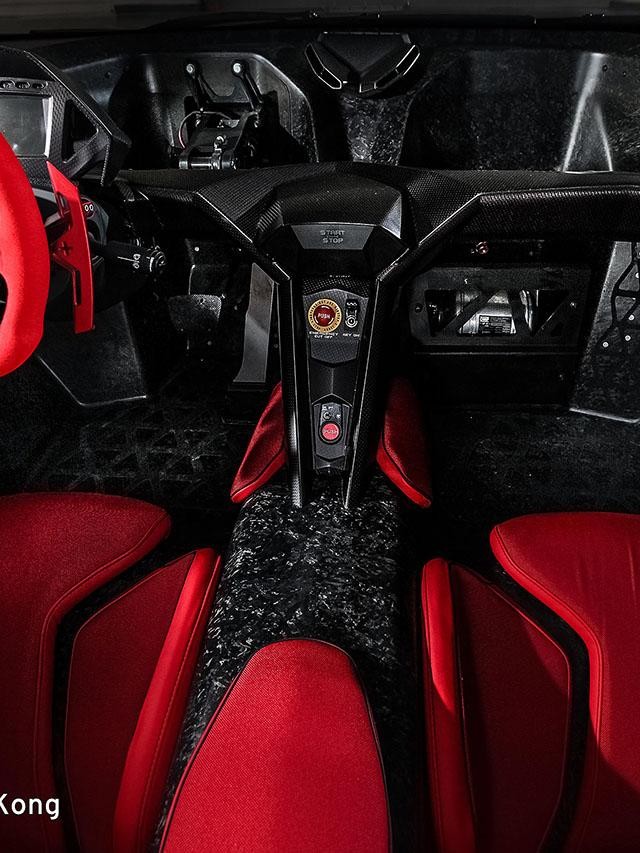
The Sesto Elemento, which preceded the Centenario by six years, remains the purest expression of what ACSL research can produce. Forged Composite served in a structural capacity on that car, proving the material could handle load-bearing duties and not just trim pieces.
Forged Composite: What It Actually Does Differently
Forged Composite is Lamborghini’s patented process, and understanding it requires a quick detour into conventional carbon fiber production. Traditional layup involves cutting sheets of pre-impregnated carbon fabric, layering them by hand into a mold, and curing them under heat and pressure in an autoclave. The process is slow, labor-intensive, and expensive. Complex three-dimensional shapes require skilled technicians to drape fabric around tight curves without creating wrinkles or voids.
Forged Composite takes a fundamentally different approach. Instead of continuous woven sheets, it uses chopped carbon fiber strands mixed with resin, compression-molded under high pressure. The result is a material that flows into complex geometries the way metal does in a forging press, hence the name. Production time drops significantly compared to traditional layup, and the process enables shapes that would be extremely difficult or impossible to achieve with woven fabric.
Board Member for R&D Maurizio Reggiani framed the advantage in both performance and production terms: “The ability to leverage this kind of lightweight material gives Lamborghini an advantage that will benefit our cars, as well as production process, in the future.”
The tradeoff is aesthetic. The chopped fiber pattern produces a distinctive marbled appearance rather than the familiar herringbone weave of traditional carbon fiber. Enthusiast opinion on the look is genuinely divided. Multiple owners and composites enthusiasts on forums describe it as everything from “amazing compared to weave type” to resembling “particle board accents.” Whether you find it beautiful or bizarre, the engineering rationale is sound: Forged Composite allows Lamborghini to produce structurally capable carbon fiber components faster and in more complex shapes than conventional methods permit.
The Competitive Angle: How Rivals Approach the Same Problem
Carbon fiber is hardly exclusive to Lamborghini. McLaren built its entire brand identity around the carbon fiber monocoque of the original F1, and every McLaren since the MP4-12C uses a carbon tub as its structural core. Ferrari employs carbon fiber extensively across its lineup, though Maranello tends to emphasize engine and aerodynamic innovation over materials science in its public messaging.
What separates Lamborghini’s approach is the dedicated external research infrastructure. No other supercar manufacturer operates a carbon fiber lab embedded within an aerospace university ecosystem, collaborating directly with a company that builds commercial aircraft. McLaren’s composites work happens primarily in-house at its Woking and Sheffield facilities. Ferrari’s material science is integrated into its Maranello campus. Lamborghini chose to go outside its walls, betting that proximity to aerospace-grade research would accelerate breakthroughs that an automotive-only environment could not.
For buyers weighing a Lamborghini against its direct competitors, the ACSL’s existence signals something about long-term product direction. Lamborghini is investing in the material science pipeline itself, not just applying existing carbon fiber technology to new body panels. Whether that translates into measurably lighter or stiffer structures in the next generation of cars remains to be proven on the scales and on track, but the research commitment is concrete and documented.
What ACSL Research Means for Future Lamborghinis
Lamborghini’s stated objective for the ACSL is to develop lighter, stronger, and more versatile materials for future vehicles. That language is deliberately broad, but the implications are specific. Every kilogram saved through better carbon fiber directly improves power-to-weight ratio, braking distances, and handling response. In an era where hybrid powertrains add battery mass to every new supercar, the ability to offset that weight through advanced composites becomes a competitive necessity rather than a luxury.
The Aventador successor‘s monofuselage architecture, as reported by CarBuzz, already demonstrates how ACSL research feeds into production vehicles. Lamborghini described that structure as taking direct inspiration from aeronautical construction, a phrase that points straight back to the Boeing collaboration in Seattle.
One practical detail worth noting for prospective owners: carbon fiber repair costs on supercars remain substantial, and more advanced composite structures do not simplify that equation. The ACSL’s work may produce lighter and stronger cars, but damaged Forged Composite panels still require specialist repair or replacement. That reality is worth factoring into ownership cost calculations, particularly for cars driven on track.
Lamborghini did not specify which future models beyond the Centenario and existing lineup would directly benefit from ACSL breakthroughs. The safer interpretation is that this research feeds the entire product portfolio over time rather than a single model. The lab’s purpose is foundational: it builds the material science knowledge base that Sant’Agata’s engineers then apply to specific vehicles as each new project demands.


