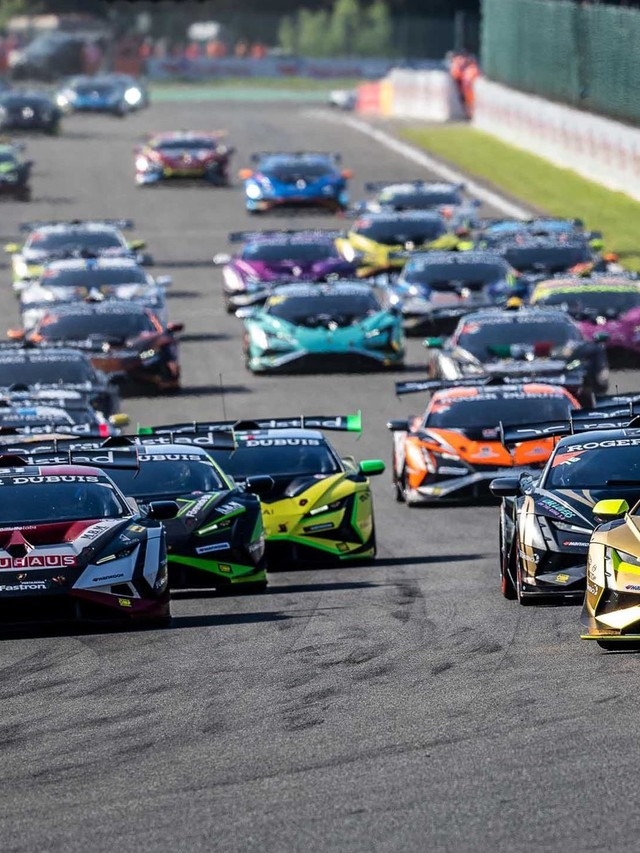
A Flag-to-Flag Statement at Laguna Seca
When Richard Antinucci led every lap of Round 1 at the 2015 Lamborghini Blancpain Super Trofeo North America season at Mazda Raceway Laguna Seca, the result itself was impressive. What made it genuinely significant was the car underneath him: the brand-new Lamborghini Huracán LP 620-2 Super Trofeo, making its competitive debut in North America. That single weekend revealed a machine built not merely to replace the aging Gallardo race car but to redefine Lamborghini’s entire approach to customer motorsport, a trajectory that would ultimately lead to the marque developing GT3 machinery entirely in-house.
Antinucci piloted the No. 50 entry fielded by O’Gara Motorsport, representing Lamborghini Beverly Hills, through the 50-minute race, which concluded under caution. “The result was perfect,” Antinucci said. “It’s a lot more difficult than it seems on paper, and we were better on our one-lap pace than on our race pace, I think. But we managed it well, and we saved a little bit extra, just in case.” Cedric Sbirrazuoli, a Monegasque driver also making his series debut, finished second in the No. 07 STR entry representing Dallas, earning the distinction of top Pro-Am class Huracán finisher. Corey Lewis rounded out the overall podium in third for Change Racing’s No. 29 entry, representing Carolinas, after climbing from sixth on the grid.
A clean sweep of the podium in the car’s first competitive outing is the kind of result manufacturers dream about but rarely achieve. For Squadra Corse, it validated years of development and signaled that the Huracán platform could carry the Super Trofeo series into a new era.
Decoding the LP 620-2: Why Rear-Wheel Drive Changed Everything
Lamborghini’s naming conventions reward close reading. The “LP 620-2” designation tells you two critical things: 620 horsepower from the 5.2-liter naturally aspirated V10, and power sent to just two wheels. That second number is the fascinating one.
The road-going Huracán LP 610-4 launched with all-wheel drive as standard. Stripping the front axle drive for the race car was deliberate and consequential. Rear-wheel drive reduces mechanical complexity, saves weight, and gives drivers a more adjustable car at the limit. Oversteer becomes a tool rather than a surprise. Corner entry rotation improves. The car rewards skill rather than compensating for its absence. More importantly for the broader strategic picture, rear-drive layouts dominate GT3 racing, so drivers learning the craft in a rear-drive Super Trofeo car were building muscle memory that translated directly to endurance racing seats.
Developed by Squadra Corse in collaboration with Dallara Engineering, the LP 620-2 was built from scratch around a racing concept rather than simply being a stripped road car. A Motec M182 engine management system replaced the production electronics, offering 9-position traction control and 12-position racing ABS. The gearbox shifted to a 6-speed sequential unit, electrically actuated, replacing the road car’s dual-clutch automatic. According to one source, the car shed roughly 550 lbs compared to the standard model through extensive use of carbon fiber and aluminum, bringing dry weight down to approximately 1,270 kg.
For context, the Gallardo LP 570-4 Super Trofeo it replaced kept all-wheel drive (the “-4” in its name). The shift to rear-wheel drive represented a philosophical pivot, one that would echo through Lamborghini’s subsequent track-focused road cars and, ultimately, through its GT3 program.
Gallardo to Huracán: More Than a Generational Handoff
The Gallardo marked Lamborghini’s return to one-make racing when the Super Trofeo series launched in 2009. By 2015, the series was established and growing, but the Gallardo platform was aging. The Huracán LP 620-2 needed to be a clear step forward, not just a reskin.
The numbers tell that story. The Gallardo LP 570-4 Super Trofeo produced 570 bhp and weighed approximately 1,400 kg dry. The Huracán delivered 620 horsepower at a dry weight roughly 130 kg lighter, dramatically improving the power-to-weight ratio. A longer wheelbase (2,620 mm versus 2,560 mm) and wider track dimensions gave the car a more planted stance, while the completely redesigned aerodynamic package, visible in the aggressive front splitter, rear fin, and prominent rear wing, generated more downforce than the Gallardo ever could.
The rear-drive layout also meant teams entering the Super Trofeo series would develop skills directly transferable to GT3 competition, where rear-drive layouts dominate. One source suggested the Super Trofeo was explicitly framed as an entry point into the world of GT3 racing, offering world-class performance at a relatively accessible price. That framing proved prescient. Super Trofeo teams in this era often consisted of gentleman drivers paired with professional coaches, and the rear-drive Huracán sharpened the learning curve in exactly the right way. Drivers who cut their teeth managing a naturally aspirated V10 through the rear wheels at tracks like Laguna Seca were building the reflexes needed for endurance racing.
From Super Trofeo to GT3: The Huracán’s Enduring Motorsport Legacy
Antinucci’s 2015 victory was not a one-off flash. He went on to win the 2019 Lamborghini Super Trofeo North America Pro class championship, building a career arc that mirrored the car’s own evolution. The Huracán Super Trofeo Evo arrived in 2017, refining aerodynamics and electronics while maintaining the same core philosophy. The platform proved so competitive and so reliable that it remained the backbone of Lamborghini’s customer racing program for nearly a decade.
The rear-wheel-drive philosophy pioneered in the LP 620-2 also bled into Lamborghini’s road car lineup. The Huracán Performante and, more directly, the Huracán STO (Super Trofeo Omologata, its name literally referencing the race car’s homologation) brought rear-drive aggression and track-derived aerodynamics to street-legal machines. The STO’s entire identity was built on the idea that a road car could carry genuine Super Trofeo DNA without compromise.
The broader strategic arc becomes clear when you look at what came next. The recently debuted Temerario GT3 represents a significant shift: Lamborghini’s first competition car fully designed, developed, and built in-house, without an external chassis partner like Dallara. According to Autoblog, the car debuted at the 2025 Goodwood Festival of Speed, signaling that Squadra Corse now possesses the engineering depth to go it alone.
The distance between the 2015 LP 620-2 and the Temerario GT3 measures more than a decade of calendar time. It maps Lamborghini’s transformation from a brand that outsourced its racing chassis development to one that controls the entire process internally. The Super Trofeo series served as the proving ground for that ambition, generating real-world data, driver feedback, and operational expertise that no amount of simulation could replace.
What the 2015 Debut Still Means for Lamborghini Buyers and Fans
For prospective buyers eyeing the collector market, the original LP 620-2 Super Trofeo occupies an interesting position. These are not street-legal cars (though Autoblog reported at least one Michigan dealer attempting to sell a titled example for road use). They were purpose-built race machines, and surviving examples with documented competition history from the car’s debut season carry a provenance that later EVO models cannot replicate.
Lamborghini has not publicly disclosed how many LP 620-2 Super Trofeo units were produced before the EVO update, and exact pricing for teams at the time remains undocumented in official sources. What the record does confirm is that the car delivered on its promise from the very first green flag: a naturally aspirated V10, rear-wheel drive, and enough performance to dominate immediately.
The transition to the Temerario GT3, with its twin-turbocharged V8 hybrid powertrain, will inevitably change the character of Lamborghini’s customer racing. For enthusiasts who value the purity of a high-revving, naturally aspirated engine sending power exclusively to the rear axle, the LP 620-2 Super Trofeo represents the beginning of a golden era that the Huracán platform carried forward for nearly ten years. Antinucci’s victory at Laguna Seca was the opening chapter, and the engineering decisions embedded in that car’s design continue to shape how Lamborghini approaches competition today.
Gallery


