A Supercar Launch Staged as a Design Exhibition
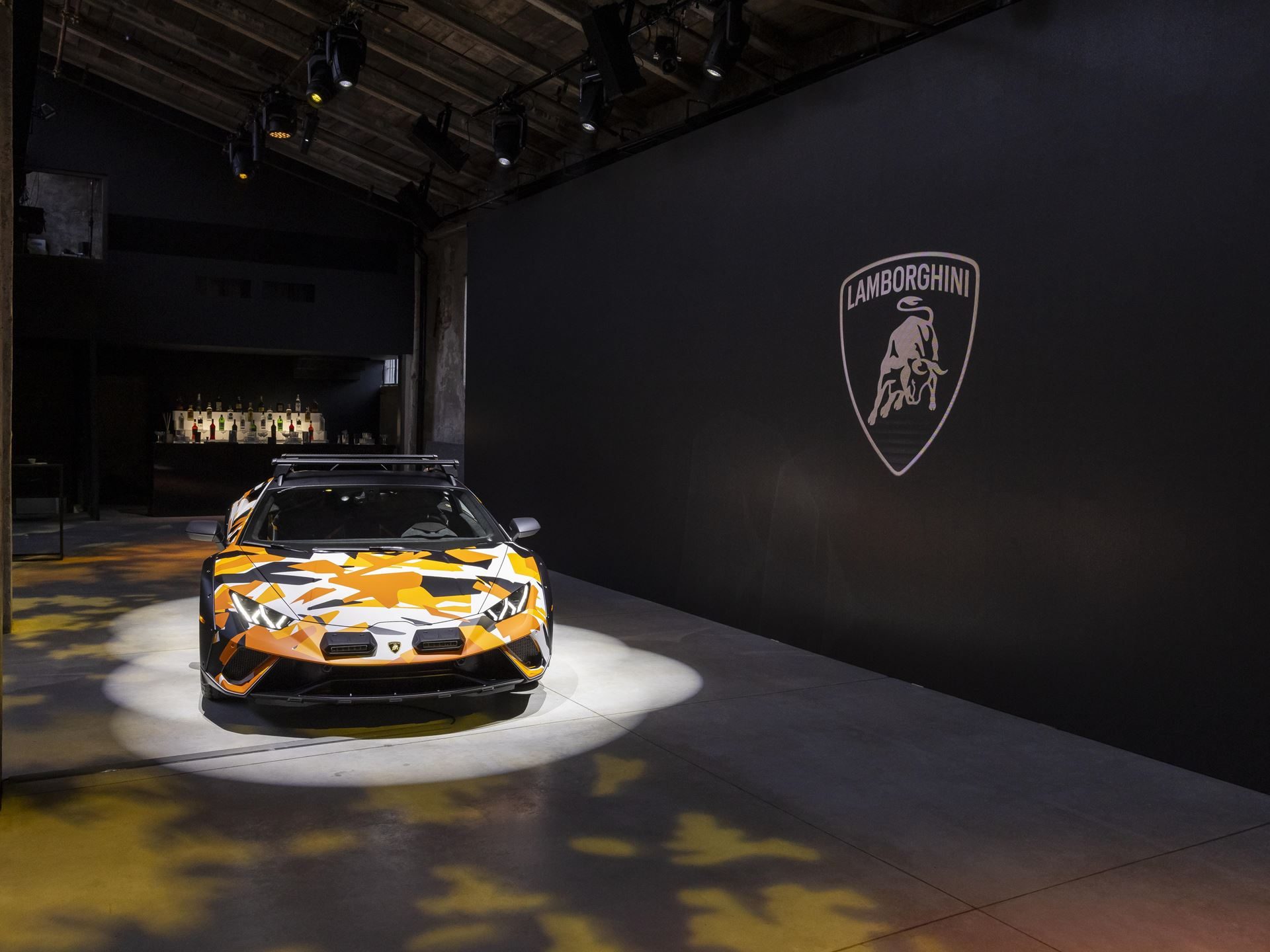
Lamborghini chose to unveil its latest ultra-limited creation not at a motor show or a racetrack, but inside Segheria of Tanja Solci, a Milanese venue known for its restoration-as-art philosophy, during Italy’s most prestigious design gathering. Over 200 guests walked into a space where each of the four Huracán Sterrato All Terrain editions sat against a trompe l’oeil backdrop matching its livery: rocks, sand dunes, forest canopy, and snow. An Italian artist painted the murals live throughout the evening. Stephan Winkelmann, Lamborghini’s Chairman and CEO, handled the formal introduction himself.
The supporting program read like a luxury brand summit. Chef Enrico Cerea, whose family runs the Michelin-starred Da Vittorio, prepared a menu themed around the same four terrains. A Tod’s artisan demonstrated the hand-stitching of the iconic Gommino loafer at a workshop station flanked by Lamborghini-branded footwear. Guests could inspect a 3T gravel bicycle designed in collaboration with Lamborghini and sample Culti fragrances. A top Milanese DJ kept the energy moving between courses.
The venue choice tells you exactly who Lamborghini considers the Sterrato’s audience: collectors and high-net-worth buyers who move between Salone del Mobile furniture previews and supercar deliveries in the same week, people who respond to the idea of a V10 supercar as a lifestyle object as much as a performance machine. Lamborghini is positioning the Sterrato not merely as a car, but as a collectible design piece that belongs in the same conversation as limited-edition furniture, haute couture, and contemporary art.

Three Lamborghini Huracan Sterrato models are showcased in an industrial setting, each featuring a distinct camouflage livery.
Why Milan Design Week, and Why Now
Design Week draws architects, fashion executives, art collectors, and industrial designers who spend lavishly on aesthetics and exclusivity but may not attend traditional automotive events. Placing the Sterrato in that context reframes it: less rally-car curiosity, more collectible design piece.
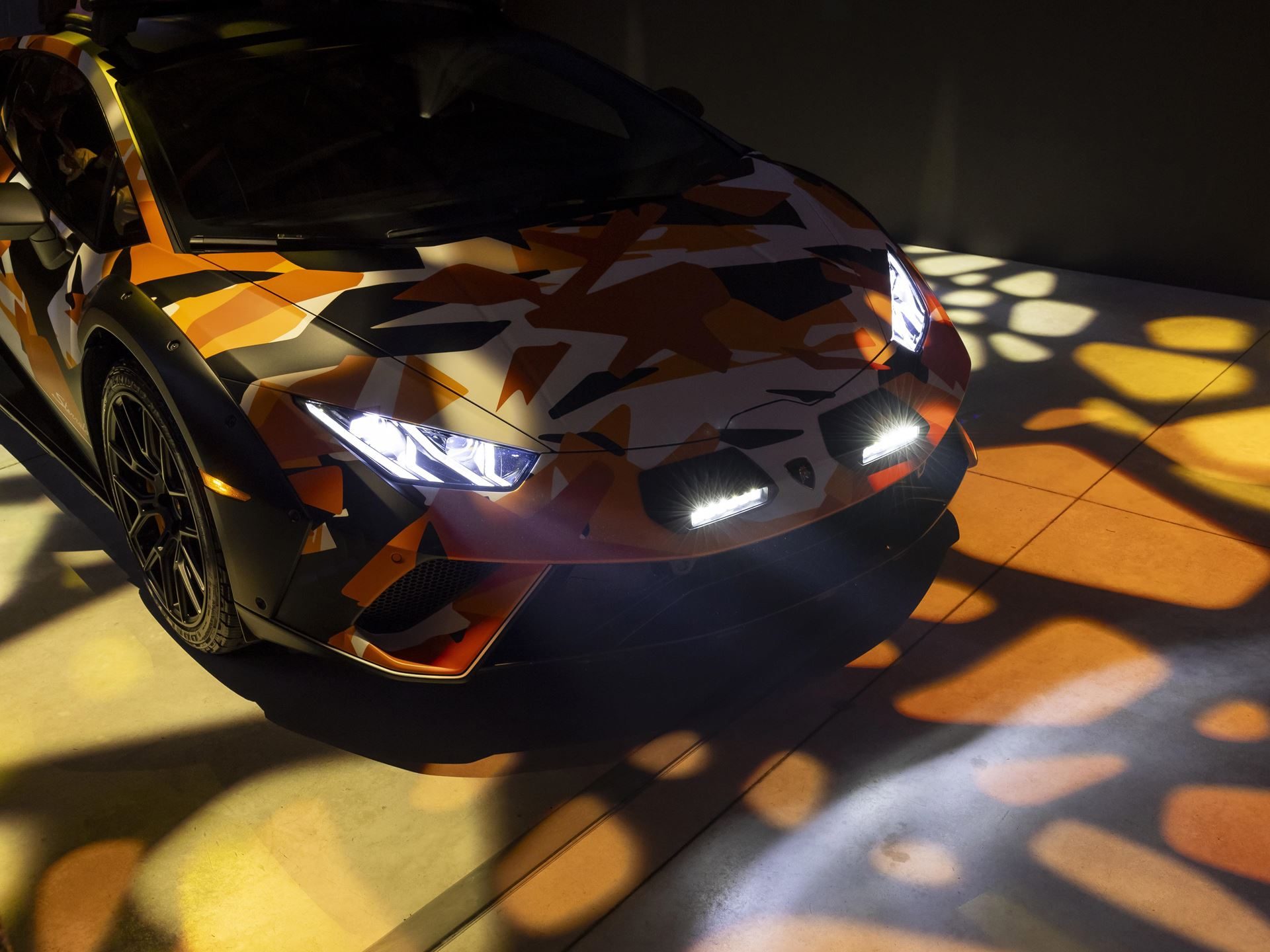
The lifestyle partnerships reinforce the message. Tod’s, 3T, and Culti are all Lamborghini licensee partners, meaning these collaborations generate revenue and brand exposure beyond the cars themselves. When a guest watches a craftsman hand-stitch a loafer under a Lamborghini logo, the company is selling the idea that its design authority extends into the broader luxury world. The car already suits this framing, with its raised stance, roof rails, and rally lights creating a silhouette no other supercar shares.
Federico Foschini, Lamborghini’s Chief Commercial and Marketing Officer, confirmed the strategic intent directly, calling limited series that demonstrate the Ad Personam studio’s capabilities “an important part of our business model.” Lamborghini is telling its investors and clients that bespoke editions are not vanity projects; they are a revenue pillar, and the All Terrain series is their latest proof of concept.

A green camouflage Lamborghini Huracan Sterrato is displayed alongside a vibrant shoe collection at an event.
Four Terrains, Four Identities: How Ad Personam Built the Liveries
The exclusive liveries were developed by Lamborghini’s Ad Personam studio in collaboration with Centro Stile. Each of the four themes carries an Italian name: NEVE (snow) deploys cool grey and white tones; SABBIA (sand) blends neutral desert hues with cactus-green accents; BOSCO (green track) layers a mossy, leafy forest palette; and TERRA (gravel) recalls warm ochres of moorland under a sunset.
All four share a common structural language. The roof and upper bonnet are finished in matt black, as is the lower body, with a colored accent band unique to each theme along the rocker panel. Morus 19-inch matt black forged rims and complementary brake caliper colors tie the exterior together. Auxiliary lights, roof rails, and cross bars complete the look.
Inside, the Ad Personam treatment continues with dark chrome trim, carbon twill paired with Alcantara, and laser-etched Sterrato graphics. Each car carries an Ad Personam plate linking the interior to its specific exterior livery. Design Director Mitja Borkert described the project as an effort to “emphasize the different dimensions of the Sterrato’s multi-faceted character.”
For the All Terrain series, creative direction came from Lamborghini’s own designers rather than individual client briefs, making this closer to an artist’s limited print run than a bespoke commission. That distinction positions the twelve cars as curated works of design rather than customer indulgences, reinforcing the art-world credibility Lamborghini was cultivating all evening.

Explore the extensive palette of Ad Personam paint and interior material options for your bespoke Lamborghini.
The Sterrato’s Enduring Appeal as the Last V10 Adventure Car
Underneath the camouflage wraps, these twelve cars carry the same mechanical package as the standard Sterrato. The 5.2-liter naturally aspirated V10 produces 610 CV (602 bhp) and 560 Nm of torque, channeled through a 7-speed dual-clutch gearbox and electronically controlled all-wheel drive with a rear mechanical self-locking differential. Lamborghini quotes 0 to 100 km/h in 3.4 seconds and a top speed of 260 km/h.
Those numbers are not the point. The wider tracks and increased ride height give the Sterrato a completely different relationship with the road. Roof rails on a V10 supercar remain genuinely unusual, and Lamborghini’s own display imagery showed snowboards, a spare tire, and a branded duffel bag mounted on the roof rack, reinforcing the adventure-utility pitch. Multiple owners describe the Sterrato as surprisingly comfortable, with the suspension soaking up rough surfaces that would punish a standard EVO, and call it the most fun supercar they own.
The car represents the final V10-powered derivative of the Huracán line, which makes every special edition built on this platform a de facto collector piece as Lamborghini transitions to the hybrid Temerario. That end-of-era gravity is precisely what gives the All Terrain series its weight as a design-world statement: these are not just beautiful objects, they are the last of their kind.

The Lamborghini Huracan Sterrato showcases its versatile roof rack with snowboards, ready for any adventure.
Why Twelve Units Vanished Before the Paint Dried
All twelve All Terrain Sterrattos sold out before the Milan event took place. The buyers, selected by Lamborghini, span three commercial regions: the Americas (ALA), Europe, Middle East, and Africa (EMEA), and Asia Pacific and Australia (APAC). Each region receives all four livery themes, meaning every NEVE, SABBIA, BOSCO, and TERRA car will be the only one of its kind in its country. These twelve units fall within the total Sterrato production volume of 1,499 cars, deliveries of which began in 2023.
Twelve units from a run of fewer than 1,500 makes this a 0.8% subset, the kind of scarcity that practically guarantees collector interest regardless of pricing, which Lamborghini has not disclosed. For buyers who already own a standard Sterrato, the All Terrain edition offers a factory-backed level of visual differentiation no aftermarket wrap can match. For those who missed the allocation, the secondary market will be the only option.
Lamborghini’s broader strategy mirrors what Ferrari accomplishes with its Tailor Made program and what McLaren pursues through MSO: turning personalization into a profit center that also reinforces the brand’s exclusivity narrative. The difference with the Sterrato is the subject matter. Ferrari’s special projects tend to celebrate racing heritage or aerodynamic purity. Lamborghini, with this series, is celebrating mud, snow, and sand. It is a more playful, less reverent approach to ultra-exclusivity, and it fits both the Sterrato’s personality and the Milan Design Week audience perfectly.

Stephan Winkelmann, CEO of Lamborghini, stands proudly beside a Huracán Sterrato with an orange camouflage livery.
What the All Terrain Series Signals for Lamborghini’s Next Chapter
The obvious question for LamboCars readers: will Lamborghini carry the Sterrato concept forward into the Temerario generation? The company has not announced any plans for an off-road Temerario variant. What the All Terrain series does confirm is that Lamborghini sees commercial value in the adventure-supercar niche, and that its Ad Personam studio can execute complex, multi-layered livery programs at a level that justifies collector premiums.
The Sterrato occupies a peculiar and enviable position in the market. It arrived as the final Huracán variant, which could have made it feel like an afterthought. Instead, it became one of the most distinctive Lamborghinis of the past decade, a car that owners report using more frequently and more adventurously than their track-focused stablemates. The All Terrain editions add a layer of art-world credibility to that story, connecting the car to Milan’s design community rather than the motorsport paddock.
If you want a Sterrato of any kind, the window is closing. Production of the entire 1,499-unit run is winding down as the Huracán line ends, and the All Terrain cars represent the most exclusive expression of a model that already carries end-of-era significance. What is clear is that Lamborghini proved, in a converted Milanese workshop with a Michelin-starred dinner and a wall of handmade loafers, that a supercar with a roof rack and camouflage paint can command the same reverence as any limited-run track weapon. The All Terrain Sterrato is Lamborghini’s argument that the supercar, at its most exclusive, belongs in the design world as much as the automotive one.

The Lamborghini Huracan Sterrato and a high-performance gravel bike stand ready for any off-road adventure.
Gallery