Nine Months, €2 Billion, and a Profit That Already Beat Last Year
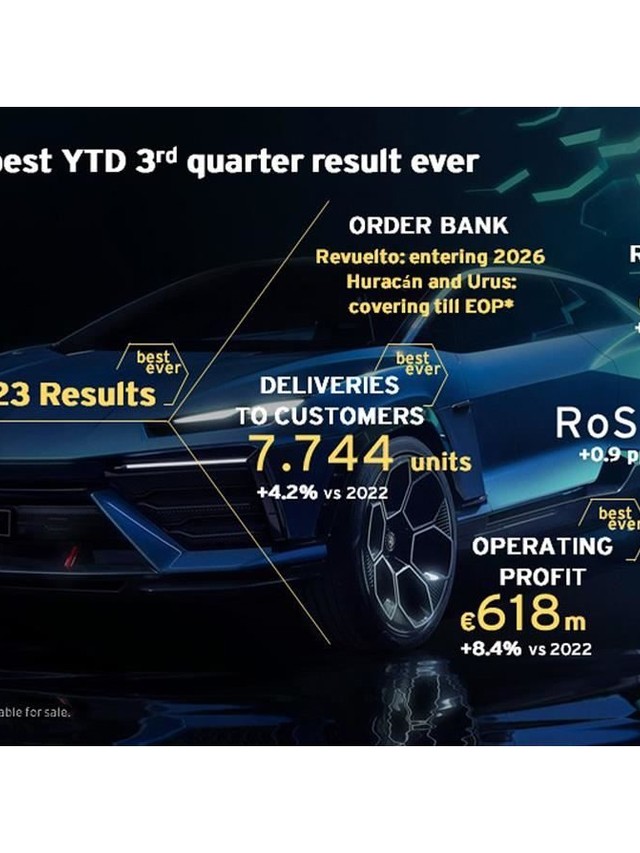
Lamborghini reported that its turnover for the first nine months of 2023 surpassed €2 billion for the first time in the company’s history, a 5.2% climb over the same period in 2022. The operating result reached €618 million, already exceeding the company’s entire fiscal year 2022 operating profit before the fourth quarter even began. Vehicle deliveries hit a record 7,744 cars, a 4.2% increase year-over-year.
Lamborghini is not a volume manufacturer. It builds roughly the same number of cars in a year that Toyota produces in a slow afternoon. When a company this small posts operating margins that would make most automakers weep, it signals something specific: the pricing power and order depth that come from genuine scarcity. The United States led individual markets with 2,342 vehicles delivered, followed by Germany at 709 and the United Kingdom at 688. China (including Hong Kong and Macau) accounted for 643, with Japan at 434, the Middle East at 370, and Italy at 336.
What makes this particular set of records meaningful beyond the spreadsheet is timing. Lamborghini posted these numbers while simultaneously preparing to sunset two of its most successful models and launch the most technically ambitious car in its history. That kind of transition takes confidence, and confidence in this business requires cash. The thesis running through every line of this financial report is simple: record profitability does not just reward the present, it purchases the freedom to reinvent the future on Lamborghini’s own terms.

Lamborghini celebrates its best YTD 3rd quarter results ever, showcasing strong financial performance for 2023. Image: Automobili Lamborghini.
Sold Out Until Shutdown: The Cash Engine Behind the Transition
Nearly every car in that 7,744 delivery total was either an Urus or a Huracán, both powered exclusively by internal combustion. Lamborghini says both models are sold out until their production ends in the second half of 2024. That sentence is easy to gloss over, but it carries real weight for the company’s ability to fund what comes next.
A “sold out” production run means the factory is running at capacity against a fixed end date, with no allocation left to fill. For buyers who already hold build slots, this is straightforward good news: the car they ordered will retain its desirability long after the last example rolls off the line. For anyone hoping to walk into a dealer and order a new Huracán, the window closed months ago. The V10’s final chapter was already written by the time these numbers were published.
From a collector’s perspective, end-of-run naturally aspirated Lamborghinis tend to age well. The last Gallardo variants command premiums today, and the Huracán’s decade-long evolution through Performante, STO, and Sterrato editions created a rich hierarchy of special models. Owners of late-production examples should expect the market to treat these cars kindly once the successor, the twin-turbo V8 Temerario, shifts the brand’s entry-level character in a fundamentally different direction.
The Urus story is slightly different. Its successor, the Urus SE, arrived as a plug-in hybrid, meaning the original twin-turbo V8-only Urus becomes the last of its kind in a different sense. Whether that distinction matters to collectors depends on how the SE is received, but the original’s sales dominance is undeniable: it transformed Lamborghini from a low-volume exotic house into a company capable of generating €2 billion in nine months, and that revenue stream is precisely what underwrites the electrification gamble ahead.

Stephan Winkelmann presents the latest Lamborghini models, including the Revuelto, at a prestigious automotive event. Image: Automobili Lamborghini.
Direzione Cor Tauri in Practice: Revuelto Deliveries and the Lanzador Pivot
The Revuelto marks Lamborghini’s first plug-in hybrid model, and the company indicated that customer deliveries were expected to begin in the months following this announcement. Its powertrain combines a V12 engine with three electric motors for a combined 1001 horsepower, making it the most powerful series-production Lamborghini ever built. The 6.5-litre V12 is largely new and positioned with a 180-degree rotation compared to the Aventador’s layout, paired with a new eight-speed DCT gearbox and a four-wheel-drive system that eliminates the traditional propshaft entirely.
For a brand that staked its identity on naturally aspirated engines for decades, the Revuelto represents a calculated bet: electrify the powertrain without abandoning the V12. The result, at least on paper, preserves the emotional core while adding low-speed electric torque and the ability to creep through Italian town centers without waking the neighbors. Whether the 1,772 kg dry weight feels like a compromise on a mountain road remains a question early reviewers will answer. Crucially, the financial muscle documented in these results is what allowed Lamborghini to develop a car this complex without cutting corners or rushing it to market.
The Lanzador concept, which debuted at Monterey Car Week in August 2023, was originally positioned as a preview of Lamborghini’s first fully electric model, slated for production from 2028 as part of the Direzione Cor Tauri electrification strategy announced in 2021. The concept previewed a 2+2 grand tourer that would serve as the brand’s fourth model line. In hindsight, the Lanzador’s trajectory illustrates exactly why financial strength matters so much during a technology transition. Car and Driver reported in early 2026 that Lamborghini officially canceled the Lanzador as a pure EV, with CEO Stephan Winkelmann stating that the brand’s target market showed “close to zero” interest in electric vehicles. The model itself survived, pivoting to a plug-in hybrid architecture instead. Autoblog described the situation as an “identity crisis,” noting that two years after the Monterey debut, Lamborghini still had not finalized the production car’s powertrain format. Record profitability gave Lamborghini the luxury of patience: the ability to wait, read the market, and change course without existential pressure.

The Lamborghini Lanzador concept car, showcasing its futuristic design, is presented on a vibrant green lawn. Image: Automobili Lamborghini.
What Record Margins Buy in a Shifting Market
Lamborghini does not operate in a vacuum. Ferrari, its most direct rival in both cultural cachet and financial performance, consistently posts operating margins in the high-20s to mid-30s percentage range. McLaren, by contrast, spent recent years navigating financial restructuring. Lamborghini’s position, cushioned by Volkswagen Group resources but increasingly self-funding through its own profitability, sits in a strategically enviable middle ground: the margins of a luxury house with the engineering backing of a global conglomerate.
This financial footing is what allows Lamborghini to hybridize its entire lineup without betting the company on a single technology direction. Ferrari committed to launching a full EV (the electric supercar previewed in late 2025). Lamborghini looked at the same market data and chose a different path, hybridizing across the board while backing away from a pure-electric commitment. Both strategies carry risk, but Lamborghini’s record profitability means the company can afford to be wrong about timing without facing an existential crisis. That is the thread connecting every number in this report to every product decision the company has made since.
For buyers and enthusiasts, the practical takeaway is straightforward: a financially healthy Lamborghini invests more aggressively in special editions, motorsport programs, and the kind of bespoke personalization (through Ad Personam and limited allocations) that protects residual values. The company’s announcement that it now operates 182 dealers across 54 markets, with four new locations opening in Q3 alone (Sapporo, Lugano, Verona, and Budapest), reflects a brand expanding its retail footprint precisely because it can afford to be selective about where and how it grows.

The sleek Lamborghini Revuelto stands poised on an industrial road, showcasing its futuristic design. Image: Automobili Lamborghini.
What These Numbers Mean If You Are Waiting for a Lamborghini
Lamborghini did not disclose specific waiting times or order-bank depth in this announcement. What the company confirmed is that both the Urus and Huracán are fully allocated through the end of production, and that Revuelto deliveries were imminent. The full-year 2023 results, reported later, showed Lamborghini crossing the 10,000-delivery mark for the first time, according to Car and Driver, reaching 10,112 cars worldwide.
If you already hold an allocation for any current model, these results reinforce that the car you are waiting for sits in the strongest demand environment in the brand’s 60-year history. If you are shopping for a late-production Huracán on the secondary market, expect premiums that reflect end-of-era scarcity. And if you had your eye on the Lanzador as a pure EV, the subsequent pivot to plug-in hybrid means the production version will arrive with a different character than the concept suggested.
Lamborghini received recognition as a 2023/2024 Sustainability Champion from the ITQF, worth noting mostly because it signals the company’s awareness that its buyer demographic increasingly cares about corporate responsibility, even while ordering 1001-horsepower hybrid supercars. The tension between those two impulses is real, and Lamborghini’s financial results suggest the company is navigating it more successfully than most. Ultimately, every record in this report points to the same conclusion: Lamborghini has earned the rarest commodity in the automotive industry during a period of technological upheaval, the financial freedom to choose its own path forward.

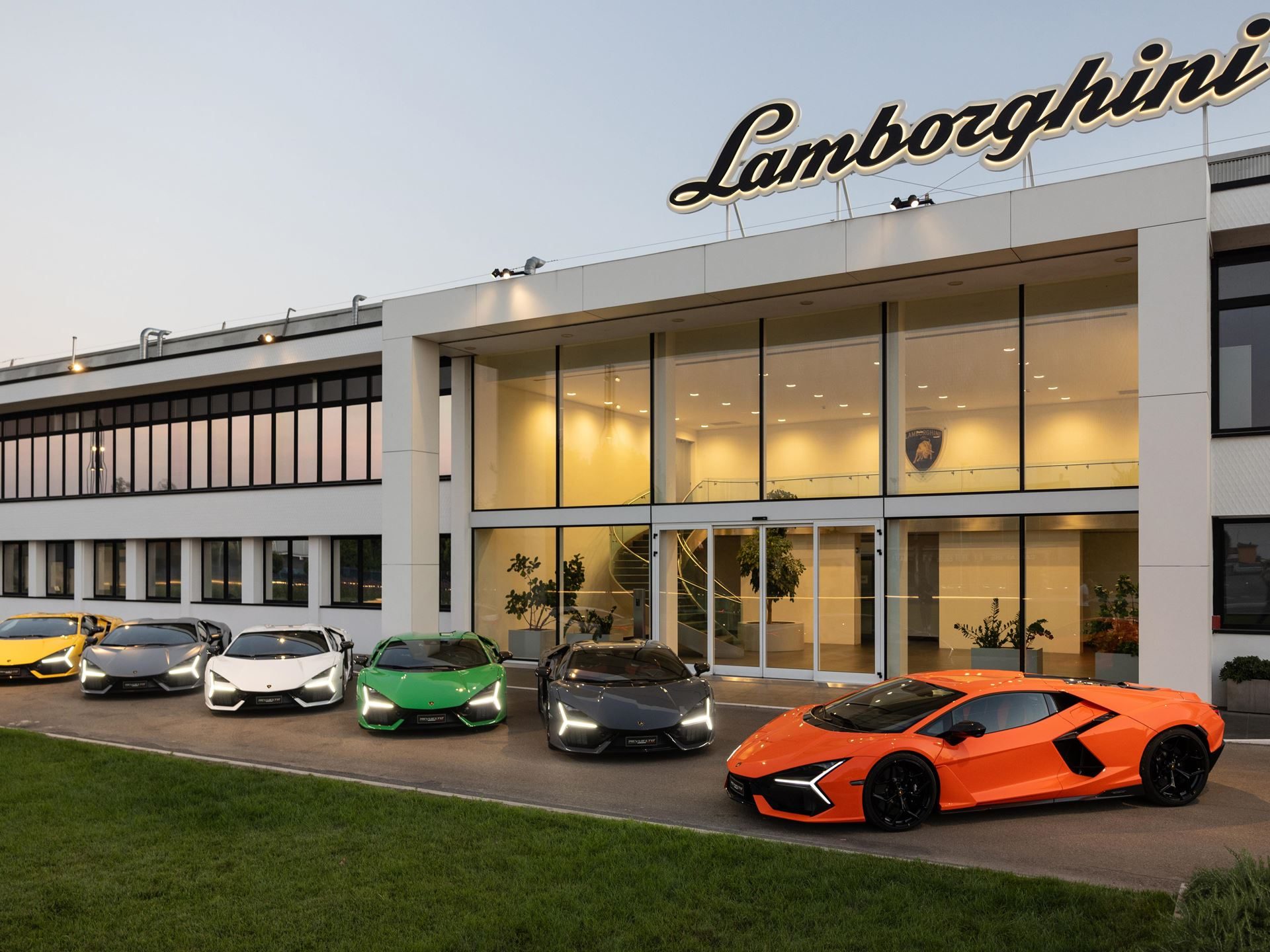
A diverse collection of Lamborghini vehicles, from classic to contemporary, parked within the expansive factory complex. Image: Automobili Lamborghini.
Gallery