A Curated Journey from Venice to Trieste, Anchored by an Architect’s Vision
Most manufacturer heritage events center on the cars alone, or on auction culture, or on celebrity appearances. Lamborghini’s second Lamborghini & Design Concorso d’Eleganza does something more deliberate: it connects the brand’s design language to a specific figure in Italian architecture, arguing that the same sensibility that produced the Miura’s proportions also produced Gae Aulenti’s transformation of the Musee d’Orsay.
Scheduled for September 19 to 21, the event sends approximately thirty classic Lamborghinis on a three-day tour from Venice to Trieste. Organized by Polo Storico, the brand’s heritage department, the concours pairs the most significant models in Lamborghini’s history (spanning 1963 to 1991, plus select modern examples) with a cultural tribute to Aulenti, who was born near Trieste and whose work reshaped museums, railway stations, and public spaces across Europe, the Americas, and Asia before her death in 2012.
The format is deliberately not a static concours lawn. Participating cars depart Venice on the morning of September 20 and complete a roughly 200-kilometer driving tour to the coastal resort village of Portopiccolo, near Trieste. Judging follows on Saturday morning. The afternoon includes a run through Piazza Unita d’Italia and a drive along the historic Trieste-Opicina hill climb road, a route steeped in motorsport history. Every element of the itinerary reinforces the central proposition: that classic Lamborghinis are cultural artifacts shaped by the same Italian design tradition that produced Aulenti’s architecture, not merely investment commodities waiting for their next auction appearance.
Gae Aulenti: Why an Architect Anchors a Car Concours
Gae Aulenti (1927 to 2012) is best known internationally for converting Paris’s Gare d’Orsay into the Musee d’Orsay, a project that required reimagining an industrial railway station as a space for Impressionist painting without erasing the building’s structural identity. That tension between preserving form and redefining function runs through much of her career, and it is the thread Lamborghini is pulling on here.
The port square in Portopiccolo will become an open-air museum displaying objects related to Aulenti’s projects during the event. The choice to honor her specifically in Trieste, the city nearest her birthplace, adds a layer of geographic intentionality that the first edition of this series also demonstrated. That inaugural event took place in Neuchatel, Switzerland, in 2017, and honored Le Corbusier, another architect whose work redefined how people move through built space.
The pattern reveals a curatorial logic that goes beyond name-dropping. Lamborghini is building a recurring series that pairs its cars with architects who challenged convention in their own disciplines. For a brand whose founding myth involves Ferruccio Lamborghini rejecting the status quo of Italian sports car manufacturing, the parallel is sound. Le Corbusier and Aulenti both refused to accept inherited assumptions about how buildings should look and function. Lamborghini’s early cars, particularly the Miura with its revolutionary mid-engine layout penned by Bertone’s Marcello Gandini, operated from the same instinct. By placing the cars alongside the architects’ work rather than simply displaying them on a manicured lawn, Polo Storico makes the design-heritage argument tangible rather than rhetorical.
Polo Storico: The Department Behind the Curtain
Established in 2015, Polo Storico is the official Lamborghini department responsible for heritage preservation, and it organizes this concours. Its mandate covers restoration, certification of authenticity for models produced up to 2001, and the reconstruction of spare parts for classic Lamborghinis. For owners of vintage bulls, Polo Storico certification functions as both a provenance guarantee and a value anchor.
A certificate of authenticity from the department verifies originality of chassis, engine, and components through the factory’s own archive, which includes original sketches, production files, and technical drawings. That archive is reportedly being digitalized, a detail that matters for long-term accessibility as the oldest Lamborghini production cars now approach their seventh decade.
Ferrari launched its comparable program, Ferrari Classiche, roughly a decade earlier, in 2006. Both departments serve similar functions: protecting provenance, enhancing collector confidence, and ensuring long-term preservation. Where Lamborghini’s approach diverges is in how Polo Storico uses events like the Concorso d’Eleganza to build community around the certification process. Ferrari Classiche certifies and restores; Lamborghini is explicitly tying its heritage program to a broader cultural narrative, anchoring each concours edition to a major architect rather than letting the cars speak for themselves. Whether that distinction matters to a buyer deciding between a certified Miura and a certified Dino depends on the buyer, but the strategic intent is legible, and it reinforces the design-heritage thesis that gives this event its identity.
The Cars on the Road: From the 350 GT to the Diablo
Lamborghini describes the field as approximately thirty classic models produced between 1963 and 1991, supplemented by select modern specimens. The company did not publish a full entry list, but the date range tells its own story. It encompasses every foundational Lamborghini: the 350 GT that started it all, the Miura that redefined the supercar, the Espada and Jarama grand tourers, the Countach that became a poster-wall icon, the Jalpa, and the Diablo that carried the V12 torch into the 1990s.
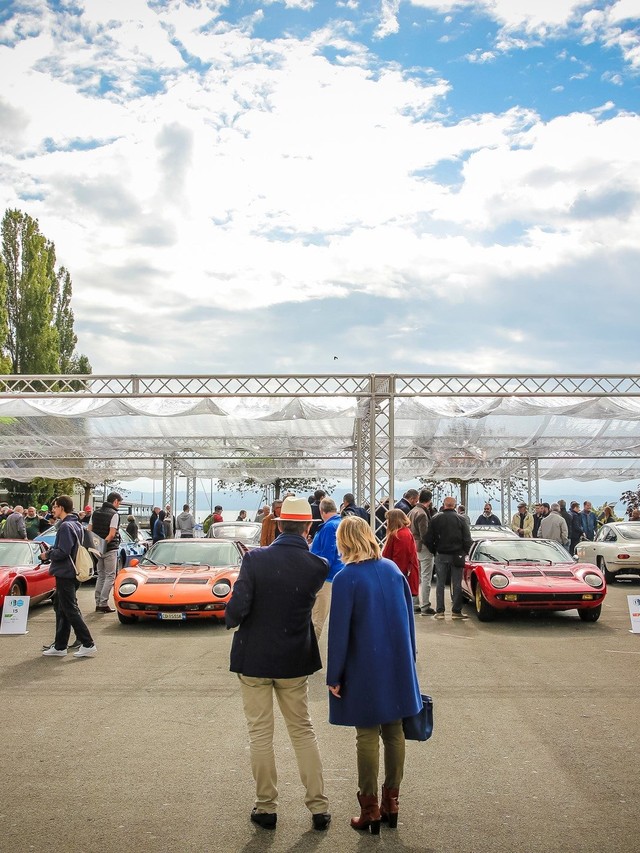
Event photography confirms the presence of multiple Miura models in various colors, their low-slung Bertone profiles and distinctive rear louvers unmistakable even at a distance. The Miura remains the gravitational center of any Lamborghini heritage gathering, and for good reason: its transverse V12 layout and Gandini-penned bodywork were genuinely revolutionary in 1966, and the car still looks startlingly modern more than fifty years later.
One detail from reporting on the event’s results adds significant color. The “Best in Show” award reportedly went to a 1964 Lamborghini 350 GT, chassis number 102. If accurate, that car holds a remarkable distinction: it was the first Lamborghini ever sold to a private customer and is considered the oldest production Lamborghini in existence. Awarding top honors to chassis 102 rather than a more visually dramatic Miura or Countach reinforces the event’s emphasis on historical significance and meticulous originality over pure spectacle. In a concours built around the idea that these cars belong alongside Aulenti’s architecture as expressions of Italian design culture, choosing the very first production Lamborghini as Best in Show is a statement of values.
Lamborghini did not specify which “modern specimens” would join the classics. The event’s focus on design heritage suggests any modern entries serve as bookends rather than centerpieces.
Why Heritage Events Matter More Than They Used To
For Lamborghini owners and collectors, events like the Concorso d’Eleganza serve a function that goes beyond a pleasant weekend in northeastern Italy. Classic Lamborghini values, particularly for the Miura and early Countach variants, respond to provenance, originality, and the kind of institutional validation that a Polo Storico-organized concours provides. Showing a car at an official Lamborghini heritage event, having it evaluated by a panel of international judges, and earning recognition in that context adds to the car’s documented history in a way that a Cars and Coffee appearance simply does not.
The broader classic car market reinforces this dynamic. Auction houses increasingly emphasize factory certification and event participation history when marketing significant lots. One report mentions that Broad Arrow’s Concorso d’Eleganza Villa d’Este Auction, scheduled for 2026, includes a 2009 Lamborghini Murcielago LP640-4 Coupe described as one of 88 examples with a gated manual transmission. Cars with that kind of documented rarity and provenance trail command premiums that uncertified equivalents cannot match.
Lamborghini’s choice to anchor each edition of this series around a major architect also signals something about the audience the company wants to cultivate. This is not a track day or a drag strip spectacle. The 200-kilometer driving tour through the Veneto and Friuli Venezia Giulia countryside, the open-air Aulenti exhibition, the judging in a Mediterranean resort village: every element reinforces a particular vision of what Lamborghini ownership means at the heritage level. Owners who engage with this ecosystem, pursuing Polo Storico certification and participating in factory-organized events, are building the kind of provenance trail that the maturing classic Lamborghini market increasingly rewards.
Lamborghini’s Heritage Play in Context
Compared to Ferrari’s extensive Classiche program, which benefits from a nine-year head start and the formidable weight of Maranello’s racing history, Polo Storico is still a relatively young operation. Ferrari Classiche’s “Red Book” certification, reportedly signed by Piero Ferrari himself, carries enormous weight in the collector market. Lamborghini’s answer is to differentiate on cultural breadth rather than compete purely on institutional longevity.
Honoring Le Corbusier in 2017 and Gae Aulenti in 2019 positions the Lamborghini & Design series as something distinct from the traditional concours circuit. Villa d’Este, Pebble Beach, and Amelia Island celebrate automotive excellence broadly. Lamborghini’s event argues that its cars belong in conversation with architecture, industrial design, and the broader Italian creative tradition. It is a narrower claim, but a more defensible one.
The Lamborghini Club of America is reportedly launching its own concours-style event, Serata Campioni, at Monterey Car Week, according to Lamborghini-Talk. That event is described as featuring 63 vintage and modern Lamborghinis competing for trophy-class titles. The emergence of multiple Lamborghini-specific concours events, both factory-organized and club-driven, suggests growing confidence that the brand’s heritage can sustain its own ecosystem rather than existing as a supporting act at broader automotive gatherings.
For the enthusiast watching from outside, the Venice-to-Trieste tour offers a reminder that Lamborghini’s design legacy extends well beyond the Countach poster and the Aventador exhaust note. The 350 GT, the Espada, the Marzal concept: these cars represent a design philosophy rooted in Italian artistic culture, and Polo Storico’s concours series is the most deliberate effort yet to make that case to the wider world. Whether a third edition follows, and which architect it honors, will say a great deal about how seriously Sant’Agata Bolognese intends to pursue this particular brand narrative.
Gallery


